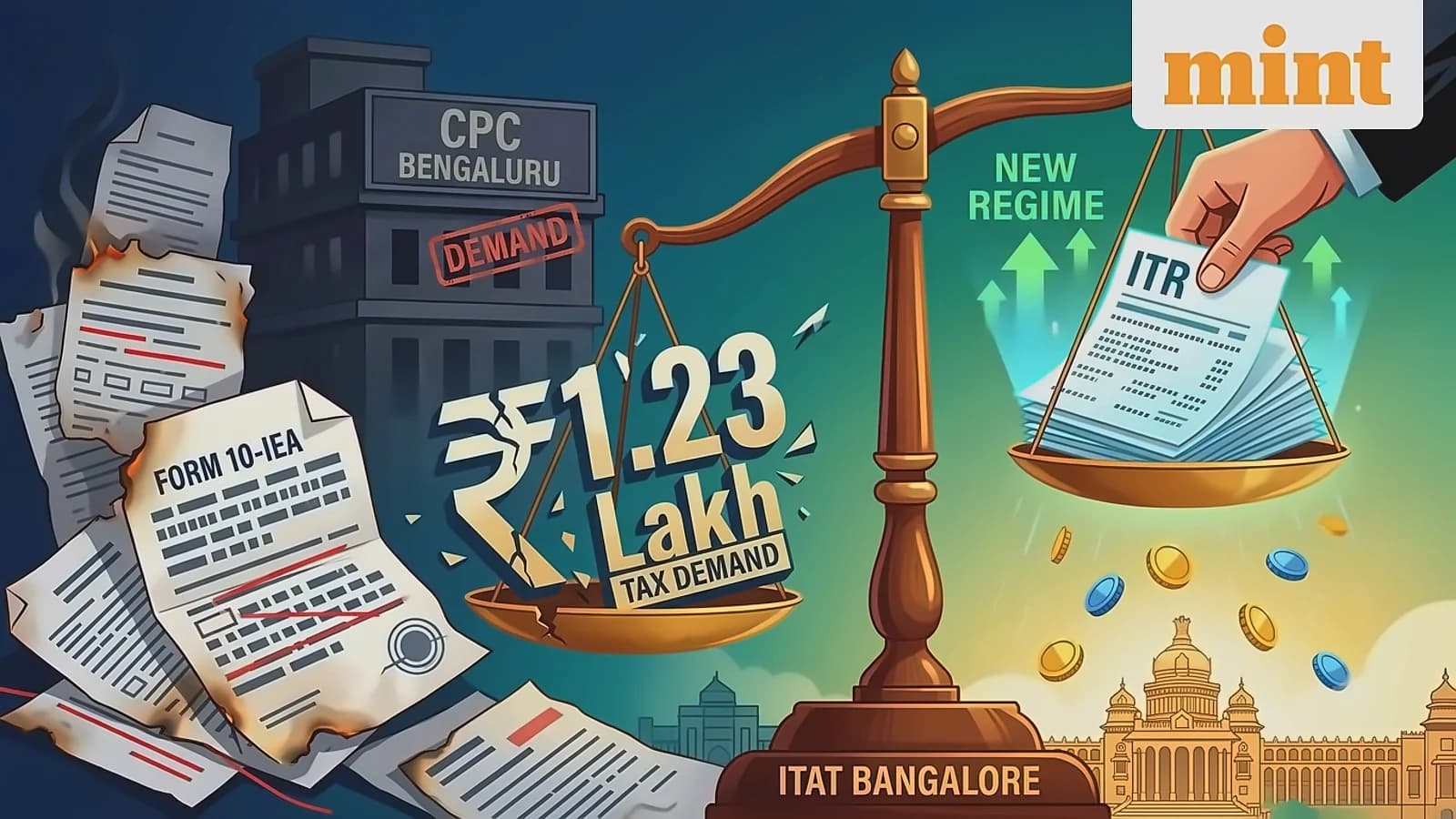
A Bengaluru taxpayer faced an additional tax demand of ₹1.23 lakh after his tax consultant mistakenly filed Form 10-IEA, indicating he had opted out of the new tax regime. According to reports from The Times of India, the taxpayer, identified as Mr Shah of Ali Asker Road, Bengaluru, had declared total income of ₹32.55 lakh and prepared his income-tax return under the new tax regime. However, on 30 September 2025, his consultant filed Form 10-IEA, which indicated Shah had opted out of the new regime and chosen the old tax regime. Shah explained that the form was filed inadvertently by his consultant during routine compliance work and did not reflect his actual intention. As per Surana & Surana, Shah stressed that his ITR clearly indicated his decision to remain in the new tax regime, not the old one.
The Centralised Processing Centre (CPC), Bengaluru, relied on the Form 10-IEA while processing Shah's return. As reported by The Times of India, on 29 January 2026, it processed his ITR under the old tax regime, resulting in the additional tax demand. According to Surana & Surana, CPC Bengaluru said they relied on Shah's Form 10-IEA and respected his decision to opt out of the new tax regime and go with the old tax regime. Shah challenged the tax demand before the Commissioner of Income Tax (Appeals), but the CIT(A) dismissed his appeal. He subsequently approached the ITAT Bangalore, where he was represented by Varun S.
The Bangalore ITAT accepted the new tax regime reflected in Shah's ITR on 17 August 2026. According to The Times of India, Shah subsequently filed his income tax return on October 24, 2025, calculating his entire tax liability under the New Tax Regime in accordance with Section 115BAC(1A). The tribunal also noted that Shah had not attempted to claim benefits under both regimes, having not claimed deductions, exemptions or allowances available specifically under the old tax regime while seeking taxation under the new regime. As per Surana & Surana, ITAT Bangalore observed that the income-tax return is the statutory document through which a taxpayer declares income and computes the tax payable and the regime. Since Shah's ITR filed after Form 10-IEA submission clearly and consistently computed his tax under the New Tax Regime, the ITAT held that this subsequent and unequivocal choice could not be ignored merely because an inconsistent form had been filed earlier due to an explained inadvertent error.
The Bangalore ITAT set aside the CIT(A)'s order and directed the AO/CPC to process Shah's return under section 115BAC(1A) and recompute his tax liability. As reported by The Times of India, the consequential demand arising from processing the return under the old tax regime was directed to be deleted, subject to the revised computation. According to Surana & Surana, the ITAT Bangalore followed the Pune Tribunal's decision in Akshay Nitin Malu v. ITO 173 taxmann.com 684, where the choice reflected in the subsequently filed ITR was respected. The ruling highlights the importance of checking the tax regime selected in the final ITR, particularly when tax compliance is handled by a consultant. Under Section 202(4) of the Income Tax Act, 2025, read together with Rule 136 of the Income Tax Rules, 2026, the option to choose the Old Tax Regime or withdraw such option must be exercised directly in the income-tax return. Notably, Form 10-IEA is no longer required from April 1, 2026, with the change applying from Tax Year 2026-2027 onwards.