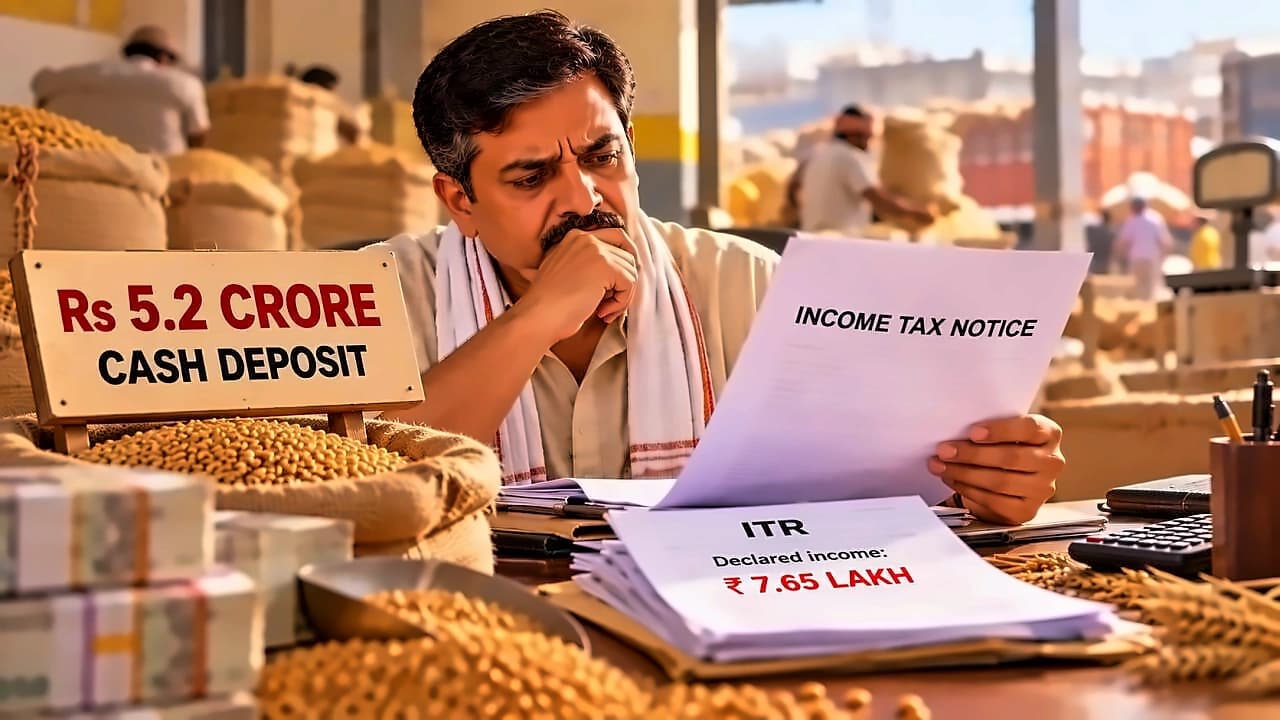
A grain trader named Mr Kumar from Rampur successfully challenged an income tax notice after depositing ₹5.2 crore in cash while declaring only ₹7.65 lakh income in his Income Tax Return (ITR). According to reports from The Times of India, the case centered on whether the bank account details were properly disclosed in the tax return, with the Income Tax Assessing Officer initially taking the view that the trader had failed to disclose the account in his ITR. The case was particularly complex as it involved multiple red flags that triggered the tax department's scrutiny.
On September 15, 2026, the Income Tax Appellate Tribunal (ITAT) Delhi ruled in favor of the grain trader. As reported by The Times of India, the tribunal found that the bank account details had been provided through Form 3CD, stating 'We further find that the bank account of Allahabad Bank has been duly disclosed in the ITR vide Form 3CD which give details of all bank accounts'. This finding led the ITAT to quash the tax notice and assessment order, as the reasons recorded for reopening were found to be based on incorrect facts. The tribunal concluded that the reasons for reopening Kumar's case are based on incorrect facts which have vitiated the assumption of jurisdiction through the notice under Section 148.
The case unfolded over several years with multiple red flags that triggered the tax department's investigation. Allahabad Bank reported the ₹5.2 crore cash deposit through its specified financial transaction (SFT) return, as required for all cash deposits above a specified limit. Additionally, Kumar's ITR failed to mention this bank account but the Form 3CD attached with the ITR mentioned it, creating initial confusion for the Income Tax Assessing Officer. Based on these assumptions, the AO issued multiple income tax notices to Kumar asking about the cash deposit and his ITR. When Kumar's answers didn't satisfy the tax department, an assessment order was issued on March 30, 2022 by the AO, which classified the ₹5.2-crore money as unexplained deposit under Section 69.
The grain trader was represented by chartered accountants Manu Gawri and Madhav Gawri who argued that the person was engaged in grain trading and had furnished Form 3CD along with his ITR. According to The Times of India, they contended that at the time Kumar filed the ITR, there was no provision for declaring bank account details apart from the bank where the refund was to be granted. The chartered accounts argued that Kumar thought this wouldn't be an issue since in any case his bank account was declared in the balance sheet which was attached to Form 3CD. They vehemently argued that since the bank account had been declared and was part of the balance sheet, the conclusion of the AO that it was an escaped income cannot be based on correct facts.
Advocate Somesh Jain of Sachdev & Jain, Advocates, explained to The Times of India that the trader's success was based on a jurisdictional issue rather than the merits of the cash deposits themselves. He noted that once the foundational fact in the reasons was shown to be incorrect, the assumption of jurisdiction under Section 147/148 as it stood then was vitiated, and the notice as well as the consequent assessment order fell with it. Akhil Chandna, Partner at Grant Thornton Bharat, emphasized that agricultural income is generally exempt from tax but must be disclosed appropriately in ITR forms when required by applicable schedules. He noted that ITR forms contain specific fields/schedules for reporting exempt income, including agricultural income, and such disclosure assumes importance where agricultural income is considered for partial integration in determining the applicable tax rate on non-agricultural income.