A division bench of Chief Justice Devendra Kumar Upadhyaya and Justice Tejas Karia issued notice to the Union of India, the Department of Revenue, Ministry of Finance, and the Central Board of Direct Taxes (CBDT), directing them to file their response. According to reports from ANI, Bar and Bench, and PTI, the matter has been listed for further hearing on November 6, 2026. The Delhi High Court on Wednesday sought the response of the Central Government on a public interest litigation (PIL) seeking the introduction of an automatic refund mechanism for Tax Deducted at Source (TDS) in cases where individuals have no income tax liability and are not otherwise required to file Income Tax Returns (ITRs).
The latest developments reveal that petitioner Aakash Goel has proposed immediate processing of unclaimed TDS refunds up to ₹5,000 per annum, along with applicable statutory interest, directly into the linked bank accounts of individual PAN holders for each of the past three assessment years. As reported by ANI, Bar and Bench, and Mint, Goel has also sought a permanent automatic TDS refund mechanism for current and future assessment years, whereby individuals whose total income is below the basic exemption limit, specifically targeting those with TDS credits up to ₹5,000 per annum, are automatically identified and their TDS refund is credited without insistence on return filing. This comprehensive proposal aims to remove the unnecessary procedural requirement of mandatory ITR filing for claiming refunds.
The PIL specifically challenges Section 433 of the Income Tax Act, 2025, which mandates ITR filing to claim refunds, even when the taxpayer has no tax liability and would otherwise not be required to file a return. As reported by ANI, Bar and Bench, and Mint, the petitioner has asked the High Court to read down the provision to the extent that it makes return filing compulsory for refund claims by people who are otherwise not required to file ITRs. The plea argues that the current system disproportionately affects senior citizens, blue-collar workers, daily wage earners, low-income individuals and small depositors, many of whom lack the financial resources or technical ability to file returns merely to recover relatively small amounts. The petitioner seeks directions for the Union Government and the Central Board of Direct Taxes (CBDT) to implement an automatic or suo motu TDS refund system for such taxpayers.
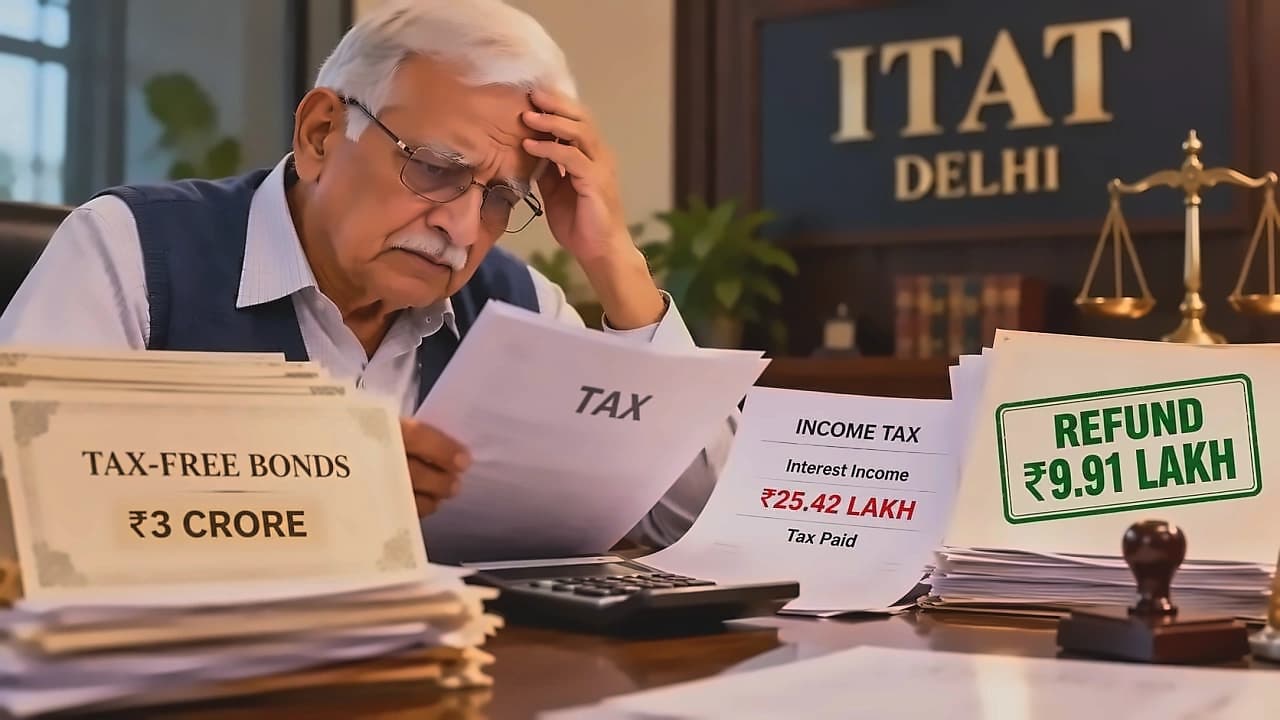
The petition highlights the significant hardship faced by nearly 23.5 million individuals who have TDS credits but are not otherwise liable to file ITR. According to ANI, Bar and Bench, and Mint, these individuals are subjected to TDS but later fall outside the tax bracket when various exemptions are claimed, thereby making them liable for TDS refund already deducted by the employer. As of now, such individuals have to file an ITR to be eligible to claim such refund, creating a substantial compliance burden. The plea argues that the issue affects a large number of taxpayers whose employers or banks deduct TDS during the financial year, but whose final taxable income falls below the exemption limit after accounting for deductions, exemptions or other eligible benefits. Latest government data presented in the PIL reveals that over 2 crore individuals had TDS credits but did not file returns for assessment year 2023-24, despite their eligibility to claim refunds. The petition also seeks the immediate refund of unclaimed TDS of up to ₹5,000 for assessment years 2023-24 to 2025-26 without requiring ITR filing or fresh verification.
The PIL claimed that while the Income Tax Department efficiently uses technology for compliance measures, including identifying potential non-filers through the Non-Filer Monitoring System (NMS), it has not adopted the same technological capabilities to automatically refund excess TDS to individuals whose tax records already establish that they have no tax liability. As reported by ANI, Bar and Bench, and Mint, the petitioner has argued that the government already possesses all the necessary information through PAN, Aadhaar, Form 26AS and TDS records and can therefore process refunds automatically without insisting on a separate compliance requirement. The petition further submits that while the Income Tax Department has developed sophisticated technology to identify tax evasion and monitor non-filers, a similar technology-driven system has not been adopted for returning excess TDS to individuals who owe no tax. The latest government data cited in the petition shows that around 8.59 crore individuals had TDS of ₹5,000 or less during financial year 2023-24, with approximately 7.51 crore having TDS of ₹1,000 or less. The PIL also refers to the Parliamentary Select Committee's recommendation on the Income Tax Bill, 2025, which had suggested removing the mandatory return-filing requirement for claiming refunds, describing it as burdensome for small taxpayers, noting that this recommendation was not incorporated in the final legislation.