Private space launch company Skyroot Aerospace successfully launched Vikram-1, India's first privately developed orbital-class rocket, on July 18 at 12:05 PM from the First Launch Pad at Satish Dhawan Space Centre-SHAR in Sriharikota. The four-stage rocket lifted off with a flight duration of approximately 16 minutes, carrying multiple technology demonstration payloads into Low Earth Orbit (LEO) at an altitude of 450 km with an inclination of 60 degrees. The launch, under Mission Aagaman (Hindi for arrival), was originally scheduled for 11:30 AM but experienced a 35-minute delay due to planned navigation issues, with authorities clearing the launch window for this historic mission. Prime Minister Narendra Modi extended his best wishes to the Skyroot Aerospace team ahead of the mission, describing it as "a defining moment" in India's space journey that proved the country's self-reliance push. The mission makes India the fourth country globally, after the United States, China and New Zealand, to have private-sector rocket capability, formally ending ISRO's monopoly on orbital launches from Indian soil.
According to the Indian Space Association (ISPA), Skyroot's success could significantly boost India's upstream space economy by opening new opportunities in launch vehicles and satellite services. As reported by Business Standard, out of the around $9 billion Indian space economy, the downstream segment contributes around 80 per cent, or $7.8 billion, while the upstream segment is valued at $1.2 billion. Lt Gen A K Bhatt (retd), director general of ISPA, stated that "Launch vehicles are the key that opens all these opportunities. Indigenous private space capability in this domain opens doors for all sectors." The upstream segment encompasses all activities ensuring development, testing, launching, operations, and monitoring of space assets, while the downstream segment focuses on applications and services relying on satellites to create business value. Experts noted that this launch is a masterclass in public-private co-existence, with ISPA emphasizing that "India's first space-tech unicorn" validation signals to global sovereign and institutional funds that the Indian private space sector is "a highly bankable, globally competitive asset class capable of breaking the global small satellite launch bottleneck."
Vikram-1 is a seven-storey-tall, multi-stage orbital launch vehicle, around 22 metres tall and 1.7 metres in diameter, built with an all-carbon composite structure and powered by in-house developed propulsion systems, including 3D-printed engines and high-thrust solid-fuel rocket boosters. The first three stages use solid propulsion, while the fourth uses a liquid engine for orbital insertion and precision manoeuvres. The vehicle is built to carry small satellites weighing up to 350 kg to low-Earth orbit (LEO) and its maiden mission targeted a 450-km orbit at a 60-degree inclination. The mission carried technology demonstration payloads from Grahaa Space, Cosmoserve, DCubed and Skyroot's own SCOPE, along with Cosmos Diamonds's artwork "Cosmic Bloom" and miniature sculptures of renowned Indian scientists including Sarabhai, C.V. Raman, and Abdul Kalam. The rocket also carried CubeSats from SOLARAS, a nanosatellite from Karnataka-based Grahaa Space, which aims to build cost-efficient, scalable nanosatellites for scientific research, Earth observation, disaster management, agriculture, and climate monitoring. For its maiden launch, the rocket carried equipment from domestic and international customers such as Indian tech start-up Cosmoserve Space, whose Mission Embrace will test the world's first soft robotic capture system in orbit, designed to gently capture defunct satellites and orbital debris using flexible robotic arms. The mission also carried a handwritten message from Prime Minister Narendra Modi among its commemorative payloads, with the postcards loaded into specialized "payload lockers" placed into Low Earth orbit.
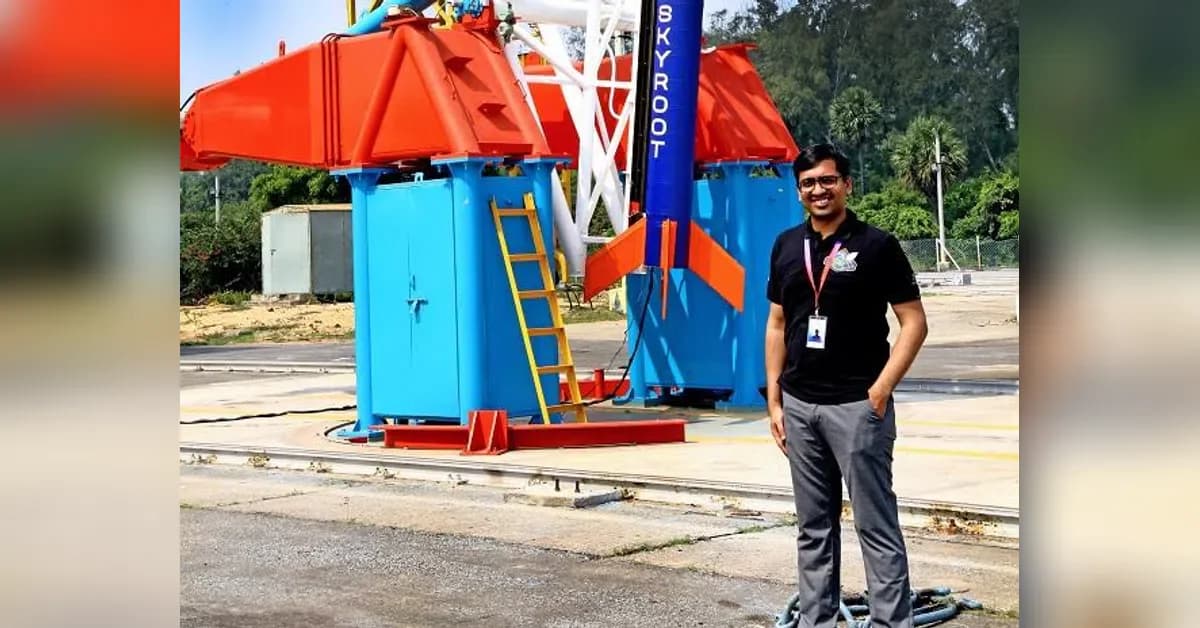
Following the successful Vikram-1 launch, Skyroot CEO Pawan Kumar Chandana announced ambitious commercial plans, telling NDTV Profit that "We'll now be getting into commercial flights" and targeting one rocket every month. The eight-year-old startup plans to scale manufacturing rapidly, with its production facility capable of building one rocket every month. Chandana emphasized that Skyroot's immediate priority is to increase the launch cadence of Vikram-1 while simultaneously advancing the development of the next-generation Vikram-2 rocket, with the company's next objective being to achieve consistent and reliable launches at that pace before expanding its commercial footprint globally. "We already have a factory which can produce one launch a month, we are yet to reach the capacity," Chandana stated, with the company planning the launch of Vikram-2, which is expected to have three times more capacity than Vikram-1's capacity. "Our ambition is to become one of the world's leading satellite launch service providers," he stated, noting that a significant share of Skyroot's customers already comes from Europe and other international markets. The CEO credited the government's space sector reforms for creating an enabling environment, with the formalisation of space policy and continued support from agencies such as ISRO and IN-SPACe helping the company overcome technological and regulatory challenges.
The success of Vikram-1 establishes the foundation for Skyroot's commercial launch programme and reinforces India's emergence as a major force in the global space economy. As reported by Business Standard, Krishanu Acharya, CEO and co-founder of Suhora Technologies, noted that "Lower-cost and more responsive launch services will enable more Indian satellite operators to deploy and replenish constellations, significantly improving the availability, revisit frequency, and timeliness of Earth observation data." Gautam Sharma, managing director of Viasat India, emphasized that "This milestone beautifully demonstrates how India's space economy is thriving through a truly collaborative ecosystem where government, brilliant startups, academia, investors, and global industry players are helping build the NewSpace future together." The company's roadmap includes Vikram-2, capable of carrying up to 1,000 kg to low-earth orbit, with its maiden flight targeted for 2027, and a fully reusable launch vehicle designed to lower the cost of reaching orbit further. Industrialist Gautam Adani congratulated the team, noting that its average age is just 28 years, demonstrating to the world what young India is capable of accomplishing. According to the company, the engineering data collected during this test flight will be analysed to validate guidance and navigation systems and to guide future refinements for commercial satellite missions, strengthening India's position in the fast-growing global small satellite launch market. Chaitanya Giri from Observer Research Foundation noted that "Skyroot will have many commercial international clients sitting on the fence awaiting its first success. With SpaceX having announced the intent to pull back from small satellite launches by 2028, we may expect multiple commercial announcements from Skyroot in the next few months."