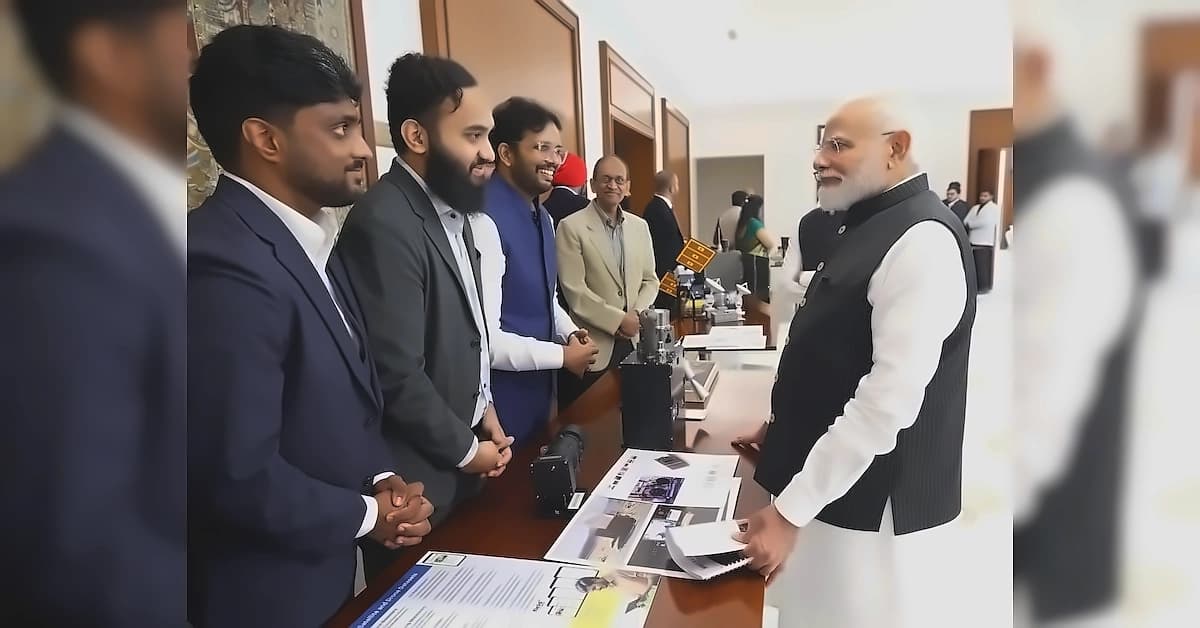
Prime Minister Narendra Modi has urged space startups to create an aura around India's private sector in space research, making the country a global destination for talent and innovation. In an interaction with CEOs and founders of 20 space startups on Friday, Modi emphasized that India's vast talent pool and high risk-taking capacity would allow the country to rapidly establish a dominant position in the global space sector. As reported by Business Standard, Modi highlighted that the world must now be looking for Indian startups wondering who is leading in this space, noting that whenever a breakthrough happens, people's attention shifts immediately. One CEO revealed that after India opened the space industry for private players, many Indian citizens living in the US and Europe now want to return and work in the country, demonstrating the growing appeal of India's space sector. Speaking ahead of National Space Day on August 23, 2026, Modi said India should become a destination where people come to build careers in the space sector, creating an 'aura' strong enough to draw global talent towards Indian startups and space agencies.
The Indian Space Research Organisation (ISRO) is implementing a significant strategic shift by handing over routine rocket and satellite production to private companies, allowing the space agency to focus on advanced research, technology and exploration. As reported by Business Standard, IN-SPACe chairman Pawan Goenka confirmed that ISRO will not manufacture any launch vehicles, with all production to be handled by private sector or public sector units. "ISRO will not make any launch vehicles and will not manufacture any launch vehicles. That will all be done by the private sector or PSU," Goenka stated at a media summit on Saturday. The transition includes technology transfer for the three-stage Small Satellite Launch Vehicle to Hindustan Aeronautics Limited following a competitive bidding process, while production of the Polar Satellite Launch Vehicle and Launch Vehicle Mark-3 is being opened to private industry consortia. The government has also proposed to invite bids within five years to operate a commercial launch pad, further liberalizing the space sector process.
India's space economy is experiencing unprecedented growth, with the space industry projected to reach $40-45 billion by 2037, up from the current $9 billion valuation. According to government data cited by IANS, this projected rise reflects India's strategic shift from a predominantly government-led space programme towards a larger commercial ecosystem involving startups, private investment, technology transfers and international customers. The transition is being facilitated by significant policy reforms and regulatory changes that have opened up the space sector to private participation. The government has already taken key policy measures such as the New Space Policy 2023, FDI Policy 2024, the Indian Telecommunication Act 2023, and the geospatial data policy, with all these measures expected to push the Indian space sector from $9 billion to $44 billion by 2033. As reported by Business Standard, recent successes by private space companies have demonstrated India's ability to build capabilities at a globally competitive level, sending an important signal to investors and international partners.
The government has established comprehensive funding mechanisms to support private space companies through multiple channels. The IN-SPACe Seed Fund Scheme supports early stage space startups, while a ₹1,000 crore Venture Capital Fund has been created to provide growth capital to the sector. Additionally, a ₹500 crore Technology Adoption Fund has been established to support wider deployment of space technologies, and the Satellite Bus as a Service (SBaaS) Scheme has received an allocation of ₹75 crore to support satellite bus development. The government has also authorised 52 non-governmental organisations for 113 clearances for satellite operations, payloads and launch services by mid-2026, demonstrating its commitment to private sector participation. Lt Gen A K Bhatt (Retd), director general of the Indian Space Association (ISpA), noted that while much attention has focused on upstream capabilities, the next phase of India's space story will be shaped equally by downstream adoption across agriculture, climate monitoring, urban planning, disaster management, connectivity and national security. Modi also called for wider use of space technology beyond traditional applications, urging startups to explore opportunities in agriculture, livestock, dairy and environmental monitoring, linking space innovation more closely with everyday economic activity.
India's space startup ecosystem has witnessed remarkable expansion, with the number of registered space-tech startups increasing from a single company in 2014 to approximately 450 as of present, demonstrating the sector's rapid growth trajectory. According to government data cited by PIB, private investment in Indian space startups has grown six-fold from 2021-22 to 2026, rising from ₹100.5 million to a cumulative ₹618.5 million by March 31, 2026, with ₹187 million arriving in 2026 alone. The Indian National Space Promotion and Authorisation Centre (IN-SPACe) has facilitated 71 transfers of ISRO technologies to industry and startups as of January 31, 2026, while NewSpace India Limited's (NSIL) turnover has grown from ₹321.77 crore in FY 2021-22 to over ₹3,000 crore in FY 2024-25. Skyroot Aerospace, India's first space-tech unicorn, successfully launched India's first private rocket into orbit, with CEOs targeting one launch per month by mid-2027 and eventually several launches per day. Krishanu Acharya, CEO of Suhora Technologies, emphasized that as more satellites reach orbit, raw data only becomes valuable once converted into usable insight, where downstream players will increasingly drive revenue for India's space economy. The 20 startups at the interaction included Skyroot Aerospace, Agnikul Cosmos, Pixxel, Dhruva Space, GalaxEye, PierSight, Bellatrix Aerospace, Digantara and SatSure, among others, with startup founders telling Modi that investor confidence has strengthened after successful private rocket launches and that Indian companies are securing growing interest from international customers.
India has liberalised its space sector foreign direct investment (FDI) rules in February 2024 to attract international participation. Up to 74% FDI is permitted automatically for satellite manufacturing and operations, while up to 49% FDI is permitted through the automatic route for launch vehicles and spaceports, and 100% automatic route FDI is permitted for manufacturing satellite and ground segment components. The Indian Space Policy 2023 aims to strengthen the role of private players across the value chain, with the policy laying out clear roles for NewSpace India Limited (NSIL) and IN-SPACe. Moin SPM, co-founder and chief operating officer of Agnikul Cosmos, highlighted that this transfer requires clear regulatory oversight, security vetting, and safeguards that keep critical IP and manufacturing capability within India, ensuring the country's strategic space capabilities remain secure. Modi also emphasized policy stability as an important factor for startups operating in a capital intensive sector, noting that entrepreneurs need confidence that government policies will remain consistent as they take risks and invest in new technologies.