The Indian National Space Promotion and Authorisation Centre (IN-SPACe) has selected three Indian space startups as the first non-governmental entities to receive funding under its Technology Adoption Fund (TAF) scheme. According to reports from ThePrint and PTI, the selected companies are Astrobase Space Technologies, SatSure Analytics India and TM2SPACE Technologies. The funding was awarded following a rigorous multi-stage evaluation process conducted by an expert committee comprising members from the Indian Space Research Organisation (ISRO), the Department for Promotion of Industry and Internal Trade (DPIIT), the Department of Science and Technology (DST), industry, academic institutions and IN-SPACe itself. This marks the first instance when the agency has invested in Indian startups, with each project capped at ₹25 crore investment. The announcement was made on June 11, 2026, during IN-SPACe Industry Connect in Ahmedabad.
Astrobase Space Technologies, founded by former ISRO propulsion engineer Devakumar Thammisetty and CoinDCX co-founder Neeraj Khandelwal in 2024, will develop a high-thrust closed-cycle liquid rocket engine (800 kN) for space launch vehicles. The project aims to develop an 800 kN-class reusable LOX-LNG rocket engine with high efficiency and modular architecture for medium- to heavy-lift launch vehicles, serving as a commercial propulsion solution for next-generation launch systems and orbital stages. SatSure Analytics India, founded in 2017 by Prateep Basu, Rashmit Singh Sukhmani, and Abhishek Raju, will develop Dhaarini, a Large Earth Observation Model (LOM) designed to serve as India's foundational artificial intelligence platform for remote-sensing applications. The model will be trained on diverse satellite and aerial datasets to generate actionable insights across agriculture, infrastructure and disaster management, enabling data-driven decision-making at a national scale. TM2SPACE Technologies, founded in 2023 by ex-NowFloats cofounder Ronak Kumar Samantray, will develop an indigenous AI-powered star tracker system for satellites, developing StarSense Lite for CubeSats and StarSense Pro for satellites above 50 kg, delivering high-precision attitude determination through advanced optics, electronics and onboard algorithms.
According to ThePrint and PTI, Pawan Goenka, chairman of IN-SPACe, stated that the selection marks a pivotal step in transforming Indian private entities into global space leaders. He emphasized that the fund aims to bridge the critical gap between early-stage development and commercial success, empowering the private sector to work on cutting-edge space technologies. "With this fund, our vision is to bridge the critical gap between early-stage development and commercial success. By offering this financial support, we are empowering the private sector to work on cutting-edge space technologies," Goenka said. The development comes at a time when India's spacetech sector is evolving rapidly, with startups in this sector raising ₹530 crore, marking a 13X jump over the past five years based on Inc42's data. Earlier this year, 360 ONE Asset launched a multi-stage defence and space strategy fund with a target corpus of ₹1,000 crore.
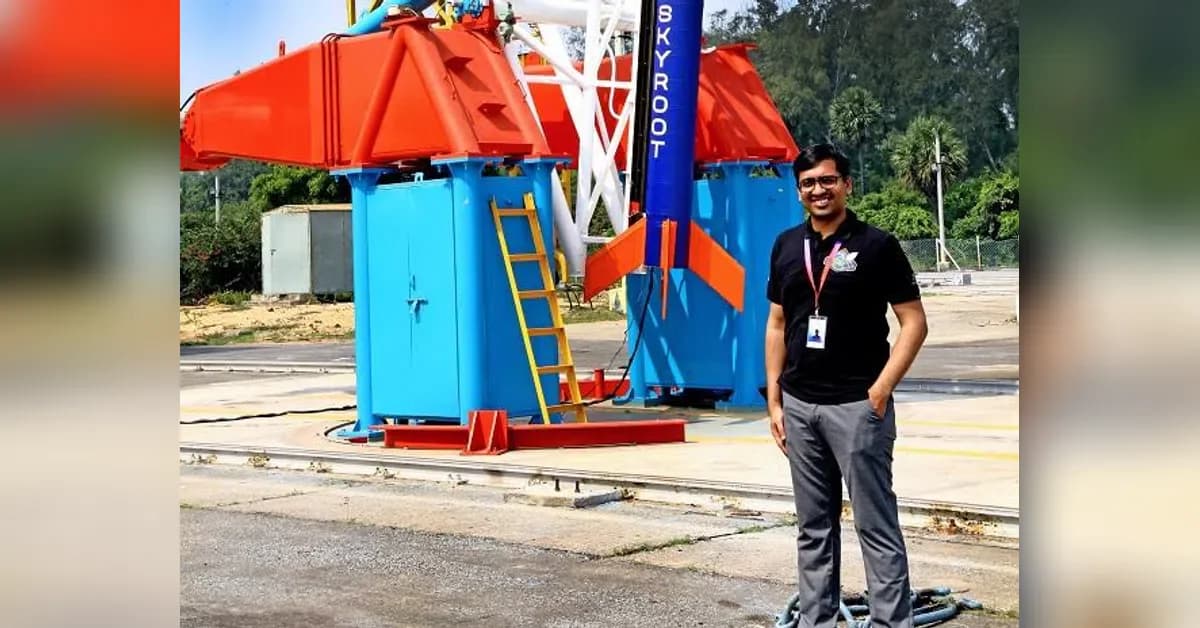
As reported by ThePrint and PTI, IN-SPACe will provide continued technical guidance, monitoring and milestone-linked disbursement of funds to ensure successful implementation of the selected projects. The Technology Adoption Fund is designed to support Indian industry in absorbing, adapting and commercialising advanced space technologies, thereby bridging the gap between research and operational deployment. In March 2025, IN-SPACe selected SIDBI Venture Capital as the fund manager for the government's ₹1,000 crore venture capital fund aimed at supporting homegrown spacetech startups. The fund, first announced by Finance Minister Nirmala Sitharaman in the Union Budget 2024 and approved by the Union Cabinet in October 2024, is intended to boost private investment in India's space sector. Additionally, IN-SPACe launched a new programme in April 2025 for private space companies to design and build small satellite bus platforms, selecting Astrome Technologies, Azista Industries and Dhruva Space to build indigenous small satellite bus platforms with a grant of ₹5 crore each. The Department of Space is also extending technical support to private launch companies, with Skyroot's orbital launch targeted for July 2026 and support including propellant casting, static tests, and launch operations.
IN-SPACe has launched several new initiatives aimed at accelerating private participation in India's growing space sector. Among the major support measures announced are a Venture Capital Fund worth ₹1,000 crore, a Technology Adoption Fund worth ₹500 crore, and Common Technical Facilities worth ₹500 crore. Additional initiatives include an Earth Observation constellation under a public-private partnership model, where IN-SPACe has selected a consortium led by Pixxel to design, build and operate a national Earth Observation satellite constellation comprising 12 satellites aimed at strengthening India's space-based monitoring capabilities. India has also begun facilitating access to orbital resources for private space companies, with one orbital slot at 89° East allocated to Ananth Technologies Ltd. and two more orbital slots at 55.8° East and 68° East identified for future allocation to non-governmental entities.