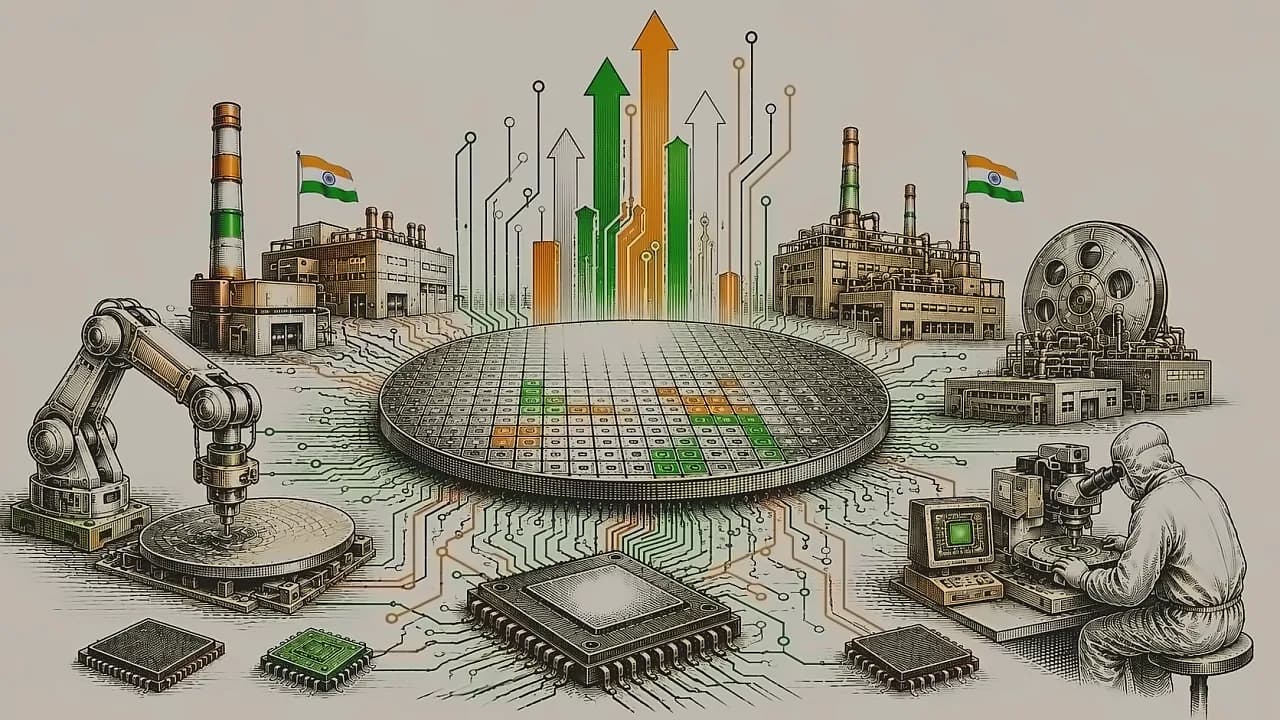
Prime Minister Narendra Modi announced during the 80th Independence Day celebrations from the Red Fort that India has started production at three semiconductor manufacturing plants, with another five to eight facilities expected to become operational over the next seven to eight years. Speaking from the ramparts of the Red Fort, PM Modi emphasized that the country's progress in the semiconductor sector reflects its increasing technological self-reliance. He noted that semiconductor chips have become indispensable across sectors ranging from electronics and healthcare to transportation and nearly every aspect of modern technology. The Prime Minister highlighted that although semiconductors had been a subject of discussion in India for many years, the country previously lacked large-scale chip manufacturing capabilities, making the current expansion particularly significant for India's technological independence. "In today's digital world and the age of technology, we understand the importance of chips. Whether it is electronic goods, medical equipment or transportation systems, chips are indispensable to all of them," Modi stated, emphasizing that without chips, the entire world could come to a standstill.
The Ministry of Electronics and Information Technology (Meity) has announced Semicon 2.0, earmarking an additional ₹1.27 trillion as financial incentive for companies to build semiconductor manufacturing facilities. This represents a significant expansion beyond the ₹76,000 crore of incentives announced under the earlier Semicon scheme, with most of its budget already allocated for one silicon fab plant and eight OSAT and ATMP plants. According to Business Standard, three of these facilities — by Micron, Kaynes Technology and CG Power — are currently up and running, demonstrating the government's commitment to accelerating India's semiconductor manufacturing capabilities. The ₹1.27 lakh crore outlay has received Cabinet approval and represents India's most ambitious push to establish itself as a global semiconductor hub. PM Modi confirmed that production has already begun at three semiconductor plants and that exports from these facilities are also underway, marking a significant milestone in India's semiconductor journey.
Meity wants India to capture a 10 per cent share of the global OSAT/ATMP business by 2030, which would be worth ₹55-70 billion. As reported by Business Standard, once the first four OSAT/ATMP plants cleared by the government are operational, their combined capacity would exceed 70 million chips per day, representing approximately 7 per cent of China's production and sub-3 per cent of global output. The four recently cleared plants in the second phase are expected to be operational by the end of this year or next year, with total investment of $6.7 billion (half of which will be in government subsidy). So far, 12 manufacturing units have been approved under the first India Semiconductor Mission, indicating strong government commitment to the sector's growth. Companies like Kaynes Semicon have already secured 100 per cent of their capacity through agreements with US, European and Japanese companies for their 2.3 billion chips per year capacity. The Indian semiconductor market is projected to expand from $38 billion in 2023 to $100-110 billion by 2030, with the government targeting to develop capability to design and manufacture chips catering to 70-75% of domestic demand by 2029.
The National Nano Fabrication Facility (NNFC) serves as the foundation of CeNSE's ecosystem, supporting complete micro- and nano-fabrication workflow from lithography and thin-film deposition to etching and process integration. As reported by Business Standard, the facility enables technology developers to prototype devices using manufacturing workflows that closely resemble industrial production, built around internationally recognised ISO-certified processes. The facility supports researchers, startups and industrial users working across semiconductor devices, MEMS, photonics and nanoelectronics, ensuring that technology developers can access the same capabilities that would otherwise require prohibitively expensive independent development. Semicon 2.0 focuses on six pillars: chip design, semiconductor equipment and materials, fabrication facilities, advanced packaging (ATMP/OSAT), research and development, and talent development, with a defined roadmap for achieving 3-nanometre and 2-nanometre technology nodes.
In his Independence Day address, PM Modi announced a significant AI skills development initiative targeting one crore youth over the next one year. As reported by Business Standard, this represents a major government commitment to preparing India's workforce for the rapidly growing artificial intelligence sector. The Prime Minister emphasized that AI technology is growing fast and to harness this potential, the government will train one crore youths with AI skills in the coming year. This initiative aligns with India's broader technology self-reliance goals and positions the country to capitalize on the global AI transformation. The announcement comes alongside the semiconductor expansion, demonstrating the government's comprehensive approach to building India's technological capabilities across multiple high-growth sectors.
India's ambition to become a US$ 35 trillion economy by 2047 cannot be realised through services growth alone. Manufacturing offers the surest route to broad-based job creation, reduced import dependence, and technological depth, all of which are essential for a nation of India's size and demographic profile. The policy architecture built over the past three decades, from liberalisation and the Goods and Services Tax to Make in India, the Production-Linked Incentive scheme, and the ecosystem-driven approach of the Union Budget 2026-27, provides a credible foundation. The Union Budget for 2026-27 has earmarked substantial new outlays for strategic and frontier sectors, including a scheme named Biopharma SHAKTI with an outlay of approximately US$ 1.2 billion over five years to build a domestic ecosystem for biologics and biosimilars, an expanded India Semiconductor Mission focused on indigenous chip design and equipment manufacturing, and a near doubling of support for electronics components manufacturing to roughly US$ 4.7 billion. According to EY India's Saurabh Agarwal, "Semiconductors could do for India what software did over the last thirty years, becoming a whole new engine of growth and self-reliance."