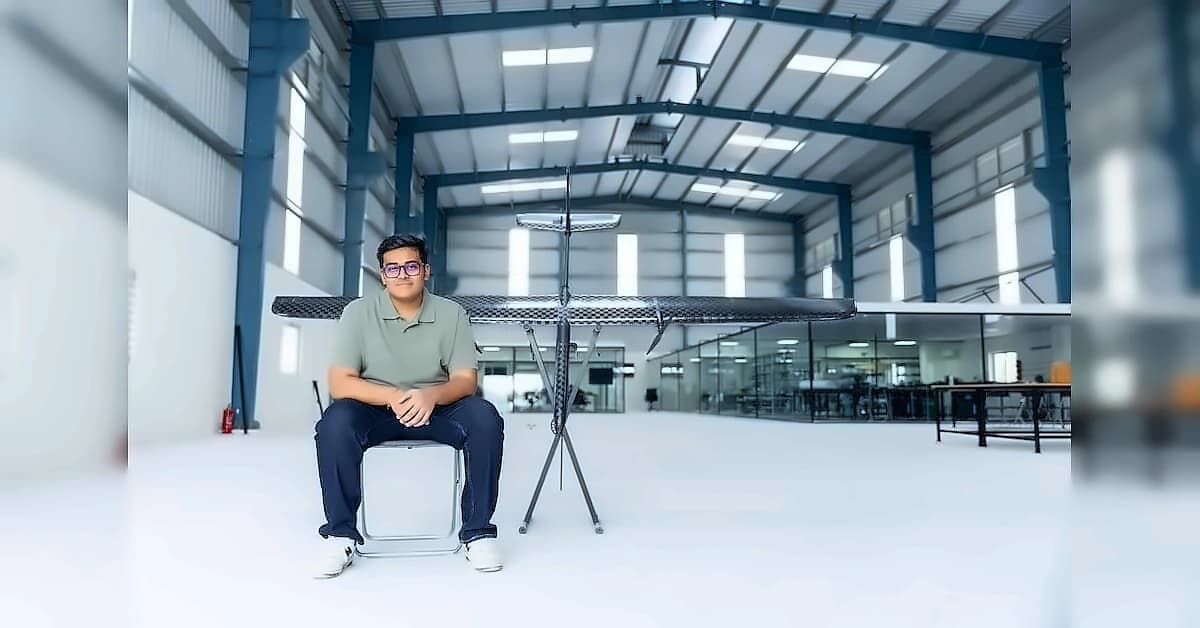
Bengaluru-based autonomous logistics and delivery drone startup Airbound has secured $37 million in a Series A funding round led by Greenoaks. The round included participation from DoorDash through its DoorDash Labs unit, Physical Intelligence founder Lachy Groom, Lightspeed, and Humba Ventures. According to reports from Mint and TechCrunch, this brings the startup's total fundraising to nearly $50 million, building on its $8.65 million seed round led by Groom in October last year. Founded in 2023, Airbound is building autonomous drones that can transport goods over short distances, focusing on developing smaller and lighter aircraft that can carry useful loads without needing conventional airport infrastructure.
According to TechCrunch, Airbound builds autonomous aircraft designed to weigh less than the cargo they carry, reversing conventional aircraft ratios. The company's current TRT drone weighs around 3.3 pounds and can carry about 2.2 pounds of cargo, with next-generation prototypes expected to weigh about 6.6 pounds and carry up to 11 pounds. The startup uses a rocket-like, tail-sitter design for its drones, which takes off and lands vertically in an upright position before transitioning to horizontal flight. This design eliminates runway dependence, allowing deployment across dense Indian cities where small hospitals, retail centers, and warehouses become potential landing sites. The company has completed a pilot program from January to March with Narayana Health to transport medical and diagnostic samples between clinics in Bengaluru's Banashankari and central laboratory in Electronic City, completing more than 1,000 flights with zero failures. The approach enables a purpose-built vehicle carrying a single passenger or roughly 100kg of cargo to weigh around 400kg once fuel and payload are factored in. Airbound has already put its technology through thousands of test flights, completing more than 13,000 autonomous flights in Bengaluru and Guntur, with the technology showing significant efficiency gains - one 2.5-mile route can be completed by drone in around seven minutes, while the same trip can take several hours by road.
The funding will support Airbound's scaling of engineering, commercial manufacturing, and go-to-market efforts as the company builds drone delivery networks across India. As reported by Mint and TechCrunch, the startup has signed formal agreements with the Andhra Pradesh government targeting a transformative three-city drone network covering areas around Amaravati, Vijayawada and Guntur. The ambitious initiative aims for 10,000 daily flights handling retail, e-commerce, and healthcare deliveries, requiring approximately 250 aircraft to achieve this scale. The company believes this project represents a potential model for wider aerial delivery in India, with Founder and CEO Naman Pushp stating that "the bar for delivery in India is high. The benchmark is 10 minutes to your doorstep, at an extremely low cost. That's the complexity here." The proposed network will serve healthcare, retail and e-commerce needs, with the long-term plan reaching as many as 10,000 flights a day. If the project reaches its planned scale, Airbound could eventually need between 250 to 1,000 aircraft to support the operations, though Pushp expects the number to be closer to 250. The agreement does not involve a government contract or subsidy, with the Andhra Pradesh government working with Airbound on the regulatory framework needed to enable the network.

While the company is still largely pre-revenue, Airbound is using its latest funding to move closer to larger commercial deployments. The startup currently designs and manufactures its drones at a 43,000-square-foot facility in Bengaluru and has more than 150 employees. According to TechCrunch, Airbound designs and manufactures its aircraft in-house, keeping work on the airframe and other core systems in-house, though Pushp declined to disclose production capacity or how many aircraft have been built so far. The company's drones use a blended wing body tailsitter design, combining the vertical take-off capability of a drone with the efficiency of a fixed-wing aircraft. Airbound is also expanding its work with Narayana Health as the healthcare provider prepares to operate its new hospital in Banashankari, Bengaluru, which was designed without an on-site diagnostic lab or blood bank and will instead rely on Airbound's drones to connect with centralized facilities. The company's focus on keeping aircraft lightweight helps reduce energy use and make drone operations more economical, important for competing with conventional delivery methods rather than simply offering drones as a premium alternative.
As reported by Mint, the funding comes as India's venture capital ecosystem increasingly backs companies with strong intellectual property, with deeptech attracting more capital even as deal volumes have fallen. According to startup intelligence platform Tracxn, the deeptech sector has raised $2.2 billion across 187 deals in 2026, compared with $1.6 billion across 487 deals in 2025. Greenoaks Partner Neil Shah noted that autonomous aircraft can move packages with the cost efficiency of a fully loaded 20-ton truck, eliminating the traditional tension between fast and cheap delivery. The latest funding comes as interest in drone technology in India continues to grow, with the focus now on proving that Airbound's aircraft can operate safely, reliably and at a cost that makes sense for businesses. If trials translate into larger commercial networks, Airbound could become one of the companies helping shape India's emerging drone logistics market, with the startup expecting the same technology could eventually support passenger transport where a 300-kilometre journey is completed in about 20 minutes. However, Pushp noted that the bigger bottleneck is regulation, particularly securing approvals for beyond visual line of sight (BVLOS) operations, which is critical to operating delivery networks at scale. The company positions itself as an aircraft manufacturer, not a delivery operator, with CEO Naman Pushp comparing the vision to Boeing supplying airlines, creating an infrastructure play that generates revenue across multiple logistics operator partners.