India's senior living market is projected to grow four times the current levels to cross ₹1 lakh crore by 2030, according to a report by Colliers. The segment's expansion is driven by evolving demographic shifts and increasing demand for senior housing solutions. As reported by Colliers, the market is entering a period of accelerated growth, with the segment evolving beyond conventional retirement housing to an organised market featuring healthcare facilities. A separate study by JLL and the Association of Senior Living India projects that India's senior-living housing sector could grow by more than 300% to reach $7.7 billion, or approximately ₹64,500 crore, by 2030. The sector's growth is being supported by India's changing demographic profile, with the United Nations Population Fund projecting that the country's population aged 60 years and above could reach nearly 347 million by 2050, accounting for more than 20% of the total population.
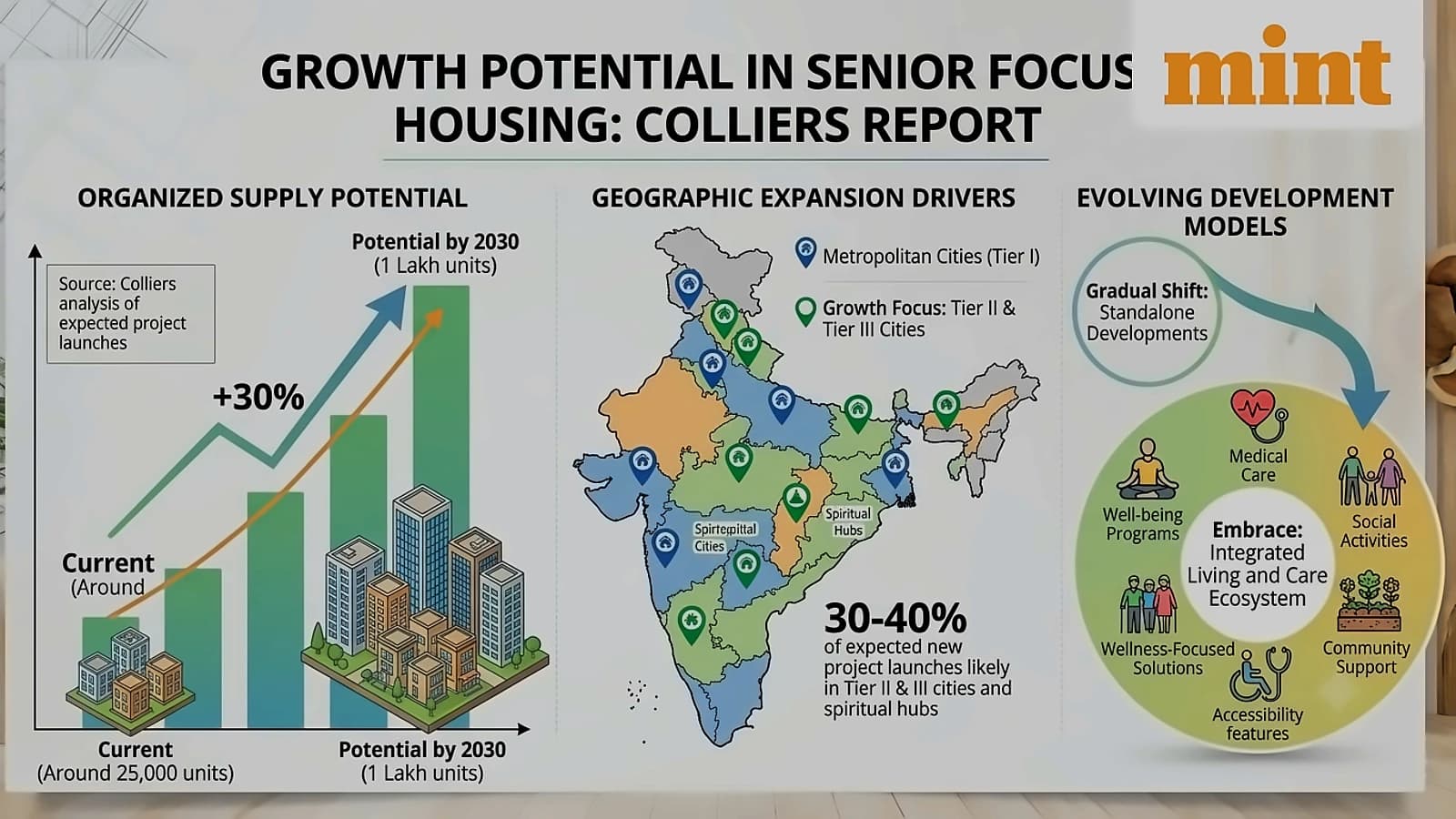
Organised supply for senior focused housing can potentially increase from around 25,000 units currently to 1 lakh units by 2030, according to the Colliers report. The penetration rate in the segment is expected to rise from above 1% currently to around 4% in the next three to four years. Leading real estate developers and investors are expected to deploy more than ₹130 billion for senior living projects by 2030, with 30-40% of new project launches likely in Tier II and III cities and spiritual hubs. The sector faces a significant demand-supply gap, with current demand estimated at 20-22 lakh units while the organised market has inventory of only around 25,000 units. Market estimates vary depending on whether they include only independent senior housing or also cover assisted living, healthcare and other senior-care services, but industry reports consistently point to a wide gap between potential demand and organised supply. Recent data shows that investments of more than ₹13,000 crore have been announced by senior-living developers and investors since 2025 and are expected to be deployed over the next three to four years.
While Tier I cities currently account for majority of India's organised senior living stock, the segment is gradually expanding into Tier II and III markets. Cities such as Coimbatore, Puducherry, Dehradun, and Vadodara along with spiritual hubs like Tirupati, Vrindavan and Ayodhya are emerging as attractive destinations for senior housing. Southern India currently accounts for a significant share of the country's organised senior-living supply, with Bengaluru, Chennai and Coimbatore among the established markets. Hyderabad is now attracting significant interest because of its healthcare ecosystem, international connectivity, relatively lower congestion and the availability of larger land parcels on the outskirts. The city's technology professionals, entrepreneurs, business families and sizeable NRI-linked population provide a potential customer base for organised senior communities. According to Colliers, demand is projected to reach nearly 30 lakh units by 2030, while organised inventory could increase to approximately 1 lakh units.
Developers are likely to embrace integrated and wellness-focused solutions, with a gradual shift away from standalone developments to integrated living and care ecosystems. According to Colliers, while 1, 2 and 3 BHK configuration units continue to remain dominant in both independent and assisted living formats, real estate developers are increasingly incorporating senior living clusters within villas, large mixed-use developments and integrated townships. New projects are increasingly being positioned as independent residential communities supported by hospitality, wellness, preventive healthcare, recreation and emergency assistance. Unlike conventional housing, senior-living developments require operators to maintain a long-term relationship with residents after possession, with dining, housekeeping, maintenance, healthcare coordination, emergency response and community programmes forming a significant part of the operating model. The latest example is Vera Vita Living LLP's Amaya project in Hyderabad, which plans to invest approximately ₹600 crore over five years in a 13-acre development near the Kandlakoya Reserve Forest. The project will offer 256 residences ranging from 950 sq. ft. to 2,400 sq. ft., with comprehensive amenities including clubhouse, multiple dining options, wellness and fitness spaces, and preventive healthcare services.
India's regulatory environment for senior living is expected to strengthen further following recent reinforcement of model guidelines for senior living projects, originally issued by the Ministry of Housing and Urban Affairs in 2019. Select states like Haryana and Maharashtra have already taken proactive steps towards establishing dedicated guidelines for senior living projects. These guidelines along with mandatory Real Estate Regulatory Authority (RERA) compliance requirements will bring greater standardisation, transparency, operational efficiency and accountability across senior living projects. The sector's ability to scale will depend on service consistency, pricing transparency, trained personnel and the long-term maintenance of communities. The entry of specialised developers and growing capital commitments indicate that senior living is developing into a distinct real estate and services asset class rather than remaining a niche extension of conventional housing.