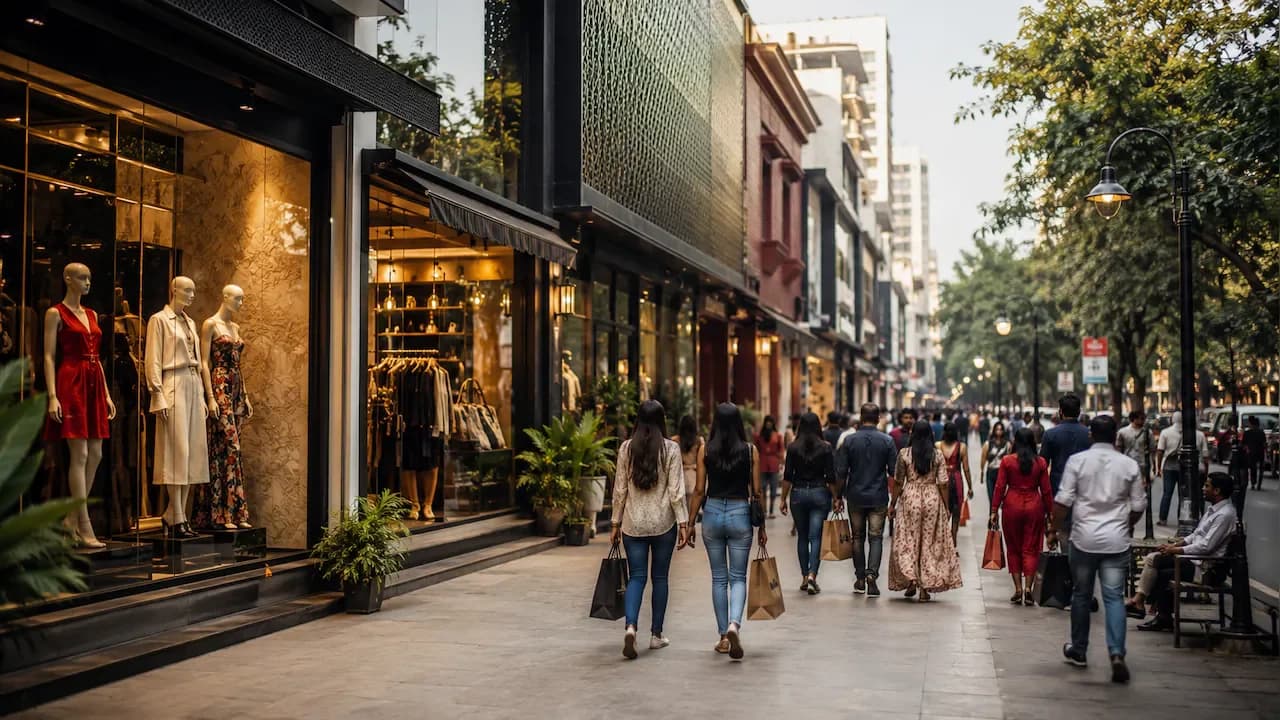
India's retail real estate sector achieved unprecedented growth in Q2 2026, with gross leasing volume reaching 2.4 million square feet across the top eight cities, representing a 17.6% year-on-year increase and 23.2% quarter-on-quarter growth, according to Cushman & Wakefield's latest report. The total leasing activity for the first half of 2026 stood at 4.35 million square feet, up 3.1% from the previous year, highlighting sustained demand across key retail markets. This growth was driven by sustained occupier demand despite tight supply conditions, with no new Grade A mall supply added for the second consecutive quarter, as reported by Cushman & Wakefield.
Fashion retailers continued to dominate leasing activity with a 28.2% share, followed by food and beverage at 17.2%, according to Cushman & Wakefield's Q2 2026 Retail Marketbeat report. Entertainment sector showed healthy traction with 10.8% share, while accessories and lifestyle segments accounted for 10% of total leasing activity. Leading this surge are the fashion and food sectors, which are eagerly pursuing top-tier spaces despite the scarcity, reflecting strong consumer demand and suggesting exciting prospects for further retail expansion as additional spaces become accessible.
Bandra's Linking Road emerged as Mumbai's premier retail destination, with rents surging 22% year-on-year and 7.8% quarter-on-quarter in Q2 2026, according to Cushman & Wakefield's Q2 2026 Retail Marketbeat report. The high street now commands asking rents of ₹1,100 per sq ft per month, representing the highest rental rates in Mumbai. Chembur followed with 12.5% annual growth, while Borivali LT Road rose 8.5% and Thane climbed 6.5%. Among major retail corridors, Mumbai's Linking Road recorded the highest annual rental increase, followed by Bengaluru's Indiranagar 100 Feet Road at 12%, Chennai's Anna Nagar 2nd Avenue at 11% and Delhi NCR's Khan Market at 9%.
Main streets accounted for 48.7% of total leasing activity, or 1.17 million square feet, with leasing volumes increasing 14% sequentially and 13.3% year-on-year, supported by continued demand for high-visibility retail locations. Domestic retailers remained the largest occupier group, contributing 82.4% of total leasing, or 1.98 million square feet, with about 54% of their leasing activity concentrated in main streets. International retailers accounted for 17.6% of leasing activity, or 0.42 million square feet, with nearly 76% of their transactions taking place in malls, reflecting their preference for institutionally managed retail destinations.
Grade A mall vacancy declined to 5% in Q2, down 163 basis points year-on-year, with no new supply added during the quarter. Around 0.35 million sq ft of fresh mall space is in the pipeline, concentrated in southern and eastern corridors, and is expected to push vacancy up marginally by the end of the year. A supply pipeline of 12.7 million square feet is scheduled for delivery between 2026 and 2028, including about 1.6 million square feet expected in the second half of 2026. Delhi NCR is projected to account for more than half of the upcoming supply, followed by Bengaluru, Chennai, Kolkata and Hyderabad. Gautam Saraf, Executive Managing Director, Mumbai & New Business at Cushman & Wakefield, noted that India's retail real estate market continues to demonstrate the strength of underlying consumer demand, with the gradual addition of new supply expected to improve market availability and create fresh expansion opportunities for retailers.