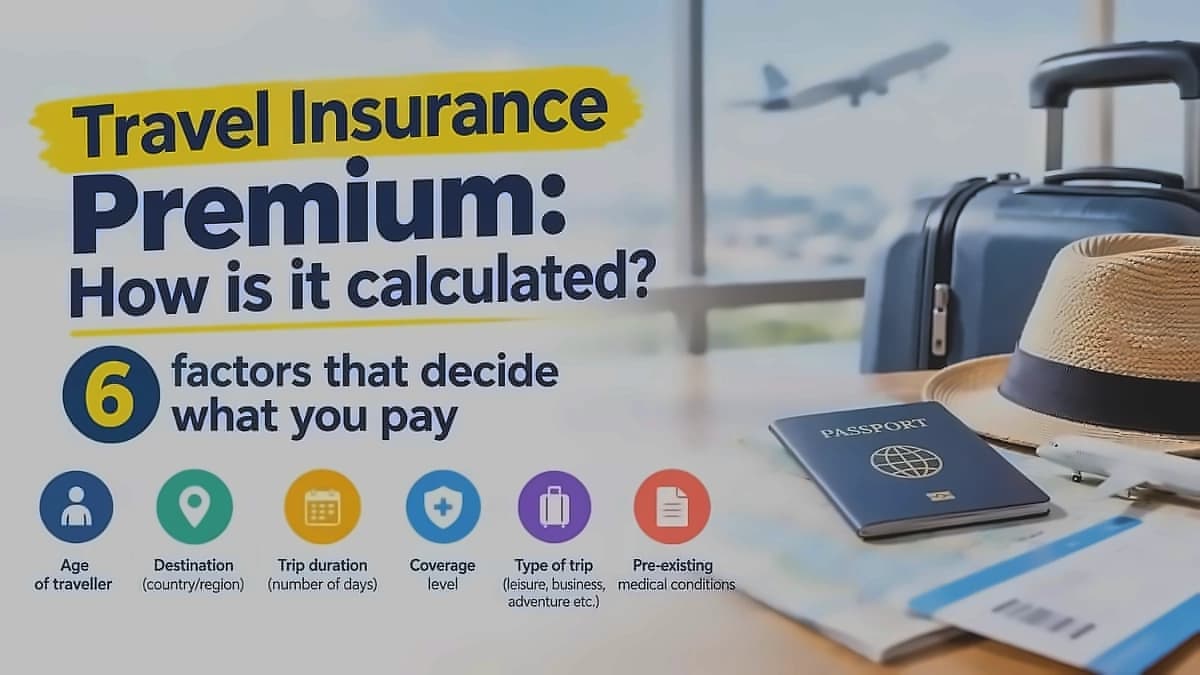
Travel insurance premiums are determined by six key factors that can significantly impact the final cost. According to Certified Financial Planner Poonam Rungta, different insurance companies may offer varying premiums, though the overall range tends to remain similar across providers. As reported by Zee Business, the destination country, traveller's age, pre-existing medical conditions, trip duration, coverage amount, and deductible options all contribute to the final premium calculation. Recent analysis reveals that sub-limits on travel medical insurance policies can lead to actual payouts much lower than the claimed cover amount, with specific caps on hospital room rent, ICU charges, and medical procedures that vary significantly across plans and age groups. According to Manas Kapoor, head of travel insurance at Policybazaar, travellers often look at the sum insured and premium when evaluating travel insurance, but there are several other aspects that can help them understand the coverage better.
The destination country represents a critical factor in determining travel insurance costs, with Mexico travel insurance premiums averaging $236 for a 9-day trip according to Squaremouth travel insurance sales data. Rungta explained that medical costs differ significantly across countries, with premiums partly based on healthcare costs at the destination. Specifically referencing countries like the US and Canada, where medical expenses can be particularly high, she emphasized that travellers should consider actual medical costs in the destination rather than focusing solely on meeting minimum visa requirements. Prathiba Girish, founder of Finwise, advised against this approach, warning that minimum insurance requirements may not adequately cover actual medical costs in expensive destinations. Recent data shows that some countries require specific minimum coverage amounts - for instance, Indian travellers applying for a Schengen visa must have €30,000 ($33,783) coverage, while tourist visas to the UAE require minimum $50,000 emergency medical coverage.
Age significantly influences premium costs, with travellers above 60 years of age typically paying higher premiums according to Rungta's analysis. Pre-existing medical conditions also play a crucial role in premium determination. As reported by Zee Business, insurers may provide coverage for pre-existing conditions like diabetes and hypertension, but may charge additional premiums or loadings where applicable. Girish cautioned against hiding pre-existing conditions, noting that disclosed medical conditions can become important later if claims are linked to those conditions. She specifically warned against treating insurance as a routine activity, emphasizing that medical conditions disclosed at purchase time can become critical later when claims are processed. According to Kapoor's analysis, age is another factor travellers should check, with sub-limits starting from as early as age 50 in some plans, while a larger segment of insurers introduces them from 56 years onwards, and several plans have specific sub-limits for travellers aged 61 and above, including products designed for senior citizens. Recent data shows that some plans introduce specific limits from 50 years onwards, 56 years onwards, and 61 years and above age brackets, making coverage more expensive for senior travellers.
The amount of insurance coverage directly impacts premium costs, with travel insurance plans offering different levels of coverage from lower sums insured to significantly higher amounts. Rungta noted that premium differences between lower and higher coverage options may not be very large, citing an example of a one-month policy for a 25-year-old traveller where premium differences were not as significant as some travellers might expect. The deductible option also influences premiums, with policies featuring deductibles typically having lower premiums compared to non-deductible policies. Rungta advised travellers to check the deductible before comparing policies purely on premium, as this can significantly impact the final cost. Recent market data shows that sub-limits on core hospitalisation benefits vary widely across plans, with room rent sub-limits ranging from $1,500 to $2,500 per day, ICU charges from $3,000 to $4,000 per day, and surgery costs from $12,500 to $22,500. According to Kapoor's comparison, the room-rent limit is $1,500 a day for an entry-level plan compared with $2,500 a day for a premium plan, while ICU limits rise from $3,000 a day to $4,000, and surgery limits increase from $12,500 to $22,500.
Adventure sports such as diving, trekking, and rafting may not be covered by standard travel insurance, requiring separate coverage for activities involving potential hazards. As reported by Mint, Ganesh M, a 25-year-old Chennai resident, found that no Indian insurance company would provide comprehensive coverage for deep-sea diving, forcing him to purchase coverage from DAN Europe, which specializes in diving insurance. Within India, Bajaj General Insurance Ltd offers adventure sports cover as an add-on to its Bharat Bhraman travel insurance policy, including air ambulance and other specialized expenses. Indian insurers that offer adventure sports cover generally do so as an add-on to international travel insurance policies, covering activities like speed boat rides, ATV tours, kayaking, water rafting, rock climbing, para-jumping, deep-sea diving, wildlife safari, and trekking at high altitudes above 2,000 metres/6,500 feet. According to Krishna Rath, Sebi-registered investment adviser and co-founder of Zenisk Insurance Brokers, travellers should buy travel insurance that includes adventure sports as an option because the default travel insurance will not include it. Popular insurers offering adventure sports cover include ICICI Lombard General Insurance, Tata AIG General Insurance, Bajaj General Insurance, IndusInd General Insurance, Zurich Kotak General Insurance, and Care Health Insurance.
Financial experts strongly advise against comparing policies solely on price, emphasizing that travellers should spend time understanding the policy, including coverage, conditions, and assistance available at the destination. Rungta stressed that the premium is only one part of the decision, with the amount of coverage and benefits included in the policy being equally important. According to the experts, travellers should check coverage amount, policy conditions, exclusions, deductible, network hospitals, and whether claims are handled through cashless facilities or reimbursement. They also highlighted that family travellers may receive discounts when opting for coverage together, making premiums variable depending on whether individuals or families are covered under the policy. For adventure sports specifically, experts recommend purchasing comprehensive travel insurance plans that include at least $50,000 in medical coverage and $100,000 in evacuation coverage, noting that no travel insurance is mandatory for visiting Mexico but can provide essential protection against medical emergencies and repatriation costs. Recent analysis emphasizes that health insurance plans without sub-limits may cost more while plans with sub-limits are comparatively affordable, as the liability of insurance companies reduces with monetary caps on claims. Kapoor advises that travellers should compare room rent and ICU limits, surgery and hospital expenses, doctor and diagnostic expenses, and ambulance cover alongside the sum insured and premium, noting that these limits can vary across plans and age groups, so travellers should consider them alongside the overall sum insured and premium when choosing coverage.