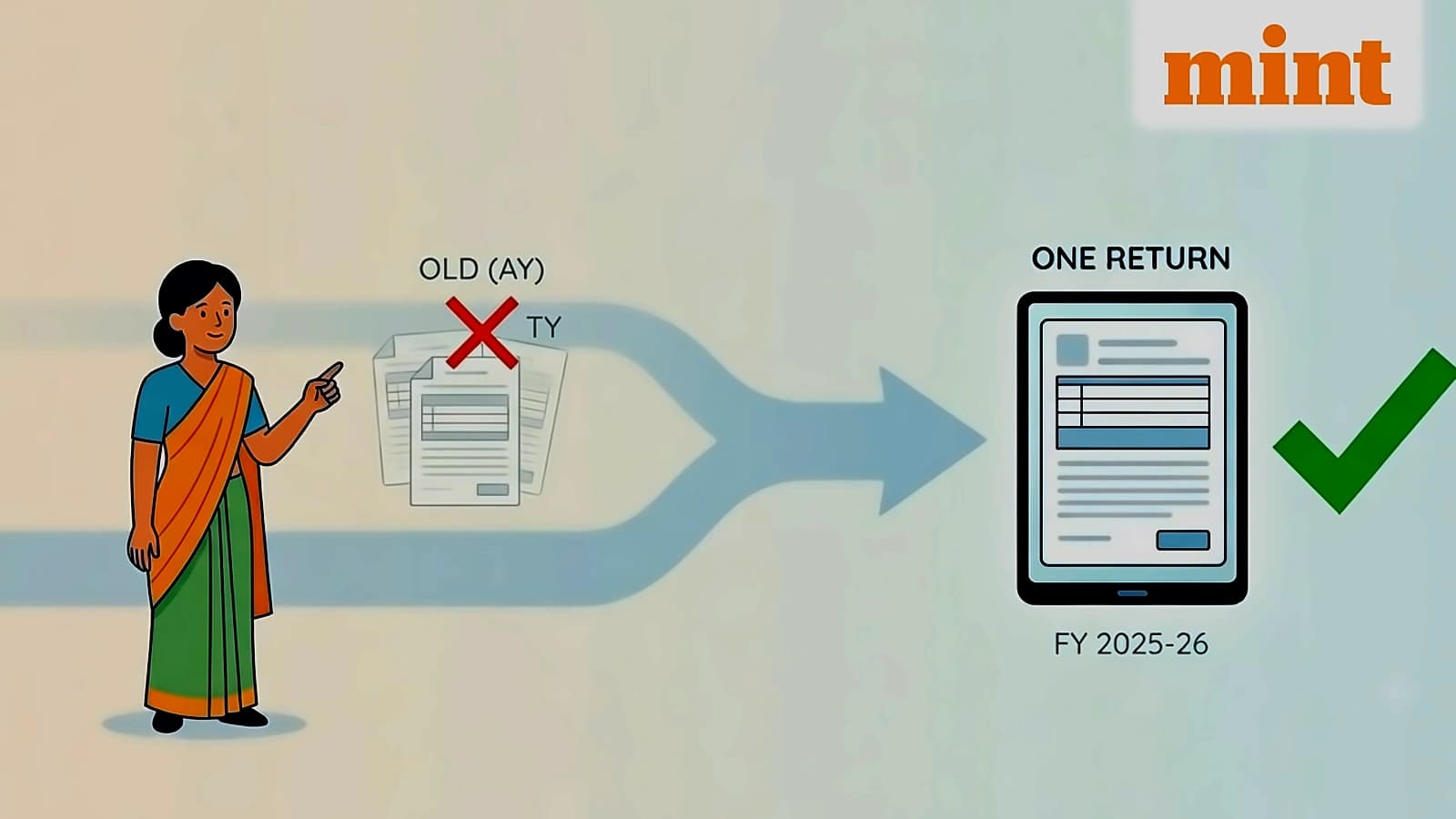
The Income Tax Department has clarified that taxpayers will not need to file two income tax returns for the same income during the transition year. According to reports from Mint, the department stated that the obligation to file a return for Tax Year 2026-27 will arise only after the end of that tax year. This means taxpayers earning income between 1 April 2025 and 31 March 2026 will file only one return under Assessment Year 2026-27. As taxpayers gear up for ITR filing in AY 2026-27, understanding the consolidated Form 168 (formerly AIS and Form 26AS) is crucial, offering a comprehensive view of financial footprint detailing income sources, investments, and tax credits. As reported by The Economic Times, reviewing this unified document meticulously against your records helps ensure accurate reporting, prevent mismatches, and avoid potential tax notices.
Another key clarification addresses which law governs income earned during FY 2025-26. As reported by Mint, the Income Tax Department confirmed that income earned between 1 April 2025 and 31 March 2026 will be filed for Assessment Year 2026-27 under the provisions of the Income-tax Act, 1961. This remains the case even though the return is filed after 1 April 2026, when the new law has already come into force. The department explained that since the return relates to a tax period that began before the commencement of the Income-tax Act, 2025, it continues to be governed by the earlier law. Despite recent flat equity returns and rupee depreciation, India's long-term growth story remains robust, according to Sanctum Wealth's Shiv Gupta, who advises NRIs to maintain their India allocation.
The Income-tax Act, 2025 introduces significant changes to the tax framework by replacing the concepts of 'Previous Year' and 'Assessment Year' with a single concept called 'Tax Year'. According to Mint, the department explained that this change aims to simplify the framework by introducing Tax Year as the reference period for income, which generally means a 12-month period beginning on 1 April and ending on 31 March. The new system eliminates the confusion caused by the old system where income was earned in one year and assessed in the following year. Stock market traders, especially those involved in intraday and F&O trading without a registered business, need to understand tax audit rules, as income from these activities is typically classified as speculative business income.
The first return under the Tax Year framework will be filed only after 31 March 2027, subject to applicable due dates. As reported by Mint, the department noted that while taxpayers are filing returns for AY 2026-27 under the Income-tax Act, 1961, advance tax obligations for income earned from 1 April 2026 onwards are already being governed by the provisions of the Income-tax Act, 2025. The transition timeline shows 1 April 2025 – 31 March 2026 as AY 2026-27, and 1 April 2026 – 31 March 2027 as Tax Year 2026-27. Turnover calculation, based on the aggregate of positive and negative differences, determines audit applicability, generally requiring an audit if it exceeds ₹10 crore for banking channel transactions. As reported by The Economic Times, July marks crucial income tax deadlines for Indian taxpayers, with the major deadline being July 31 for salaried individuals and pensioners to file their Income Tax Returns.