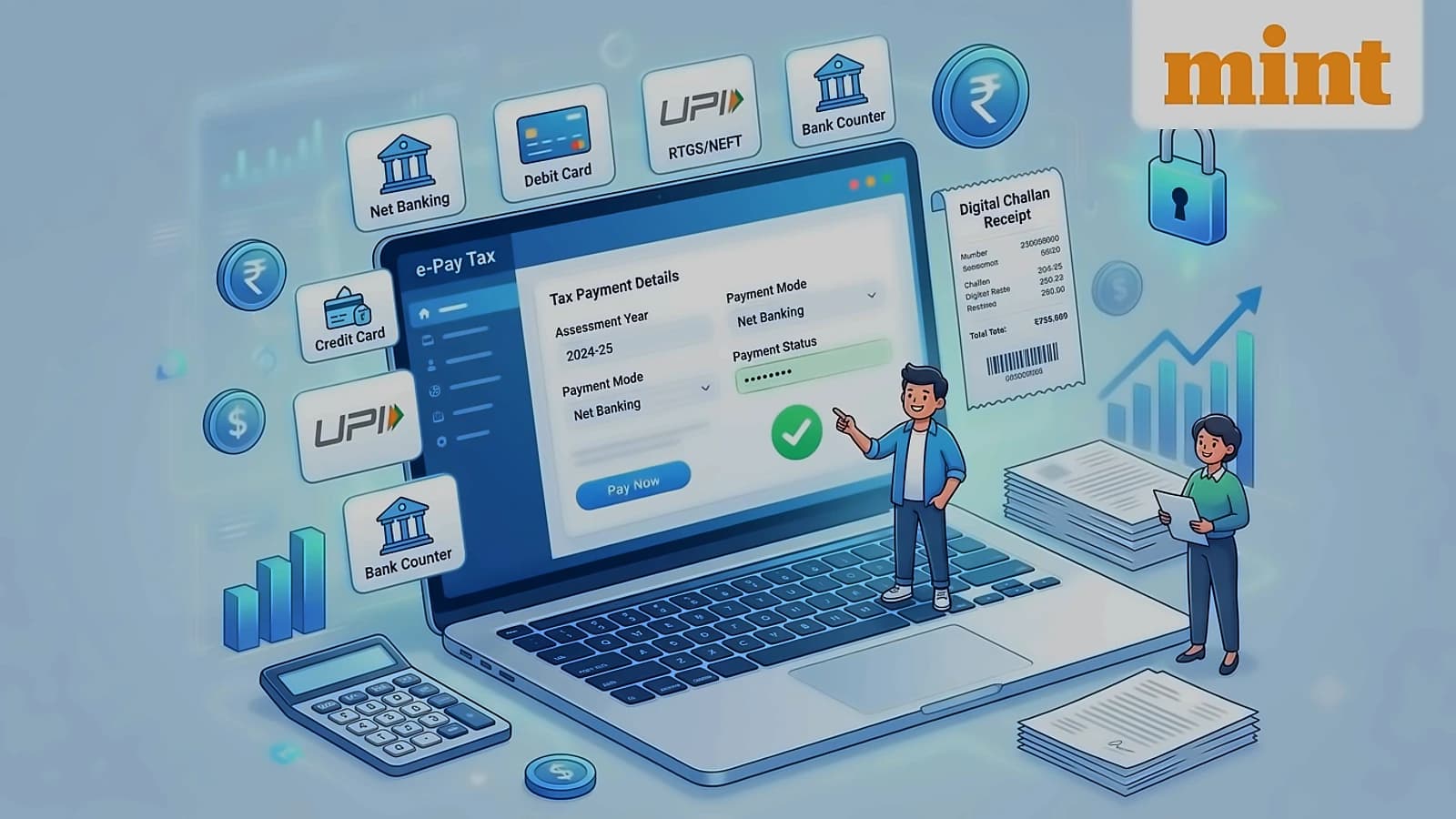
The income tax department allows taxpayers to use credit cards for paying income taxes through the official e-filing portal. According to reports from Mint, taxpayers can clear certain income tax liabilities, including advance tax, self-assessment tax and outstanding demand, through the official income tax e-pay facility using authorized payment gateways that support credit card transactions. The facility is available online and works in a manner similar to other digital payment methods, with taxpayers able to pay taxes through debit cards, net banking and UPI in addition to credit cards.
The e-pay tax service is an online payment system that enables taxpayers to pay direct taxes electronically through the income tax department's e-filing portal. As reported by Mint, taxpayers can access this facility in both pre-login and post-login modes. For post-login payments, users must click e-file > e-pay tax from the dashboard, select the applicable tax payment tile, enter tax breakup amounts, and choose credit card as the preferred mode of payment. Pre-login users can make payments by verifying their PAN or TAN through OTP sent to their registered mobile number.
Banks and payment gateways may levy convenience or processing charges for tax payments made via credit cards, typically ranging between 0.85% to 1.25% of the tax amount, according to a HDFC Bank report cited by Mint. However, recent data shows more specific charges across different banks, with HDFC Bank charging around 0.72% for HDFC credit cards and 0.80% for other bank credit cards, Federal Bank around 0.85%, ICICI Bank around 0.85% for retail credit cards, and Bank of Maharashtra around 1%. Additionally, payment gateways generally charge convenience fees along with applicable GST, though some credit card issuers offer reward points, cashback or other benefits on tax payments made through credit cards, with users potentially receiving rewards equivalent to 2% to 3% of the transaction value depending on card terms and conditions.
A common misconception is that interest begins accruing as soon as a tax payment is made, but in reality, interest applies only if the full outstanding is not paid by the original due date. As reported by Mint, most credit cards offer an interest-free period of around 45-55 days, which can help individuals manage short-term cash flow without incurring finance charges. Interest is charged only if the outstanding amount is carried forward beyond the due date or if less than the full payment is made. Taxpayers should note that interest can significantly increase the overall cost if outstanding credit card bills are not cleared on time.
Paying income tax through the official Income Tax Department's e-filing portal is considered safe, as transactions are processed through authorized payment gateways. Taxpayers should avoid making payments through unofficial links or third-party websites and should always download the payment receipt after the transaction is completed. After a successful payment, a Challan Identification Number (CIN) will be generated and should be saved for records. This option can be particularly useful for taxpayers who are short of immediate cash and need to clear outstanding tax dues before the ITR filing deadline.