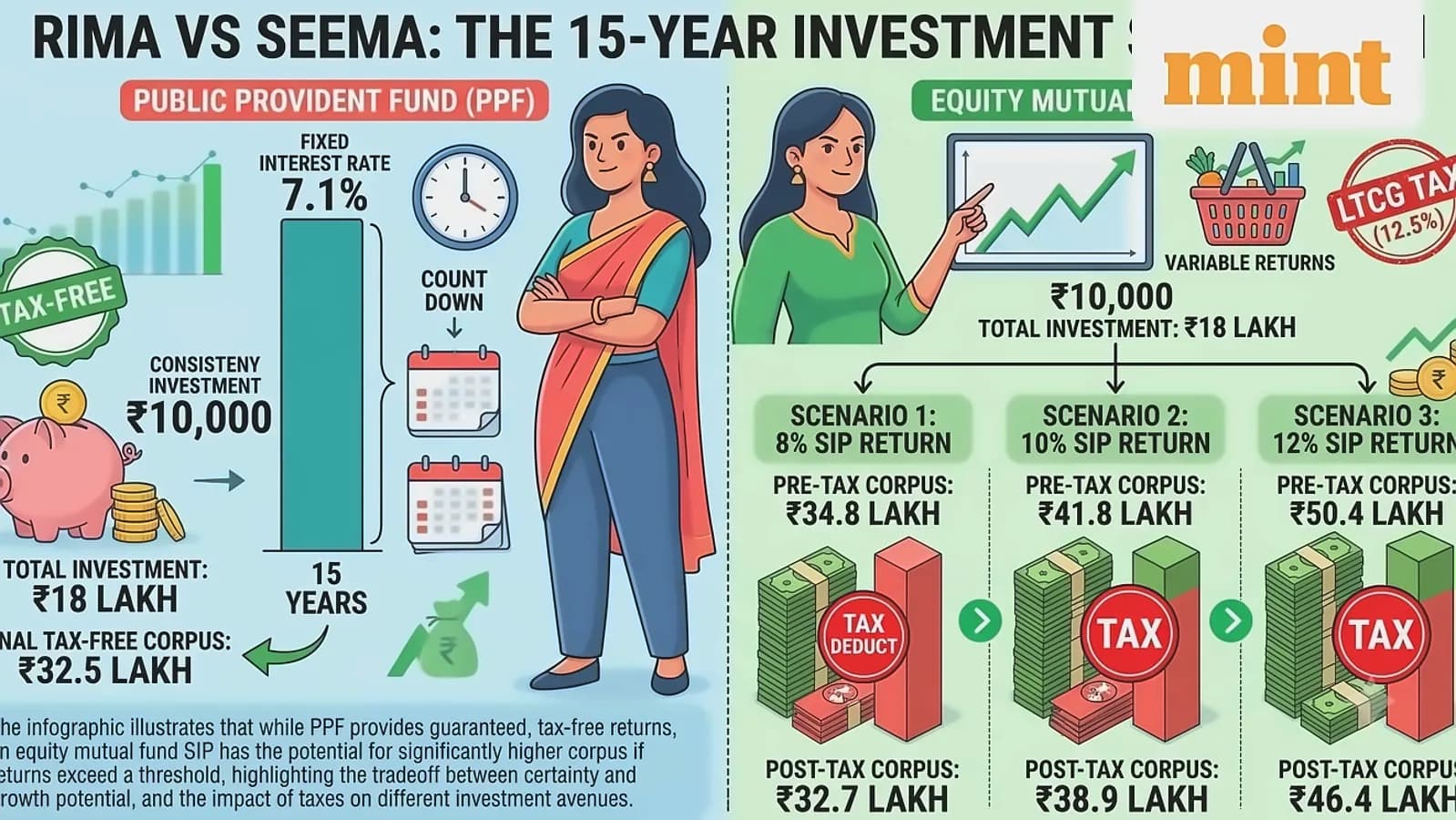
While Systematic Investment Plan (SIP) and Public Provident Fund (PPF) both require constant investments to aggregate money, their fundamental mechanisms differ significantly. According to reports from Zee News, SIP invests money in mutual funds that pool assets, while PPF is a government-backed savings scheme with tax benefits, guaranteed returns, and a 15-year lock-in period. The interest rates for PPF are decided by the government, offering stability without market volatility, whereas SIP investments are linked to market movements and carry associated risks.
PPF accounts require contributions ranging from ₹500 to ₹1.5 lakh annually, which can be made either in lump sum or installments. As reported by Zee News, the current PPF interest rate stands at 7.1 percent, while SIPs typically offer approximately 12 percent returns annually when considering 1 percent monthly interest rates. However, PPF has a maximum annual investment limit of ₹1.5 lakh, meaning monthly contributions cannot exceed ₹12,500, which may be insufficient for investors with higher monthly investment amounts.
According to the analysis from Zee News, when comparing SIP and PPF with the same investment amount and tenure at current rates, SIP would yield higher returns. However, this advantage is not guaranteed due to market volatility, as poor market performance can reduce returns. SIP benefits from compounding principles but may offer lower returns if the investment ends during a market downturn. PPF, on the other hand, provides guaranteed returns tied to government-decided rates with no associated market risks. Recent calculations show that for ₹10,000 monthly investments over 20 years, SIP would yield approximately ₹26.08 lakh compared to PPF's ₹16.09 lakh, though SIP carries market risk while PPF remains completely safe.

As reported by Zee News, the choice between SIP and PPF depends more on risk appetite than investment amount or duration. PPF offers stability with no associated risks, making it suitable for investors preferring certainty over high returns. SIP requires emotional resilience to handle market volatility and may be more appropriate for those seeking growth potential. The analysis emphasizes that inflation and taxes can impact actual returns, with equity funds potentially generating higher returns after accounting for these factors. Recent analysis suggests that for money intended for 5+ years with growth potential, Equity Mutual Fund is preferred, while for safe, tax-free base money not needed for 15 years, PPF is the better choice.
According to the report from Zee News, SIP and PPF are not competing tools but complementary elements for achieving financial goals based on individual circumstances. SIP provides growth potential while PPF ensures stability, with each serving different investment objectives. Recent calculations support this approach, showing that using both instruments together - one for growth and one for safety/tax-efficiency - usually beats an either/or choice. The analysis suggests that investors should consider their financial standing, goals, and targeted duration when deciding between these investment instruments, rather than viewing them as competing options.