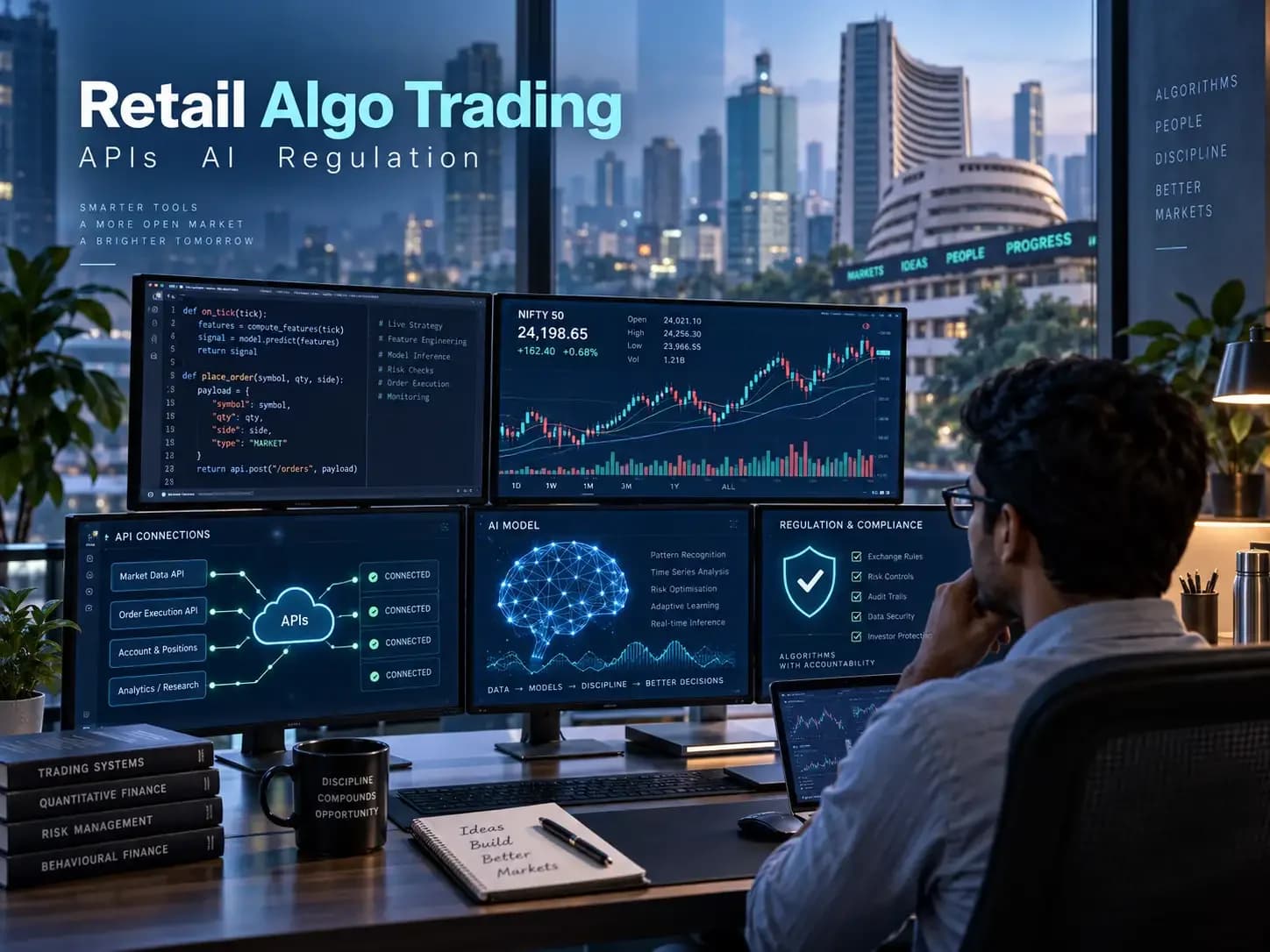
The Securities and Exchange Board of India's (Sebi's) revised framework for safer participation of retail traders in algorithmic trading has been in place since April 2026. According to recent media reports, major brokers are preparing to roll out algorithmic tools for retail traders over the next few months, with retail clients potentially able to access some of these strategies for as little as ₹5,000. Traders planning to use such tools should carry out comprehensive due diligence before opting for an algo offered by a broker or vendor.
Traders should avoid placing too much reliance on algos that are only one or two months old, according to industry experts. Ramakrishnan Selvaraj, co-founder of catbots.tech, recommends that algos should have at least one year of back-test data and at least two months of live trading data. As reported by Business Standard, Rajesh Ganesh, CEO and founder of TripleInt Trading Systems, warns that a back-test may show a 10-20% drawdown, but if live trading shows much higher drawdowns, that should be treated as a red flag. Live-trading results should broadly match back-test results, with Chintan Singh Jaggi, co-founder of AlgoTest, recommending live performance results for at least six months to one year for additional comfort.
Traders should examine the market conditions in which the algo was back-tested, as reported by Business Standard. Ganesh explains that an algo that performs well in a bull market may not perform as well in a bear or sideways market. The performance assessment should cover different market conditions, with the algo not losing too much capital during a prolonged bear market. Abhishek Kumar, Sebi-registered investment adviser and founder of SahajMoney.com, emphasizes that traders should examine whether the strategy has been tested across multiple market cycles—bull, bear and sideways markets to ensure returns are not based on over-optimized, small, or short-term data samples. Traders should also account for outlier trades - a one-off large winning trade can distort an algo's performance record, and a black-swan event may make one trade unusually profitable.
Traders should know whether the returns shown are net of all expenses, especially the algo provider's fees, according to industry experts. As reported by Business Standard, what matters is not the gross return but the return that finally comes into the trader's account after all costs have been deducted. Ganesh warns that many traders get attracted to algos that claim high success rates, but a system with a 99% success rate can still lose money - if an algo earns only ₹1 on each winning trade and loses ₹100 on one losing trade, the net result can still be negative. Chintan Singh Jaggi, co-founder of AlgoTest, recommends checking the number of trades, win rate, average profit per trade, average loss per trade, worst day, best day and monthly consistency. Traders should also check the peak drawdown, or the maximum money the algo loses from peak to trough, with Ganesh noting that drawdown should be limited to 20% or less - anything above that level becomes uncomfortable for retail investors.
Buyers should check the algo vendor's reputation before subscribing, as reported by Business Standard. They should also examine the vendor's execution capability, with user comments on social media helping identify execution-related problems. Ganesh emphasizes that once an order is placed, it should get executed without issues. White-box algos allow users to know the logic behind trade entry and exit signals, but their main drawback is that their logic can become widely known and vulnerable to market participants. Black-box algos retain uniqueness and protect intellectual property, but the key risk is the provider's accountability. Chintan Singh Jaggi, co-founder of AlgoTest, explains that traders should understand the basic logic of the strategy - whether it's trend-following, mean-reversion, option-selling or option-buying, intraday, positional, hedged or unhedged. They should also check its trading frequency, as high-frequency trading can raise expenses significantly.