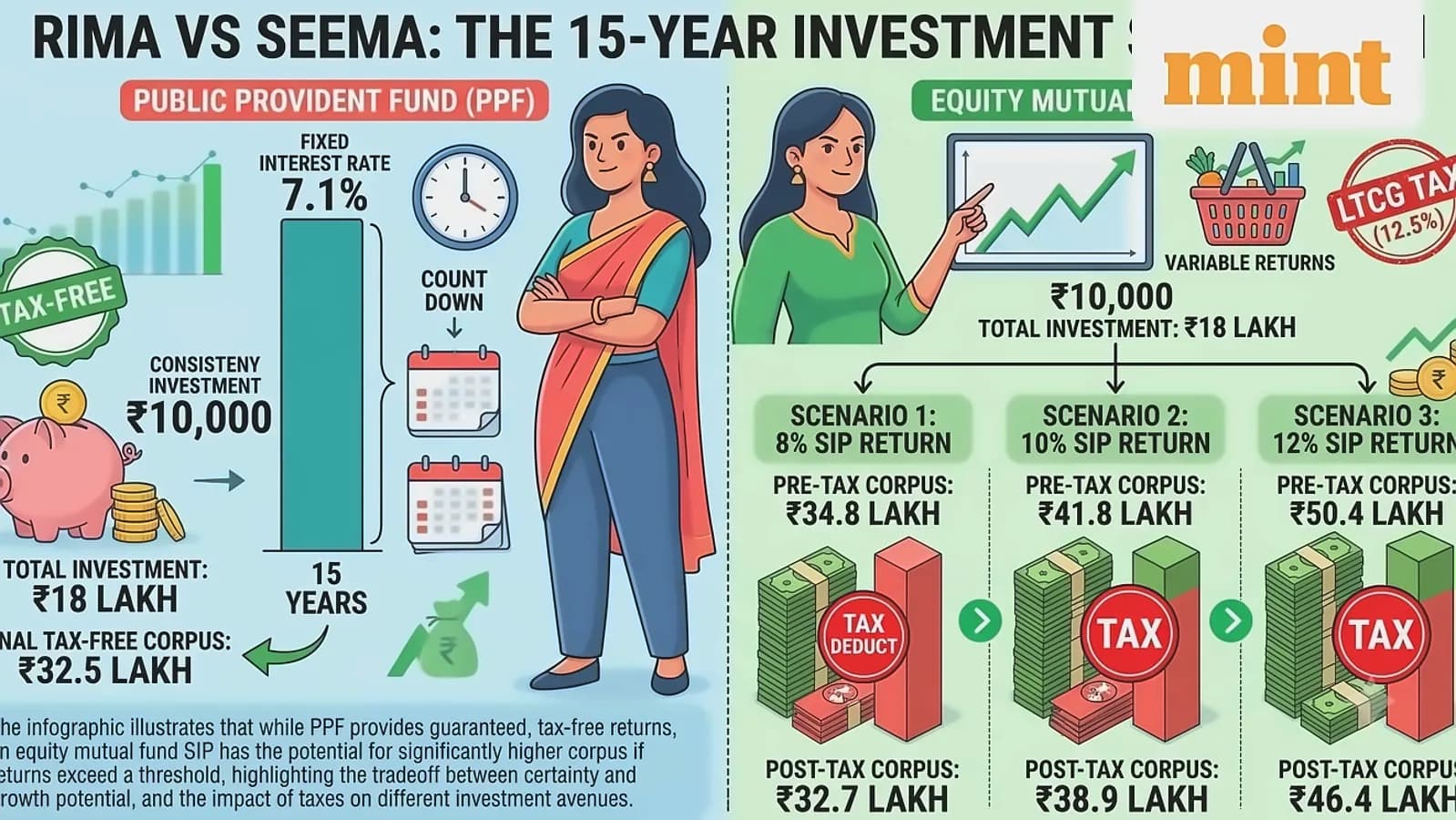
A ₹3,000 monthly investment in PPF versus SIP presents starkly different outcomes over 15 years. While PPF offers guaranteed returns at 7.1% annual interest rate with a total investment of ₹5.40 lakh, SIP investments in equity mutual funds deliver significantly higher returns. The SIP investment generates ₹9.73 lakh in estimated returns compared to PPF's ₹5.40 lakh, demonstrating the power of market-linked investments over time. The higher return potential of equity mutual funds allows SIP investors to benefit from compounding and long-term market growth, with 12% average annualized returns turning the ₹5.4 lakh investment into a corpus where nearly 64% is pure profit. SIP investments require no large capital outlay - starting as low as ₹500 monthly and scaling up as income grows, making them accessible to salaried employees building wealth systematically.
A ₹10,000 monthly investment in a public provident fund (PPF) account can generate substantial returns over time, according to reports from Mint. For a 40-year investment starting at age 20, the total investment of ₹48 lakh earns interest of ₹2.15 crore, resulting in a total maturity payout of over ₹2.63 crore at age 60. Starting at age 25, the same monthly investment for 35 years yields ₹1.39 crore in interest with a total maturity payout of over ₹1.81 crore at age 60. The returns vary significantly based on the starting age, with earlier investments providing higher compounding benefits. PPF offers the advantage of guaranteed returns at a fixed interest rate of 7.1% reviewed quarterly, with the account having a tenure of 20 years including a lock-in period of 15 years.
The ₹3,000 monthly SIP investment at 12% annual returns demonstrates superior wealth creation potential over 15 years. Monthly SIP performance shows consistent growth with ₹1.08 lakh at year 3, ₹2.16 lakh at year 6, ₹3.24 lakh at year 9, ₹4.32 lakh at year 12, and reaching ₹5.40 lakh at year 15. The total investment value of ₹5.40 lakh grows to ₹15.13 lakh through systematic investing, significantly outperforming PPF's ₹5.40 lakh maturity. SIP investments benefit from rupee cost averaging, where monthly investments purchase more units during market downturns and gain value during market upturns, maximizing long-term returns. The Step-Up SIP strategy can significantly enhance returns by increasing monthly investments by 10% annually, potentially doubling the final corpus compared to regular fixed SIPs over 20 years.
The public provident fund offers several attractive features for long-term investors, according to Mint reports. The account has a tenure of 20 years including a lock-in period of 15 years, with indefinitely renewable extensions in five-year blocks. It provides guaranteed returns at a fixed interest rate of 7.1% this quarter, which is reviewed each quarter. The PPF is classified as an EEE instrument where investment, maturity amount, and interest earned are all exempt from taxes. Under the old tax regime, ₹1.5 lakh annual contribution is exempt under Section 80C of the Income-Tax Act, with no similar benefit available under the new tax regime. Unlike mutual funds, PPF provides complete liquidity and no lock-in periods, making it suitable for investors who require access to funds during the investment period.
The timing of PPF investments significantly affects returns, as reported by Mint. Interest is calculated monthly on the minimum balance between the 5th and end of the month, with annual transfers on March 31st. Missing the deposit deadline before April 5th results in losing one full month of interest, with the impact compounding over time. For a ₹1.5 lakh annual investment at 7.1% interest rate, missing the April 5th deadline reduces cumulative interest from ₹18.18 lakh to ₹17.95 lakh, representing a loss of ₹23,188. SIP investments during market volatility actually work in the investor's favor, as fixed monthly investments buy more units at lower prices during market corrections. Historical data shows that investors who continued SIPs through the 2008 crash, 2020 COVID fall, and 2022 correction recovered quickly and earned strong returns, demonstrating that bear markets are the SIP investor's best friend.