The NPS Vatsalya Scheme, launched on September 18, 2024, allows parents to open and operate a pension account for their minor child until they reach majority age. According to reports from Mint and Zee News, the scheme is regulated and administered by the Pension Fund Regulatory and Development Authority (PFRDA) under Sections 12(1)(a) and 20 of the Pension Fund Regulatory and Development Authority Act, 2013. The child retains sole beneficiary status, and the account can be converted to a standard NPS account after they reach 18 years of age. All tax benefits applicable to NPS accounts also apply to NPS Vatsalya accounts. Indian citizens below 18 years of age, including Non-Resident Indians (NRIs) and Overseas Citizens of India (OCIs), are eligible for the scheme, making it gender-neutral for both girls and boys.
The scheme requires a minimum annual contribution of ₹250 at account opening, with no maximum cap on contributions. As reported by Zee News, contributions can be made any number of times in a financial year, and parents, relatives and friends can also contribute through registered Points of Presence (PoPs) or online through mobile apps, UPI apps or the eNPS portal. Tax benefits are available for combined contributions up to ₹2 lakh for the parent or guardian, including ₹1.5 lakh under Section 80CCD(1B) of the Income Tax Act and ₹50,000 as additional deduction. Parents can choose from three investment options: the Default Choice (Moderate Lifecycle Fund - LC-50 with 50% equity), Auto Choice (Aggressive Lifecycle Fund - LC-75 with 75% equity), or Active Choice where parents can actively allocate funds across equity (up to 100%), government securities (up to 20%), debt (up to 30%), and money market instruments (up to 10%).
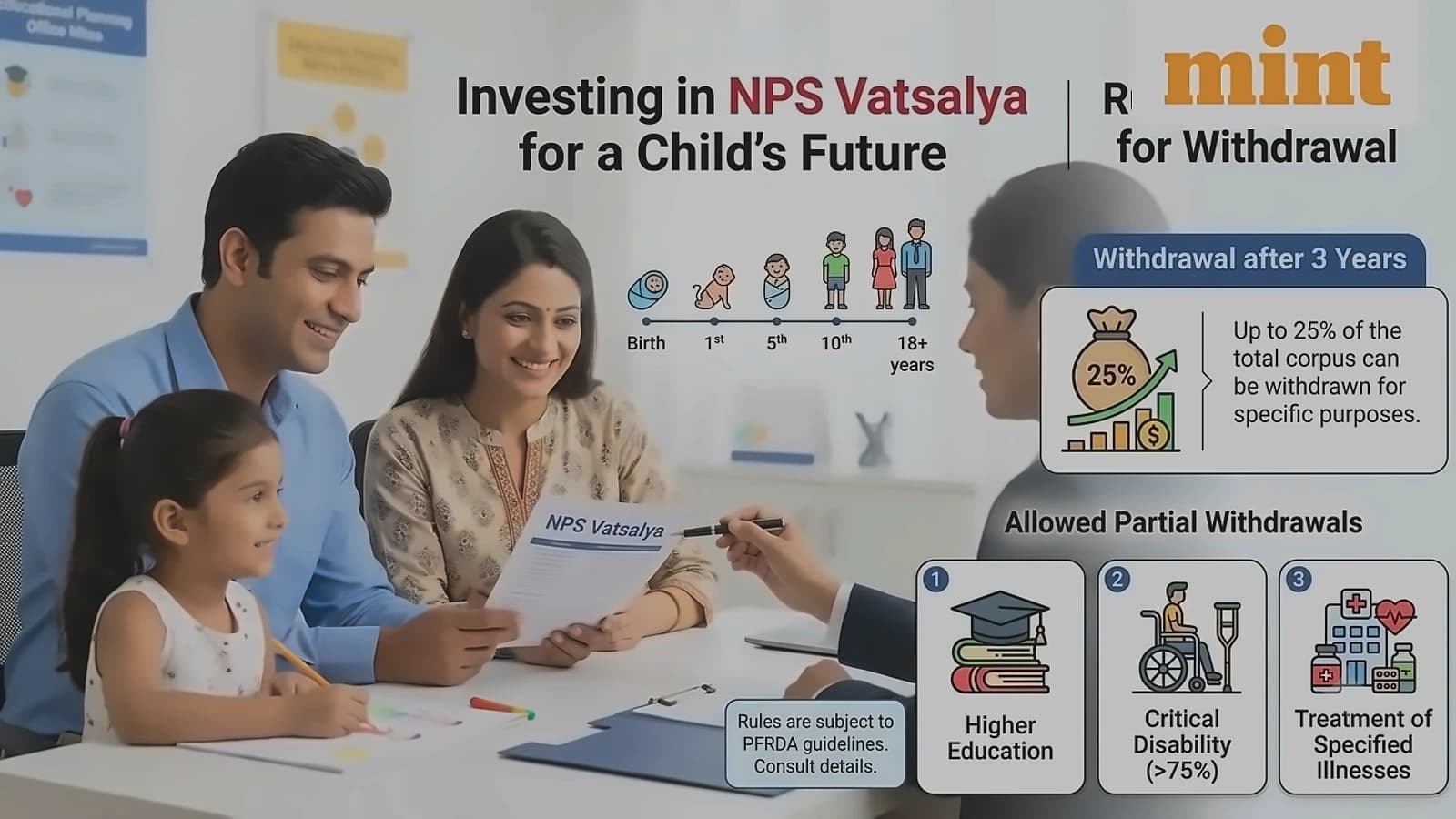
According to Zee News and Mint reports, parents or guardians can withdraw up to 25% of the contributed amount after three years since joining the scheme. This option can be availed only thrice until the beneficiary turns 18 years old. Additional partial withdrawal options include education expenses, medical treatment, disability payments (over 75%), and health treatment for specified illnesses. To initiate a partial withdrawal, parents can submit a request digitally through their Central Recordkeeping Agency (CRA) portal. Until the subscriber turns 18, a maximum of two such partial withdrawals can be made. After attaining 18 years, two additional withdrawals can be made until the age of 21, with mandatory KYC completion required for withdrawal eligibility.
As reported by Zee News, when the child turns 18, they can choose to exit the scheme or convert it to a regular NPS account. This requires KYC completion within three months of turning 18, leading to full transfer of the corpus into the new account. Upon exit, at least 80% of the accumulated corpus must be used to purchase an annuity, with the remaining balance provided as a lump sum. However, if the accumulated corpus is ₹8 lakh or more, 20% must be used to buy an annuity, and the remaining 80% can be taken as a lump sum. If the total amount falls below ₹8 lakh, the entire corpus can be withdrawn as a lump sum. The beneficiary may also choose to shift the entire corpus to the All Citizen Model or any other applicable model of NPS. The account shifts automatically to the higher-equity scheme under the Multiple Schemes Framework if no conversion steps are taken.
According to Zee News and Mint reports, in case of the child's death, the entire corpus will be returned to the parents or legal guardians, with no tax deduction. If the parent or guardian dies, the other responsible party must be registered with fresh KYC. In case of death of both parents, a legal guardian can continue the scheme without contributions until the child attains majority. The scheme requires birth certificate of the minor, school leaving certificate/matriculation, passport of minor, and PAN card for account opening. For NRIs and OCIs, a bank account is required even as the scheme begins, whereas the beneficiary is not required to have a bank account at the onset of the scheme.