On 15 May 2026, the Pension Fund Regulatory and Development Authority (PFRDA) introduced Retirement Income Schemes (RIS) for NPS subscribers. According to reports from Mint, the scheme allows NPS subscribers to receive regular payouts from the designated portion of their corpus that is available for phased withdrawals. The RIS is available to both government and non-government NPS subscribers who wish to receive regular payouts from their designated pension corpus, up to the age of 85 years. Recent PFRDA changes have modified several exit provisions for the All Citizen Model, with the entry and exit age increased to 85 years, and the earlier five-year minimum subscription lock-in removed for applicable Common Scheme and Multiple Scheme Framework.
Under NPS exit rules, a specified portion of 20% or 40% of the corpus must be used to purchase an annuity, while the remaining portion can be used according to withdrawal rules. As reported by Mint, the RIS provides subscribers with two sources of retirement income: the annuity (pension) income from the mandatory portion and regular RIS payouts from the designated remaining portion. The RIS payouts can be received monthly, quarterly, or annually, with the amount depending on the available corpus, payout option, and corpus value when payouts are calculated. Under the current All Citizen Model framework, normal exit after the applicable vesting period or age condition can allow a subscriber to withdraw up to 80% as lump sum, with at least 20% used for annuity, subject to applicable conditions and corpus thresholds.
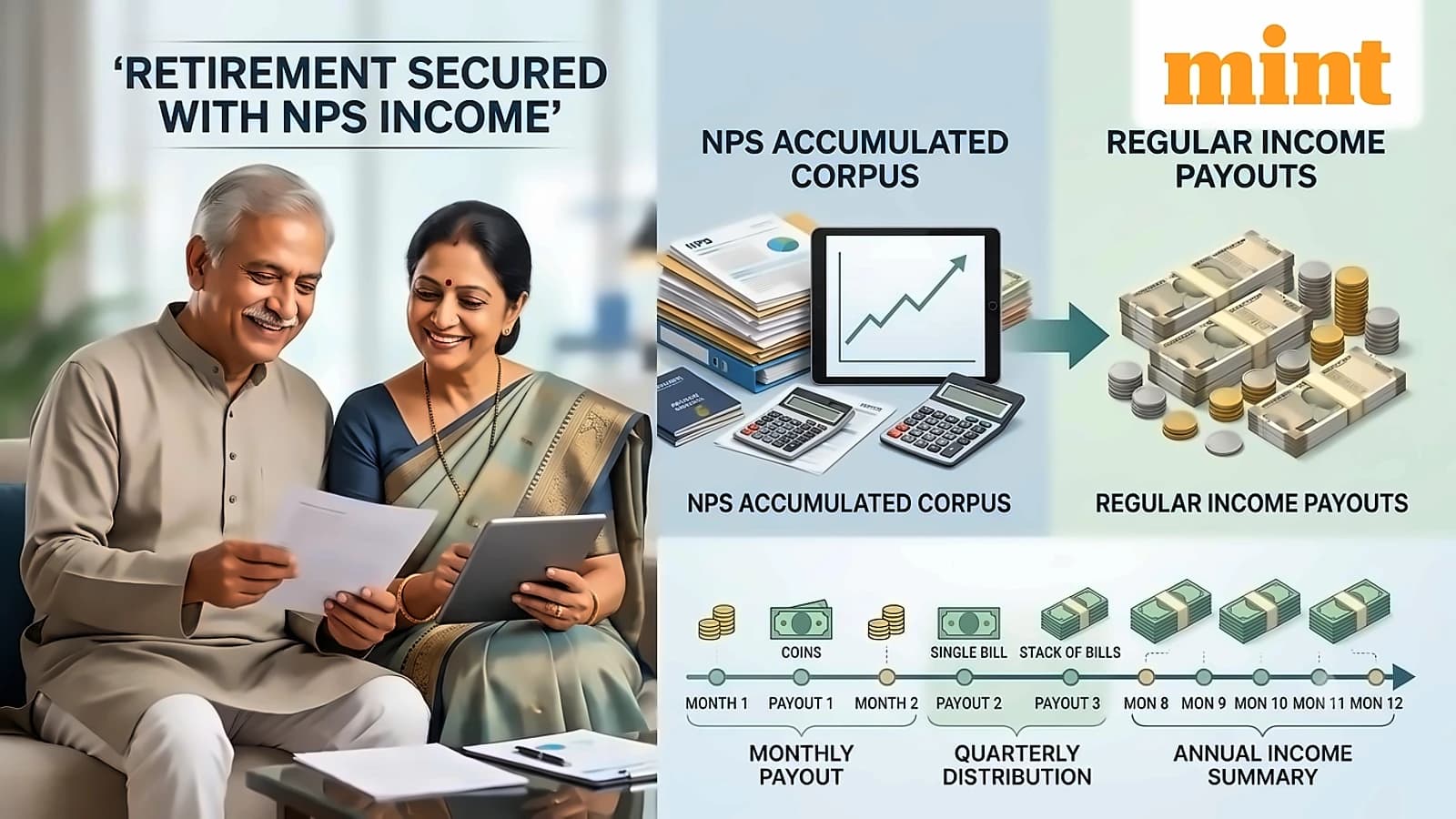
Under RIS, the designated NPS corpus continues to be invested while subscribers receive periodic payouts. According to Mint, the scheme follows a life-cycle investment approach, where asset allocation changes as the subscriber ages. The RIS Steady variant follows an age-based investment approach, with 35% in equity, 10% in corporate debt, and 55% in government securities at age 60. The equity allocation gradually decreases to 25% at 65, 15% at 70, and 10% from age 75 onwards, while debt and government securities allocation increases correspondingly. The NPS framework also provides special provisions for smaller corpus amounts, with up to ₹12 lakh corpus allowing additional withdrawal options depending on the exact amount.
The RIS does not replace the existing mandatory annuity requirement, as the required 20% or 40% portion must still be used for annuity purchase. As reported by Mint, there is no fixed pension amount under RIS, with the amount received depending on corpus availability, payout option, and corpus value calculation. The scheme's objective is to help retirees manage post-retirement cash flow while keeping the remaining corpus invested during the payout period, providing flexibility in retirement income management. Premature exit rules under the current All Citizen Model state that up to 20% of the corpus can be taken as lump sum, while at least 80% must be used to purchase an annuity, subject to applicable provisions. For smaller corpus amounts up to ₹5 lakh, complete withdrawal or approved payout options are permitted.