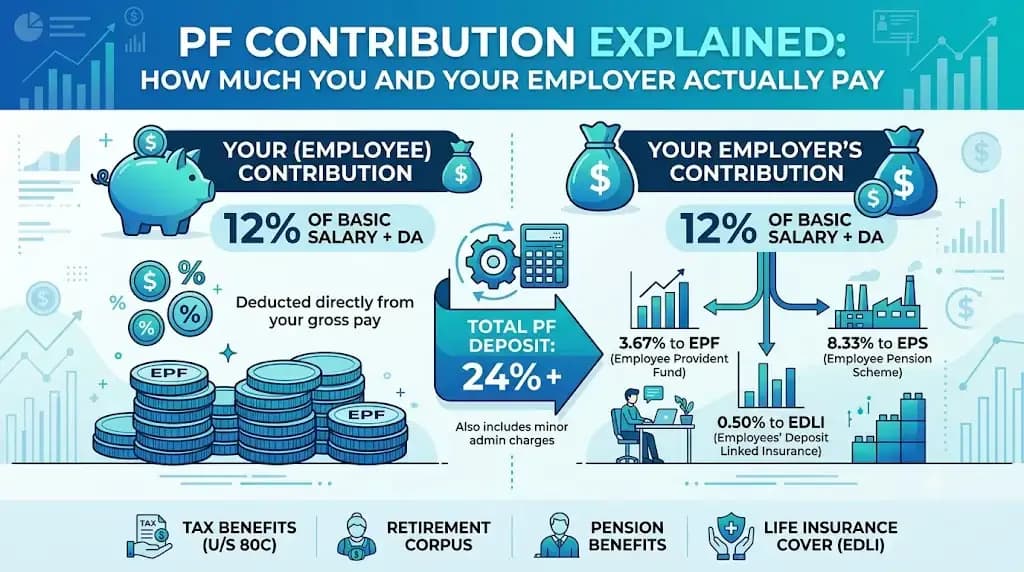
Employees expecting larger monthly salaries after annual appraisals could experience changes in their salary breakup depending on how companies structure compensation, according to financial experts speaking on Zee Business. Pankaj Mathpal, Managing Director of Optima Money, explained that concerns around in-hand salary are understandable, but outcomes would depend on how employers design salary packages. He noted that if the basic salary component forms a larger share of total compensation, Provident Fund (PF) contributions can increase because both employee and employer contributions are linked to basic pay, which could potentially reduce monthly take-home salary in some cases due to higher deductions. However, Mathpal added that companies may also absorb part of the impact through salary revisions so that employees do not necessarily see a significant fall in in-hand income.
Vishwajeet Parashar, mutual fund expert, explained that many companies have traditionally kept the basic salary component lower while increasing allowances, which reduced mandatory contributions such as PF. According to Parashar, in many salary structures, basic pay often accounted for around 20-30 per cent of total compensation, while the remaining amount came through allowances such as HRA and special allowances. Using an example, he said that if an employee earning ₹1 lakh earlier had a lower basic salary component, a higher basic pay structure could increase PF deductions. If companies move toward structures where basic salary forms a larger portion of total compensation, PF contributions for both employers and employees could increase significantly.
The Wage Code consolidates four earlier statutes - the Minimum Wages Act 1948, the Payment of Wages Act 1936, the Payment of Bonus Act 1965, and the Equal Remuneration Act 1976. Section 2(y) of the Wage Code defines 'wages' to include basic pay, dearness allowance, and retaining allowance. If other allowances such as HRA, conveyance, special allowances, food coupons, mobile recharge, and similar items together exceed 50% of total remuneration, the excess is deemed wages. The practical effect is that excluded components of remuneration cannot exceed 50% of total remuneration for wage computation, thus the wage base for statutory benefits would be at a minimum of 50% of entire remuneration. This directly increases the base on which PF, ESI, gratuity, bonus, and overtime are calculated, materially raising the statutory employment cost for manufacturers.

Despite short-term pressure on take-home salary, experts emphasized that higher contributions may strengthen long-term financial security. Mathpal stressed that higher contributions can eventually create a larger retirement corpus, suggesting that immediate take-home income and long-term savings need to be viewed together. According to Parashar, this may create short-term pressure on take-home salary in some cases but could also strengthen retirement benefits through larger PF accumulation and higher gratuity calculations over time. The broader objective discussed was greater social security through stronger retirement savings.
Experts stressed that employees should not confuse Cost to Company (CTC) with the amount credited to their bank accounts each month. Mathpal explained that CTC can include several costs and benefits beyond direct salary payments, including employer PF contribution, health insurance premiums, meal vouchers and other benefits. "CTC reflects the company's total cost and does not necessarily mean that the full amount comes as take-home salary," he said. Parashar added that annual bonuses, incentives and performance-linked benefits can also make compensation packages appear larger than the actual monthly payout, emphasizing that employees should focus on understanding the salary breakup and what ultimately reaches their account.