A mutual fund operates by pooling money from multiple investors and investing it in assets such as equities, bonds, government securities, gold, or other permitted instruments according to a stated investment objective. The fund is managed by professional fund managers, while investors receive units representing their share in the fund. The value of these units changes depending on the value of the underlying investments, which is reflected through the fund's Net Asset Value (NAV). According to reports from Dalal Street Investment Journal, mutual funds are not a single type of investment but come in different categories designed for different investor requirements.
Equity funds primarily invest in company shares and generally carry higher market risk compared with debt-oriented funds. Large-cap funds primarily invest in large companies that are generally more established, while mid-cap funds invest in medium-sized companies offering higher growth potential but experiencing greater volatility. Small-cap funds invest in smaller companies that can benefit from strong growth in successful businesses but generally carry higher risk. Multi-cap funds invest across large-cap, mid-cap and small-cap companies, while flexi-cap funds give the fund manager flexibility to move across market capitalisation segments.
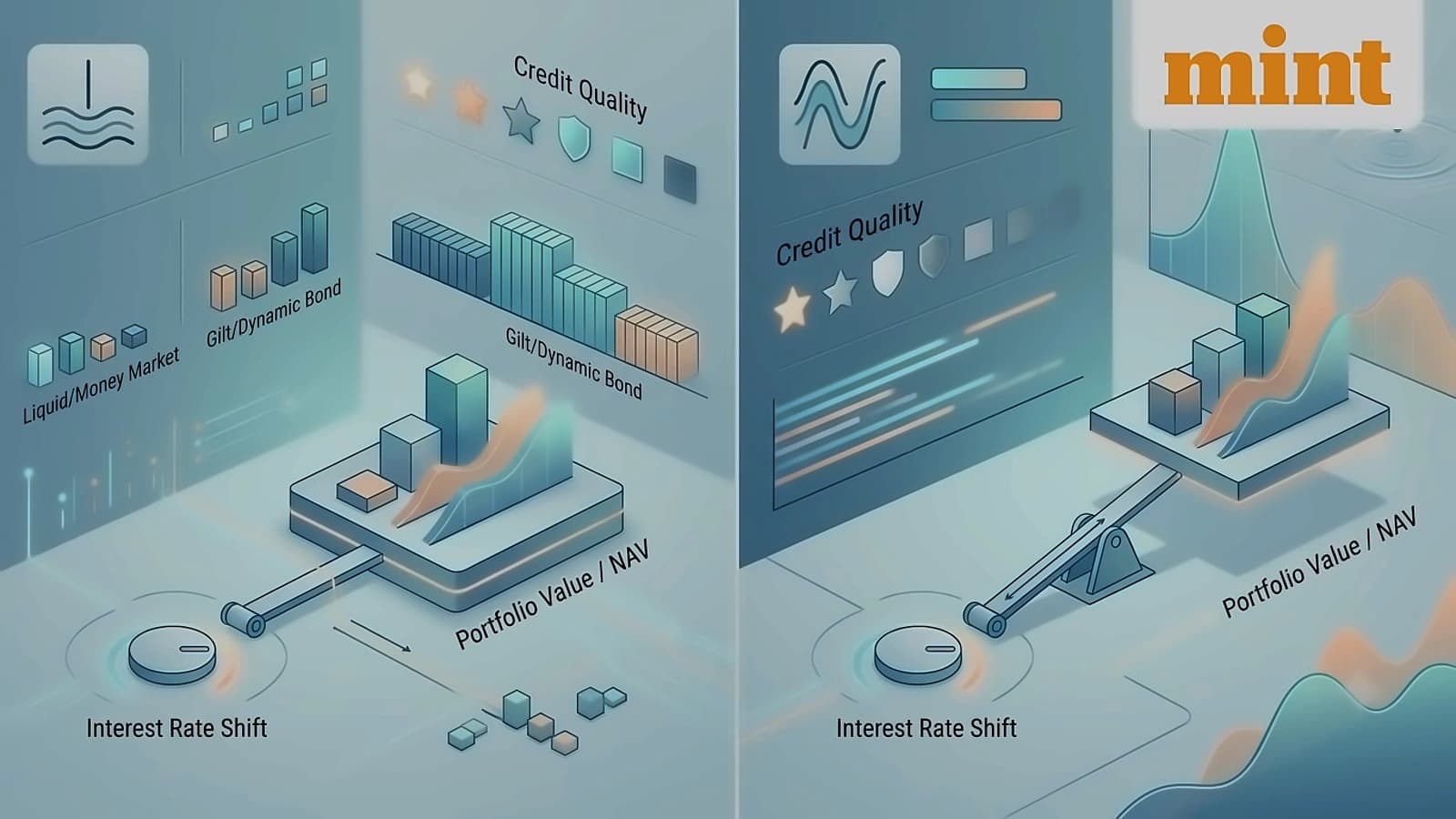
Debt funds invest primarily in fixed-income instruments such as government securities, corporate bonds, treasury bills and other money-market instruments. These funds are generally used by investors looking for relatively more predictable income and lower equity-market exposure. However, as reported by Dalal Street Investment Journal, debt funds are not completely risk-free, as interest-rate movements can affect bond prices, while lower-rated securities can carry credit risk. According to Mint, Devang Shah of Axis Mutual Fund emphasizes that different segments of the debt market carry different risks, including interest-rate (duration) risk, credit risk, liquidity risk and reinvestment risk. With bond yields around 7.5%, investors are looking at fixed income more closely, but higher yields do not automatically translate into higher or guaranteed returns.

Hybrid funds combine different asset classes, mainly equities and debt, to create a portfolio that balances growth potential with relatively lower risk compared with a pure equity portfolio. Index funds aim to replicate the performance of a particular market index rather than trying to outperform it through active stock selection, such as an index fund tracking the Nifty 50. Exchange-Traded Funds (ETFs) are funds that trade on stock exchanges like shares, tracking equity indices, bond indices, commodities or other underlying assets. Solution-oriented funds are designed around specific long-term financial objectives, including retirement planning and children's financial needs, while sectoral and thematic funds concentrate investments in particular sectors or themes.
According to Dalal Street Investment Journal, choosing a mutual fund should not be based solely on its recent return. Investors should consider their investment objective, time horizon, risk appetite, asset allocation, fund strategy and costs. A fund that is suitable for a long-term investor seeking equity growth may not be suitable for someone who needs the money in the near term. Past performance can provide useful information about how a fund behaved in different market conditions, but it does not guarantee future returns. The right choice depends on how much risk an investor can take, how long the money can remain invested and what the investment is intended to achieve. As noted by ETMutualFunds, any search for 'best' or 'top' schemes should be approached with caution, as these terms often lead to ready-made lists based on short-term performance rather than matching individual investment objectives. Mint reports that the most successful debt investors are not necessarily those chasing the highest yield; they are the ones who align the right debt strategy with their time horizon, liquidity requirements and overall financial goals.