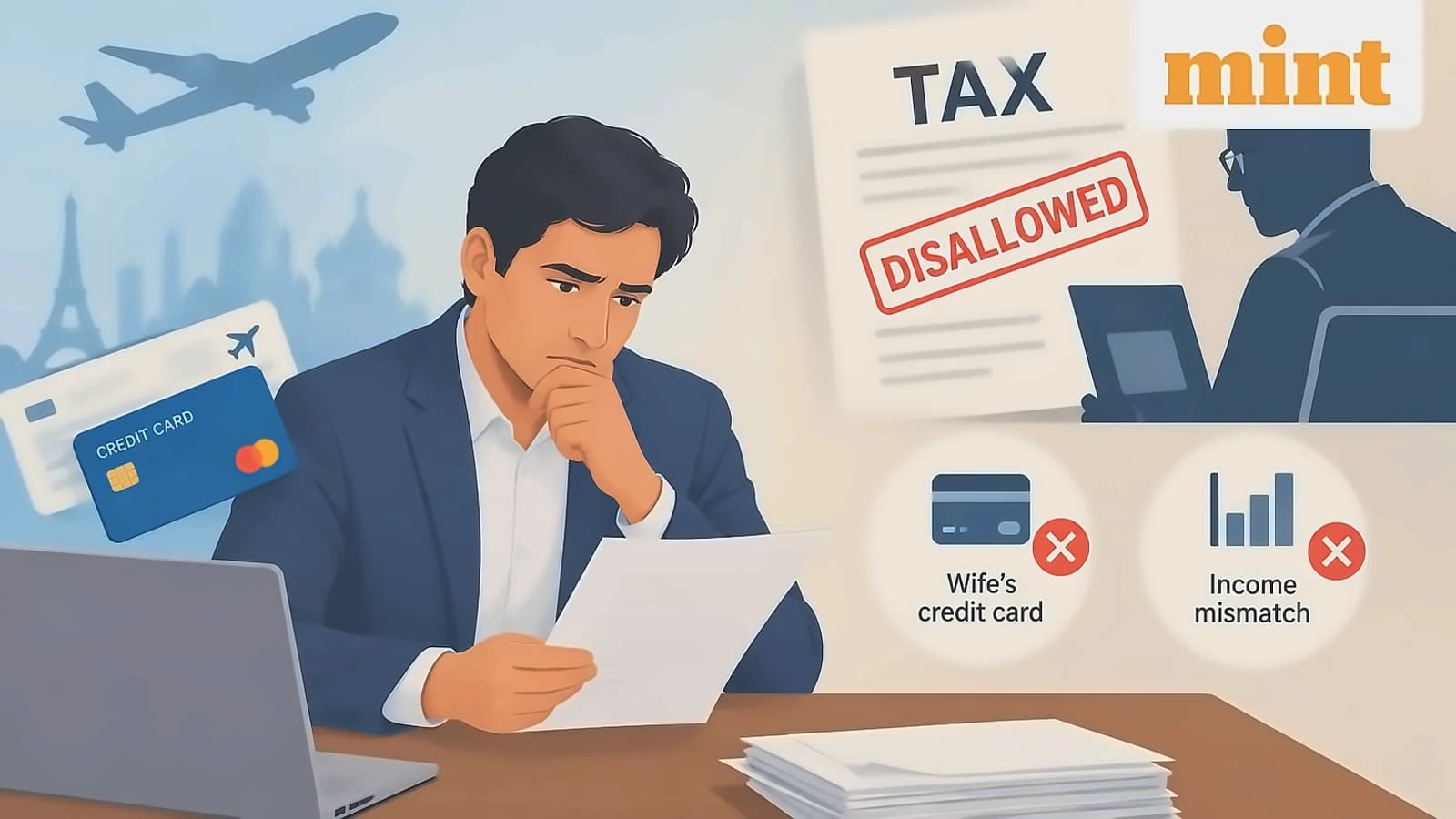
The Income Tax Appellate Tribunal (ITAT) Mumbai has provided partial relief to a Mumbai-based businessman after the income tax department disallowed ₹6.42 lakh of his travel expenses because the payments had been made using his wife's credit card. According to The Times of India, Challa Nagendra Prasad, Judicial Member, and GM Doss, Accountant Member held that there is no legal bar on a person using their spouse's credit card to meet business expenses and subsequently reimbursing the spouse for those payments. The tribunal ruled that "there is nothing in law which precludes an assessee from incurring business expenditure through the credit card of his spouse and thereafter reimbursing the said expenditure to the spouse."
The dispute arose from a Mumbai resident's business travel to Paris, Russia and other destinations, incurring total travel expenses of ₹20.32 lakh. Of this amount, ₹6.42 lakh was paid through his wife's credit card, which he subsequently reimbursed after returning to India. As reported by The Times of India, the income tax department questioned the deduction despite the expenses being incurred for business purposes, arguing that the ₹6.42 lakh remains unexplained as his wife had no connection with his business travel. The Assessing Officer (AO) consequently disallowed the expenditure from the assessee's business income.
The assessment also raised a separate issue concerning the income reported by the taxpayer. According to The Times of India, Form 26AS showed the man's income at ₹79.87 lakh, whereas his books of account reflected income of ₹75.51 lakh. The difference worked out to ₹4,36,400, which the AO sought to bring to tax. The dispute before the tax authorities therefore involved two separate issues: business expenses paid using his wife's credit card and the difference between the income reported in Form 26AS and the man's books of account.
Feeling aggrieved by the decision, the businessman first challenged the assessment before the Commissioner of Appeals (CIT A), but his appeal was rejected. Through his chartered accountant, he approached ITAT Mumbai, which granted partial relief on August 31, 2026 regarding the travel expenditure made using his wife's credit card. However, ITAT Mumbai sent the matter regarding the ₹4,36,400 difference between Form 26AS and books of account back to the Assessing Officer for further verification. The tribunal also made a further 20% disallowance on the remaining foreign travel expenses of ₹12.4 lakh due to the businessman's failure to furnish adequate details of the foreign travel, including information about the people who travelled and the services they provided.
According to Pranshu Goel, Partner at Ashok Pranshu & Co., ITAT Mumbai ruled in the man's favour after finding that the disputed expenses were genuinely incurred for foreign business travel. The tribunal rejected the argument that the reimbursement represented payment for services provided by the man's wife, since she had not rendered any independent service. Goel advises taxpayers to preserve the complete documentary trail, purpose, invoices, card statements and proof of reimbursement to substantiate that the expense is for business purposes and not personal expenditure. He also pointed out that high-value credit card transactions are now reported and reflected in AIS/TIS, making spending that appears disproportionate to the cardholder's disclosed income subject to tax department scrutiny unless properly explained.