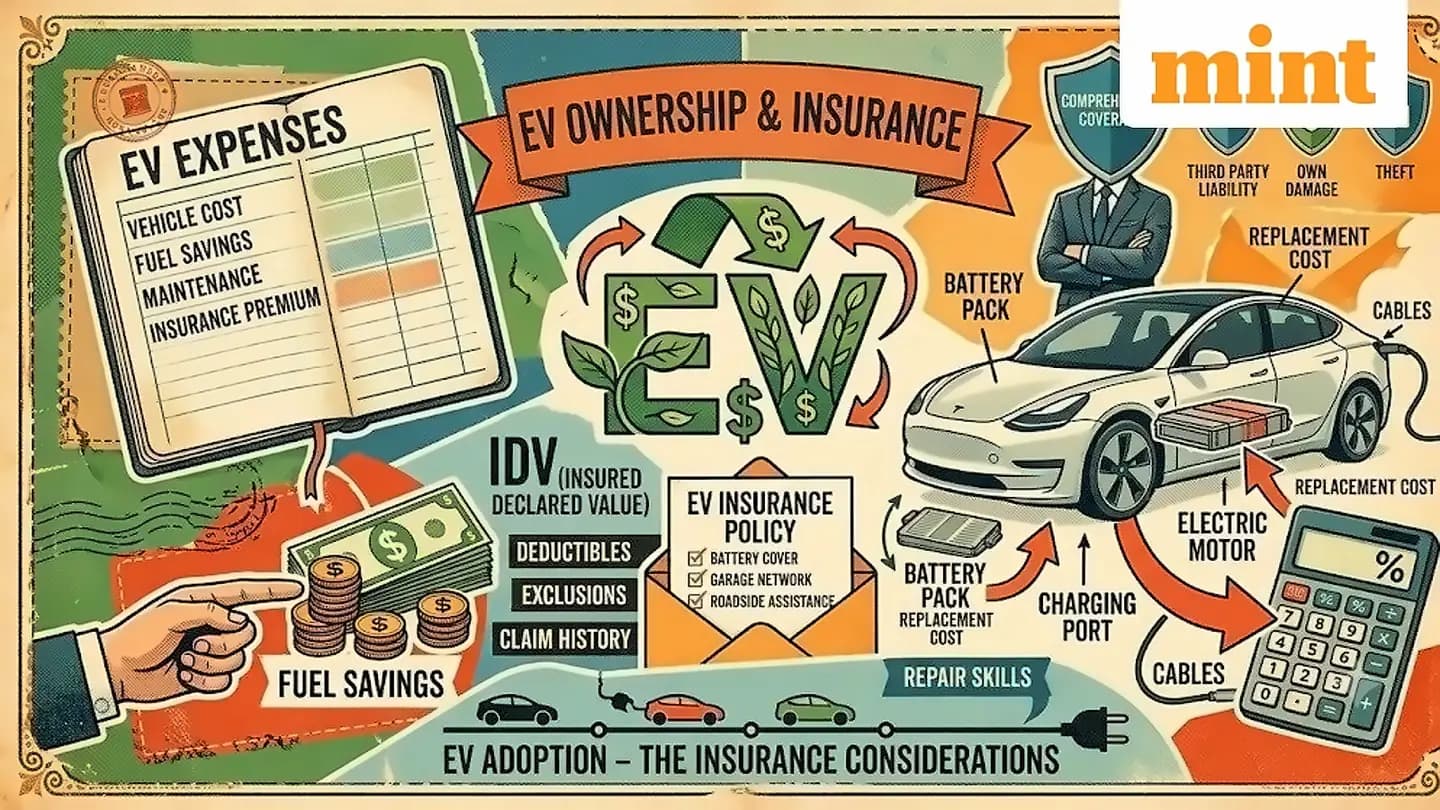
Electric vehicle insurance is fundamentally different from standard motor policies, with batteries accounting for 40-60% of vehicle value. As reported by Mint, comprehensive motor insurance policies provide financial protection against theft, accidents, and third-party liabilities, but the real protection for EVs lies in specific covers like 'EV Shield'. According to Shilpa Arora, co-founder and COO at Insurance Samadhan, EV owners need to specifically confirm battery coverage rather than assume standard comprehensive cover treats it like any other part. EV owners should buy insurance that specifically covers the battery and related equipment, as the most critical component is the battery which often accounts for up to 40% of the vehicle's total cost. Own-damage premiums are 20%-40% higher than petrol equivalents due to the high cost of battery replacement, with minor collisions potentially triggering lakhs-worth of replacement costs versus much smaller body-panel repairs for ICE vehicles.
Engine protect should be the first priority for monsoon-related risks, covering consequential engine damage due to water ingress, hydrolock, and lubricant leakage. According to Shilpa Arora, co-founder and chief operating officer at Insurance Samadhan, this add-on covers engine components that would otherwise be excluded. A zero-depreciation add-on reduces out-of-pocket expenses by covering depreciation on replaced parts, allowing policyholders to receive full claim value for damaged components. As reported by Kapil Mehta, co-founder of SecureNow Insurance Broker, starting a submerged vehicle is a major cause of claim denial, as insurers regard such attempts as negligence. A consumables rider pays for engine oil, coolant, filters, nuts, bolts and clips that standard claims often exclude, forming a substantial part of claim amounts. EV owners should consider 'Roadside Assistance' add-ons that offer emergency battery-swapping or mobile charging units if stranded with a fully depleted battery.
'EV Shield' is essential as it specifically covers the battery, electric panel, and charging equipment, including wall chargers and charging cables. According to Mint, EV Shield typically offers battery protection, electric motor cover, charging equipment cover, and protection against water ingress, short circuits, electrical surges, or accidental damage. 'Return to Invoice' cover pays the vehicle's full original invoice value in the event of total loss or theft, providing comprehensive protection. EV owners should also consider 'Consumables and Tyre Protect' add-ons as they provide coverage for smaller replacement costs such as coolants and brake fluids while safeguarding against damage to tyres. 'Return to Invoice' as an add-on guarantees a payout of the vehicle's full original invoice value in the event of total loss or theft, ensuring adequate compensation for the high battery replacement costs.
Standard comprehensive motor insurance policies provide substantial protection against monsoon-related damage, covering floods, inundation, water ingress, cyclones, storms, and hailstorms. According to reports from Business Standard, these policies also extend coverage to landslides, rockslides, and falling trees during storms. However, standard policies exclude mechanical or electrical breakdown not directly caused by insured events, normal wear and tear, corrosion, rust, and consumables. As reported by Pradeep Funde, senior vice president at Anand Rathi Insurance Brokers, depreciation of up to 50% may apply to parts according to the defined schedule. Insurers may also exclude damage caused by knowingly driving through deep water, depending on the facts and policy wording. 'Own Damage' cover under comprehensive policies pays for damage to your own vehicle from accident, fire, flood, or theft, while third-party cover only pays for damage caused to others.
Claims can be rejected for exceeding the wading depth specified in vehicle policies. As reported by Mint, your claim can be rejected if the vehicle's depth exceeds the one specified in the policy. For instance, if your vehicle stopped mid-road after riding through 1-foot water and the depth allowed in your policy is only 150mm, then your claim will be rejected. The biggest error owners make is trying to start a submerged vehicle, which often causes hydrostatic lock and is usually excluded from standard policies because insurers view it as consequential loss rather than a direct accidental event. The vehicle should be left untouched and towed to a workshop until a professional surveyor inspects the water damage. Experts recommend switching off the ignition immediately if the vehicle stalls in floodwater, as insurers may classify restart-related damage as avoidable and reject that portion of the claim.