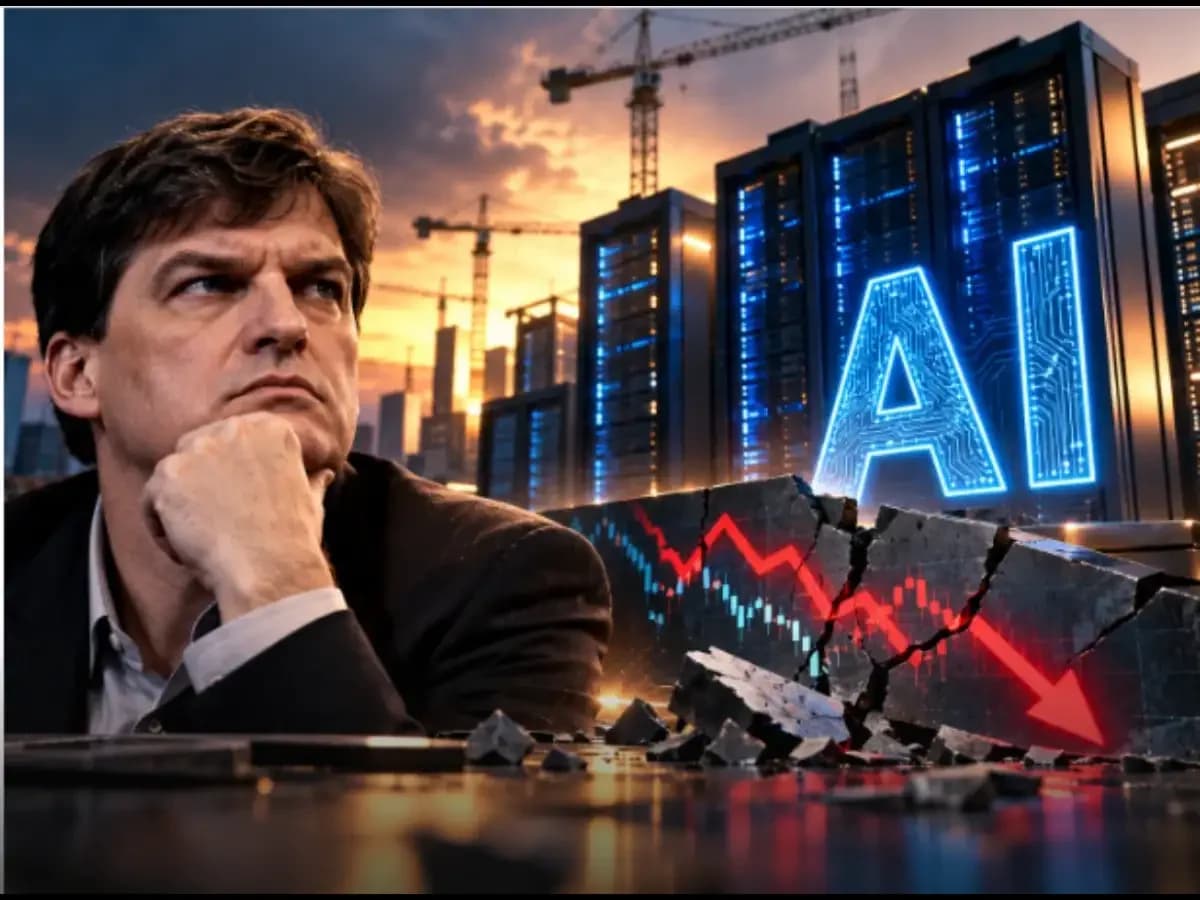
Michael Burry has intensified his warnings against the AI industry following Anthropic's IPO filing, citing the company's massive infrastructure commitments as evidence of 'catastrophic vulnerability'. According to The Economic Times, Burry pointed to Anthropic's $537 billion in compute commitments to Amazon, Alphabet, and Microsoft, along with preliminary agreements worth hundreds of billions more with companies like SpaceXAI. This puts the company's total commitments at approximately 12 times its current annual revenue run-rate. In a recent Substack post, Burry emphasized that 'this is not stated clearly in the S-1, and in my view it is the most deserved headline from it'. He noted that while the company's growth slowdown is attributed to declining tokenization, he did not expect this factor to be mentioned in the IPO documents.

Anthropic's IPO filing revealed exceptional financial performance that has reignited investor interest in AI companies. According to Investing.com India, the company achieved quarterly revenue growth of 31 times, rising from $376 million in Q1 2025 to $11.6 billion in Q2 2026. The company's efficiency has improved dramatically, with compute costs rising only 6x while revenue per dollar of compute increased to $2.08 from $0.40. Investing.com India reports that more than 11,900 customers now spend $100,000 or more annually, up from approximately 950 customers a year earlier. The company has raised $141.1 billion since 2021 and maintains $131.7 billion in cash and short-term investments at the end of June. At the projected $1.5-2 trillion valuation, Anthropic would be valued at 32-43 times Q2 revenue annualized, representing significant premium for a company that generated over $100 billion in ARR exiting this year.
According to reports from The Economic Times, Michael Burry provided comprehensive life advice to a 26-year-old GenZ individual through a Substack post on his channel 'Cassandra Unchained'. The legendary investor emphasized the importance of being thankful and charitable while advising against gambling. Burry stated that 'art in the eye of the beholder is cheap', meaning people should find value in things that are free rather than assuming expensive items are more valuable. He also recommended manifesting the power of compounding and warned against discretionary spending on depreciating assets like planes and boats, saying 'if it flies or floats, rent it'. As reported by The Economic Times, Burry's philosophy aligns with other investing legends like Warren Buffett, who have repeatedly advised investors to stay patient and continue compounding their wealth.
As reported by The Economic Times, Burry provided specific guidance on housing purchases, advising individuals to 'buy half the house you can afford'. This recommendation comes from the market veteran who correctly predicted the 2008 housing crisis that triggered a global financial crisis. The advice contrasts with his previous role as a bubble predictor in the housing market, demonstrating his current view on residential real estate as a viable investment option for younger investors. The irony of Burry advising home purchases while being known for predicting housing market crises has not been lost on observers, as reported by The Economic Times.
Burry's latest warnings suggest the anticipated AI market correction is accelerating from his previous August timeline of 2028. According to The Economic Times, he recently cited data showing that it would take only a season of AI revenue disappointing massive capital expenditure for hyperscalers to shift focus. Burry has been shorting AI-linked stocks and warned that the AI crash could begin from 2028, though his latest comments imply this timeline is moving sooner. He explained that President Trump-led US administration cannot afford to let the AI boom fail due to AI infrastructure buildout becoming critical economic support. As reported by The Economic Times, this positioning comes after Burry said in August that the AI crash could begin from 2028, with his latest comments suggesting an accelerated timeline for the anticipated market correction.