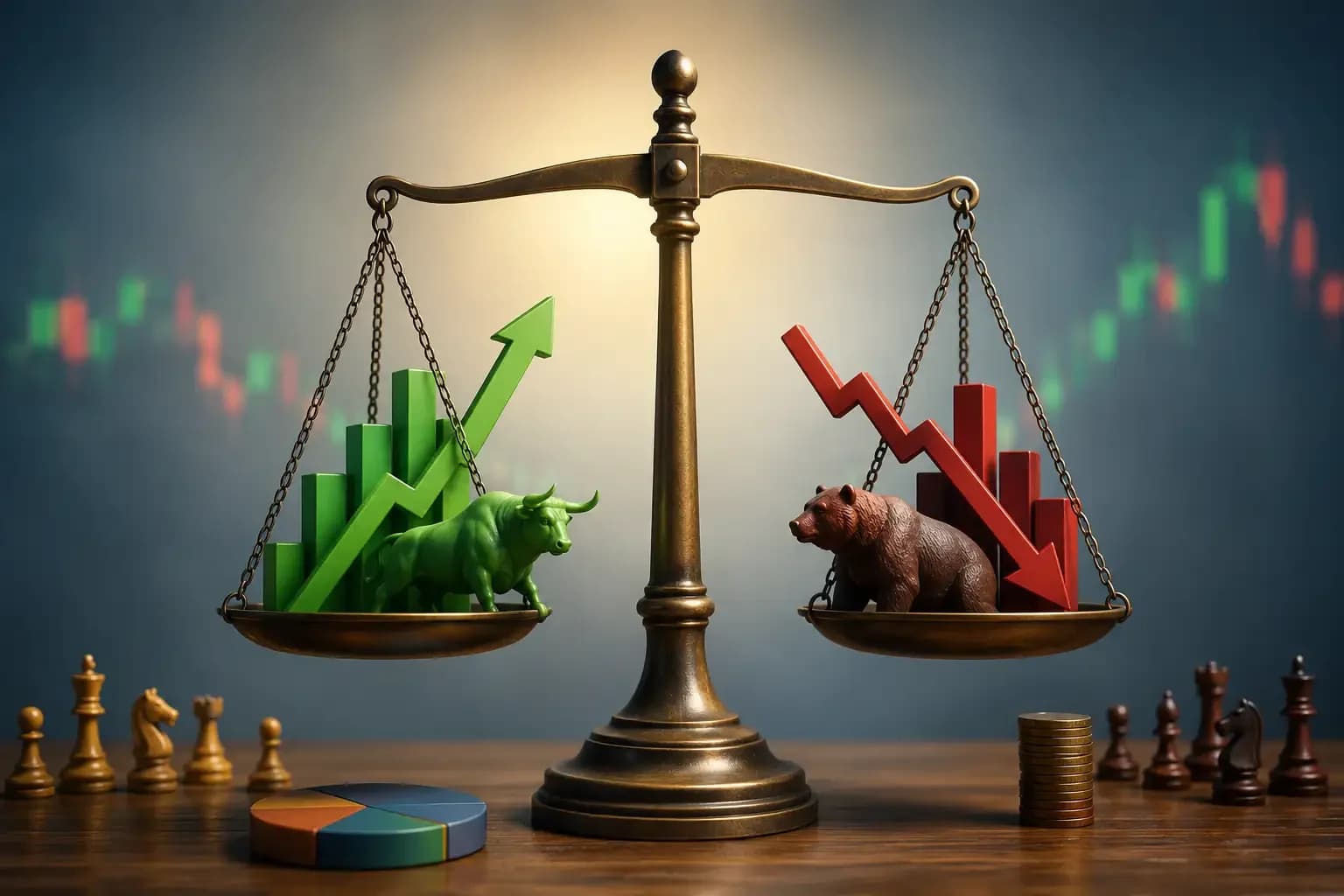
The proliferation of artificial intelligence has coincided with recent elevated market volatility and uncertainty, creating a complex environment for investors. The software sector experienced its largest non-recessionary drawdown in more than 30 years, driven in part by AI-related disruption fears. As reported by Bessemer, retail investor participation remains elevated, and social media's growing influence can amplify market moves, even when fundamentals remain sound. The debate around AI's impact has shifted from whether it will end work to how societies shape the next configuration of work, with the greater risk lying less in a vanishing job market and more in complacency around distributional effects of rapid change.
According to The Economic Times, the Nifty 50 index reached a new high of 21,731 in December 2023 and touched an intramonth high of 21,801. As reported by The Economic Times, at the end of March 2026, markets are very close to that level. However, many stocks, especially in the broader market, are below the December 2023 level. The article notes that experienced investors express uncertainty about the current downturn, with statements like 'I don't know where the markets will bottom. I haven't seen anything like this earlier.'
As reported by The Economic Times, Nobel Prize winner Daniel Kahneman's 'Two Selves' theory explains why investors feel 'this time it's different.' According to the article, Kahneman describes how there are two selves in everyone—a 'Remembering Self' and an 'Experiencing Self.' The 'remembering self' recites stories of past successes, while the 'experiencing self' lives through current fear and anxiety. The article suggests that investors carry memories of profitable investing during crashes but forget the fear and pain experienced during those periods.
According to The Economic Times, myopic loss aversion and recency bias are key barriers preventing investors from taking advantage of market falls. The article explains that during the current market fall, the 'experiencing self' is living the pain of contrarian investing, while the 'remembering self' recalls stories of profitable investing during bad times. The piece suggests that investors undergo the same fear and pain during every large down move, but the story feels different each time, leading to the 'this time it's different' phenomenon. As reported by Bessemer, AI has become less a technology discussion and more a cultural Rorschach test, with extreme narratives about AI persisting because they are emotionally satisfying, strategically useful, and economically incentivized.
As reported by The Economic Times, the article suggests that staggering investments during market cycles through SIPs or STPs can help mitigate near-term volatility risk while ensuring participation across cycles. The Inspired Investor article emphasizes the importance of consistent strategies like dollar-cost averaging and avoiding rash decisions during fresh start periods. The Bessemer approach involves using recent market pullbacks to add to companies with compressed valuations, deeply embedded platforms, and strong fundamentals. Notable investments include Microsoft, which serves roughly 450 million commercial users of Microsoft 365, and CrowdStrike, positioned to adapt to the increasingly complex cybersecurity landscape as AI increases importance in this sector.