June 15 marks a crucial deadline for taxpayers with estimated net tax liability exceeding ₹10,000, who must pay 15% of their advance tax for financial year 2026-27. According to reports, this represents the first advance tax cycle operating fully under the Income Tax Act 2025 and Income Tax Rules 2026, making it a significant compliance milestone. Failure to meet this deadline may attract interest at 1% per month. Advance tax typically applies to freelancers and consultants, business owners and professionals, individuals earning substantial interest income, investors earning capital gains, and people with income sources beyond regular salary subject to tax deducted at source or TDS. Salaried individuals in the old tax regime will benefit from higher exemption limits, with Children Education Allowance increasing from ₹100 to ₹3,000 per month per child and hostel allowance raised to ₹9,000 per month. Additionally, Bengaluru, Pune, Hyderabad and Ahmedabad have been added to the 50% House Rent Allowance exemption category.
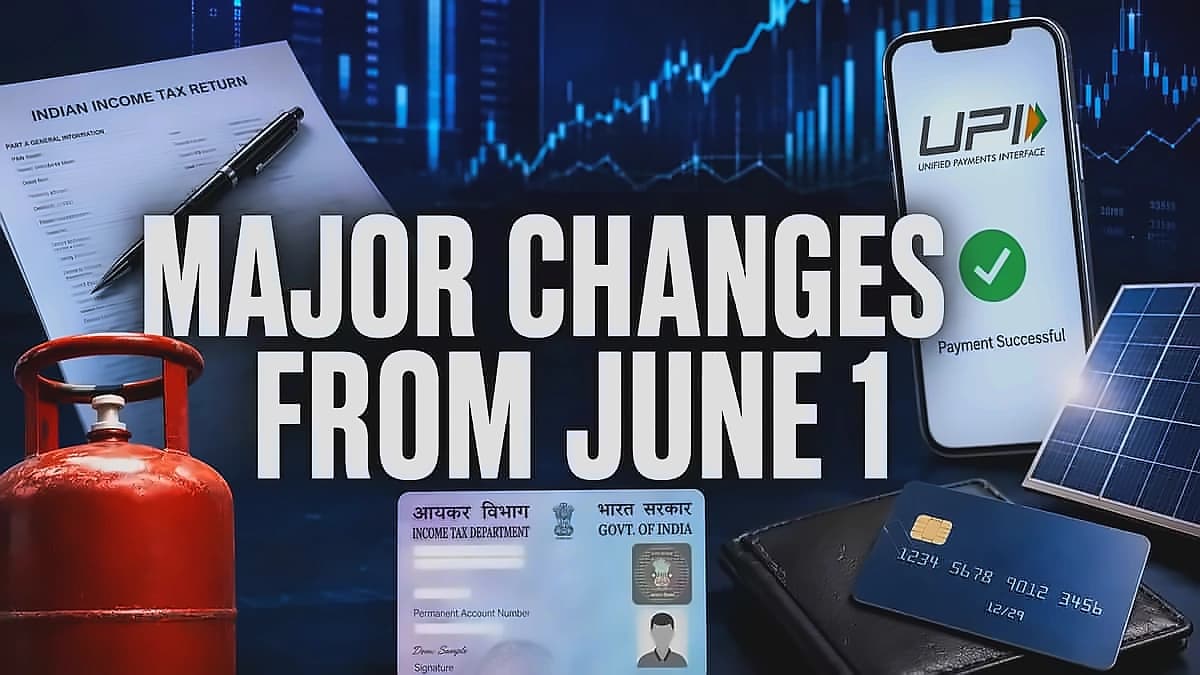
Digital payments are receiving significant security upgrades with UPI transactions requiring additional authentication beyond the usual UPI PIN from June 2026. As reported, depending on the app and transaction type, users could be asked to verify payments through fingerprint authentication, facial recognition or another device-based security layer. This enhancement is aimed at reducing unauthorised transactions and making it harder for fraudsters to misuse stolen credentials. Popular UPI apps such as Google Pay, PhonePe and Paytm are expected to incorporate these enhanced security measures as part of broader fraud-prevention efforts. Additionally, banks are expected to treat UPI-enabled cardless ATM withdrawals in the same manner as conventional ATM transactions for monthly free withdrawal limits, meaning customers who exhaust their free quota could face additional charges even when using UPI for cash withdrawals.
The government has introduced significant changes to PAN card requirements in 2026, creating a more balanced framework between ease and accountability. Cash deposits below revised limits no longer require PAN details for amounts above ₹50,000 in a single day, reducing paperwork burden for routine banking activities. Additionally, vehicle purchases are now exempt from PAN requirements for vehicles costing less than ₹5 lakh, eliminating the need to furnish PAN for smaller transactions. However, PAN compliance becomes important when aggregate cash deposits or withdrawals reach ₹10 lakh or more during a financial year. The threshold for quoting PAN in certain property sale transactions has been increased from ₹10 lakh to ₹20 lakh. However, PAN will remain compulsory for property deals above ₹45 lakh, gift deeds and joint development agreements. For investors and property buyers, the changes highlight the need to maintain proper documentation for significant financial transactions.
India's solar sector is witnessing major compliance changes from June 1, 2026, with all government-backed, subsidised and net-metered solar projects now required to use modules listed under the Approved List of Models and Manufacturers (ALMM). As reported, the government has ruled out any further extensions to this deadline, with the move expected to strengthen domestic manufacturing standards and quality control. Meanwhile, LPG households with PNG access may be required to surrender cylinders and annual subsidy capped at 12 cylinders per household. Energy regulations see significant restructuring with refill lock-in extended to 25 days (urban) and 45 days (rural) to streamline distribution and push cleaner energy adoption.
Bank customers should prepare for higher service costs as several banks are revising charges related to ATM services, including cash withdrawals, balance enquiries and mini statements. Customers are advised to check their respective bank notifications for updated fee structures. Credit card users will face numerous changes as banks revise reward programmes, redemption values and transaction charges. Certain categories such as rent payments, utility bills, education payments and fuel transactions may attract additional charges once specified spending limits are crossed. For investors, SEBI's fully implemented 50:50 margin rule will now require Futures and Options traders to maintain at least 50% of their margin requirement in cash or cash-equivalent instruments, with reliance solely on pledged shares for margin requirements no longer permitted. The government has maintained unchanged interest rates for major small savings schemes, with PPF offering 7.1% interest and Sukanya Samriddhi Yojana providing 8.2% for the current quarter.