SEBI permits life-cycle funds with 5-, 10-, 15-, 20-, 25-, and 30-year maturities, according to reports from Mint. For a 30-year fund, equity allocation ranges from 65% to 95% when 15 to 30 years remain, gradually falling to 5% to 20% in the final year. Gold or silver ETFs can account for up to 10% throughout the glide path. As of September 29, seven life-cycle fund schemes from three AMCs were available, with maturity horizons of 5, 10, 15 and 30 years. Zerodha Fund House offers three types: Zerodha Life Cycle Fund 2031 (5-year horizon), 2036 (10-year horizon), and 2041 (15-year horizon). ICICI Prudential has launched funds with target years of 2031, 2036, and 2041, while Mirae Asset has launched a 2056 fund for investors with a 30-year horizon.
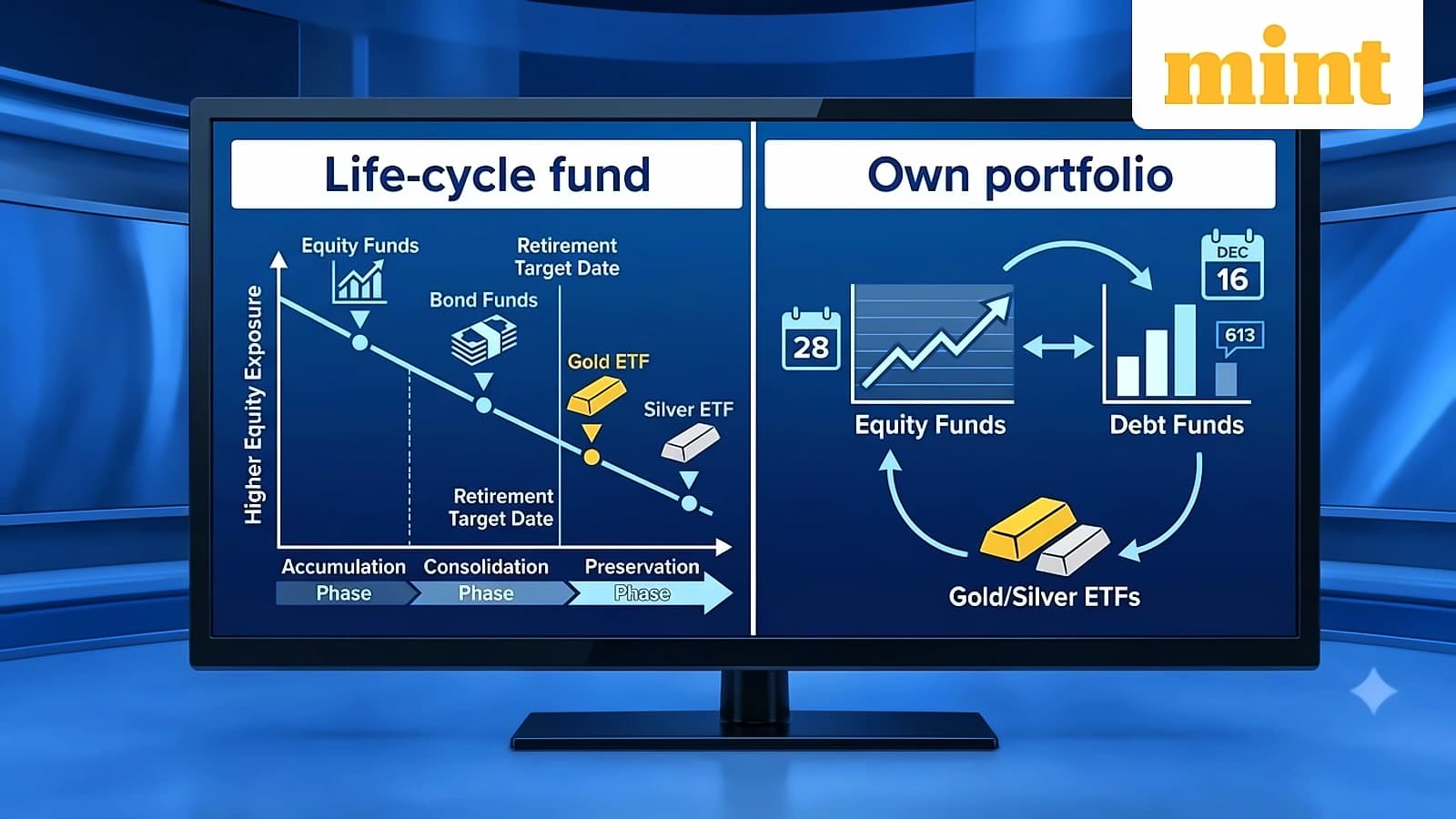
For a 30-year retirement goal, experts suggest starting with 70% to 80% equity through a flexi-cap or broad index fund, 10% to 20% in a short-duration or corporate bond fund, and 5% to 10% in gold or silver ETFs, as reported by Mint. As retirement approaches, equity should be reduced roughly every five years—to about 65% at 15 years, 50% at 10 years, 35% at five years, and 20% in the final two years. A possible allocation for different time horizons could be 80:20 equity-debt for long-term goals, 70:30 for medium-term goals, and 100% debt for short-term goals. For a 5-year goal, life-cycle funds start with 35% to 50% equity and 25% to 50% debt, giving a hybrid-fund-like allocation with a defined glide path.
A life-cycle fund suits investors who would otherwise never rebalance, offering one decision, one SIP, one date with the fund handling the rest, according to Mint reports. However, investors could build separate portfolios for different time horizons, with the main factor being time horizon and years left before money is needed. For fixed goals like a child's college admission in 2031, life-cycle funds may be suitable due to reduced need for regular portfolio management. For flexible goals such as house purchase in five years, a self-built portfolio may offer more flexibility. A self-built portfolio also offers more flexibility to hold more gold or debt than the prescribed bands allow.
SEBI's March 2026 master circular limits fund houses: one that keeps its old retirement fund cannot launch a 30-year life-cycle fund, and one that keeps a children's fund cannot launch a 20-year fund, as reported by Mint. Some large houses, ICICI Prudential among them, still run a retirement fund. There is potential for life-cycle funds to gain traction as investors prefer a hands-off approach, but investors would be more suited to manually construct their own portfolio for different time horizons. The 30-year maturity life-cycle fund may suit investors starting out or unlikely to review their portfolio, while a 20-year life-cycle fund could serve similar investors once available.