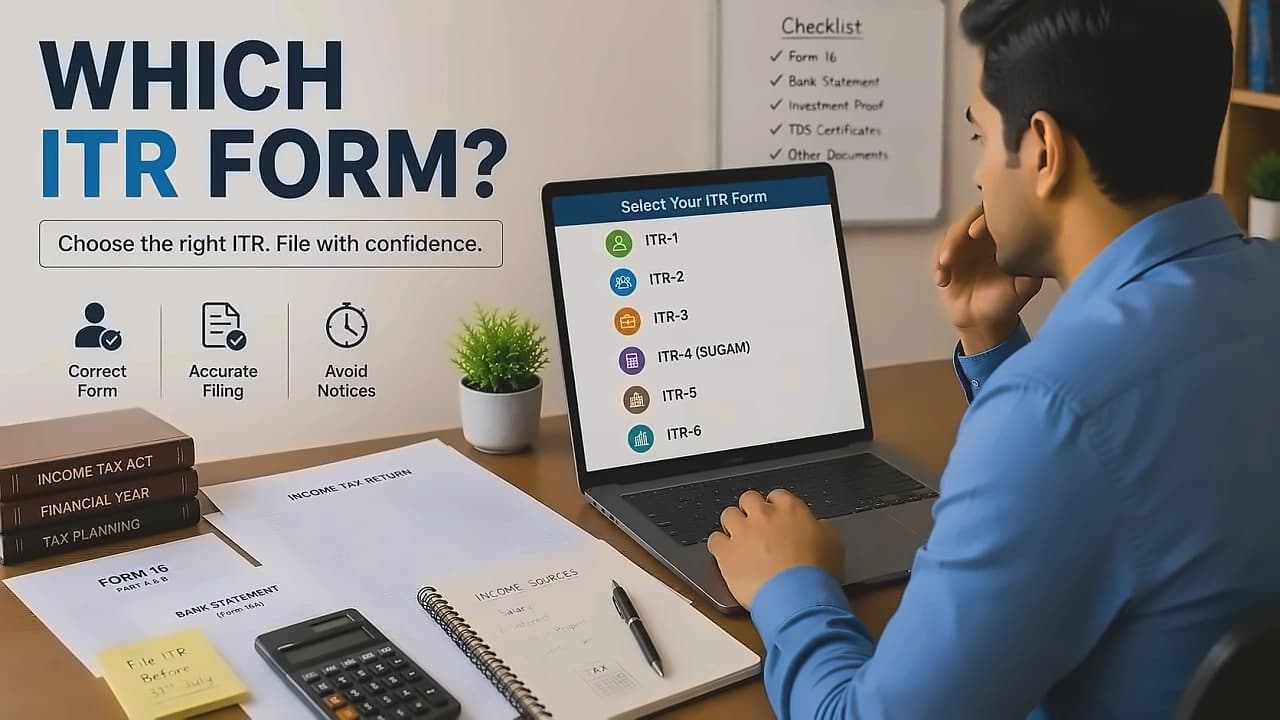
The Income Tax Department has prescribed seven different ITR forms for taxpayers based on their income sources, residential status, and taxpayer type. According to the latest guidelines, ITR-1 applies to resident individuals earning up to ₹50 lakh from salary, up to two house properties, interest income, long-term capital gains under Section 112A up to ₹1.25 lakh, and agricultural income up to ₹5,000. ITR-2 is meant for individuals and Hindu Undivided Families (HUFs) who do not have business or professional income but are not eligible for ITR-1. ITR-3 applies to individuals and HUFs earning income from business or profession, while ITR-4 (Sugam) is available to resident individuals, HUFs, and firms having total income up to ₹50 lakh and opting for presumptive taxation schemes under Sections 44AD, 44ADA, or 44AE. ITR-5, 6, and 7 are tax forms for non-individual entities, with ITR-5 used by partnership firms, LLPs, AOPs, and Co-operative Societies, ITR-6 for companies, and ITR-7 for entities required to file under Section 139.

For freelancers and self-employed professionals, the choice between ITR-4 and ITR-3 depends on how professional income is reported. As reported by EY India, ITR-4 is suitable for taxpayers opting for presumptive taxation, where income is declared at a prescribed percentage of gross receipts without maintaining detailed books of account. However, this simplified scheme is available only to resident taxpayers fulfilling the eligibility conditions prescribed for ITR-4. ITR-3 becomes mandatory where presumptive taxation is not opted for, such as when actual business expenses are claimed, books of account are maintained, income exceeds prescribed limits, or additional disclosures are required. While ITR-4 offers simpler compliance for small professionals and freelancers, ITR-3 is intended for taxpayers with more complex professional or business income structures.
Directors in companies, holders of unlisted equity shares, and taxpayers with foreign assets or foreign income are not permitted to file ITR-1 or ITR-4 because these are simplified return forms designed for straightforward income profiles. According to EY India, company directors are required to disclose detailed information regarding directorships, shareholding patterns, and financial interests. Taxpayers holding unlisted shares must report details related to acquisition, transfer, and valuation of such shares. Individuals owning foreign assets or earning foreign-source income are required to furnish disclosures under Schedule FA, which captures details of overseas assets and income. Since ITR-1 and ITR-4 do not contain the necessary schedules and disclosure fields for such reporting requirements, these taxpayers must file ITR-2 or ITR-3, depending on the nature of their income.
Filing an incorrect Income Tax Return form can have serious legal and financial consequences, as noted by EY India's Tax Partner Amarpal Chadha. Returns filed using an inappropriate form are often treated as defective under Section 139(9) of the Income-tax Act, 1961, and must be rectified within the prescribed time. Failure to do so can render the return invalid, leading to delayed or denied refunds, loss of carry-forward of losses, and levy of interest or late-filing fees. Using a simplified ITR form where detailed disclosures are mandatory, particularly in cases involving foreign bank accounts or overseas investments, can result in non-disclosure of foreign assets that may trigger proceedings under the Black Money Act. Incorrect form selection may also lead to incomplete reporting of business income, capital gains, or shareholdings, increasing the risk of scrutiny and reassessment.
Tax experts recommend that taxpayers should consult the Income Tax Department website for relevant instructions and FAQs to ensure they select the correct form. As emphasized by EY India, taxpayers should seek professional assistance where the return involves complex disclosures. The key is to understand the specific income sources, residential status, and legal classification before selecting the appropriate form. For taxpayers who have already filed incorrect forms, they can revise using the correct form before the tax department marks it as defective, ensuring the revision is undertaken within the specified deadline to avoid serious legal and financial consequences.