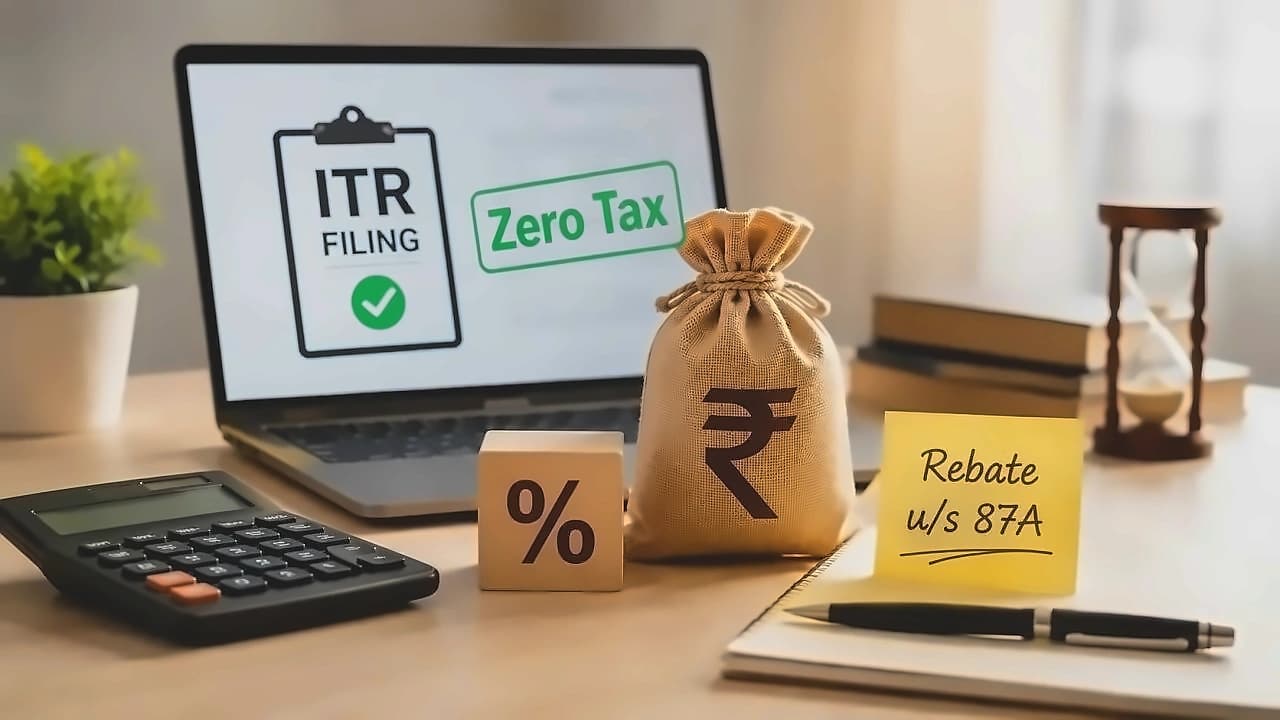
The income-tax department has notified all ITR forms 1-5 for assessment year 2026-27 (financial year 2025-26) and enabled the excel utility facility for online ITR-1 (Sahaj), ITR-2, ITR-3, and ITR-4 (Sugam) forms. According to reports from Mint, taxpayers can now prepare their returns offline before uploading them digitally. The deadline for filing taxes is 31 July, which can be completed by logging into the e-filing portal with User ID and password.
Currently, Section 87A allows individuals to claim a rebate of up to ₹12,500 under the old tax regime and up to ₹60,000 under the new tax regime. As reported by Mint, rebate reduces tax dues by deducting a fixed amount from calculated payable tax for middle to low-income earners within the 10% tax slab bracket. Under the old regime, a rebate of ₹12,500 is allowed for income up to ₹5 lakh, while the new tax regime allows rebate of ₹60,000 for income up to ₹12 lakh. According to Clear Tax, rebate can be applied to total tax before adding health and education cess of 4%.
Under the new regime for FY 2025-26, the rebate of up to ₹60,000 makes taxable income up to ₹12 lakh tax-free, while salaried individuals and pensioners get the ₹75,000 standard deduction. After subtracting the standard deduction, a salary of up to ₹12.75 lakh leaves taxable income of ₹12 lakh, which the rebate makes tax-free. In the old regime, the rebate of up to ₹12,500 covers taxable income up to ₹5 lakh, with the old regime's ₹50,000 standard deduction allowing a salaried person earning up to ₹5.5 lakh to have nil tax if no other income pushes them over.
The confusion arises when taxpayers mix up TDS on salary with total income taxation. As reported by Moneycontrol, your employer only knows about your salary and deducts TDS under Section 192 based on full-year estimates. If salary plus standard deduction stays under ₹12.75 lakh, no TDS is deducted. However, the final tax is based on total income, not just salary, so FD interest, savings account interest, or other income can create tax liability even when no TDS was deducted on salary. Chartered Accountant Pratibha Gupta explains that "the biggest trouble in convincing a client comes when their salary is up to ₹12 lakh and no TDS has been deducted under the new tax regime."
The ₹12 lakh rebate limit applies to total income, not just salary, meaning FD interest, savings account interest, rental income, or other earnings get added during ITR filing. For example, on a gross salary of ₹13.10 lakh with standard deduction of ₹75,000, the taxable salary becomes ₹12.35 lakh, exceeding the ₹12 lakh threshold. Though tax on ₹12.35 lakh comes to ₹65,250, marginal relief limits tax to ₹35,000 (amount by which income exceeds ₹12 lakh). As reported by Moneycontrol, "the moment your FD interest or other income tips your total past ₹12 lakh, the rebate starts shrinking."
Rebate is only allowed for individuals and not companies or Hindu Undivided Families (HUFs). Non-resident Indians (NRI) are also not eligible for rebate under Section 87A. According to Mint, rebate cannot be claimed against long-term capital gains (LTCG) under Section 112A of the I-T Act and short-term capital gains (STCG) under Section 111A of the ITA. Additionally, rebate cannot be claimed on income taxed at special rates such as winnings from lottery and game shows.