The new income tax e-filing portal at incometax.gov.in was launched in June 2021, replacing the older portal (incometaxindiaefiling.gov.in) that was permanently shut down in 2021. Registration is mandatory for all taxpayers who want to file ITR, view Form 26AS, check refund status, or access any e-filing service. Registration requires PAN, Aadhaar (if linked), mobile and email verification and is completely free. The portal offers secure login using PAN + Aadhaar OTP or EVC (Electronic Verification Code) with two-factor authentication for enhanced security. Taxpayers can also authorize Chartered Accountants or Enrolled Agents to access their account and file returns on their behalf through authorized access.
For Assessment Year 2026-27, the Income Tax Department has enabled ITR-1, ITR-2, ITR-3 and ITR-4 for filing on their e-filing portal with both online and offline options. According to reports from The Economic Times, taxpayers with relatively straightforward income and tax affairs can now handle their returns independently using the department's online tools and pre-filled information. The growing use of pre-filled information has made tax filing more accessible, but taxpayers remain responsible for the information submitted in their returns. As per the latest guidance, taxpayers can now track their ITR status on the portal and receive notifications under the "e-Proceedings" tab if the department needs clarifications. The portal now offers pre-filled ITR forms with data from Form 26AS, AIS and TIS, auto-calculation of tax, faster processing and instant acknowledgement generation.
Before logging into the tax portal, taxpayers should collect all necessary information including Form 16, salary details, bank statements, Form 26AS, and the Annual Information Statement (AIS). As reported by The Economic Times, tax experts advise waiting until after June 15 for greater accuracy as Form 16, AIS and Form 26AS information is generally updated by this period. The new portal introduces two key features: Annual Information Statement (AIS) containing comprehensive data from tax deductors, banks, stock exchanges, registrars, foreign exchange dealers and other reporting entities, and Tax Information Statement (TIS) which is an editable version where taxpayers can provide feedback, accept or reject entries. TIS allows you to filter and correct income entries before they are used in your ITR, reducing the risk of over-reporting income and paying excess tax. The portal also offers real-time tracking of ITR processing, refund initiation, refund issued status and failure reasons.
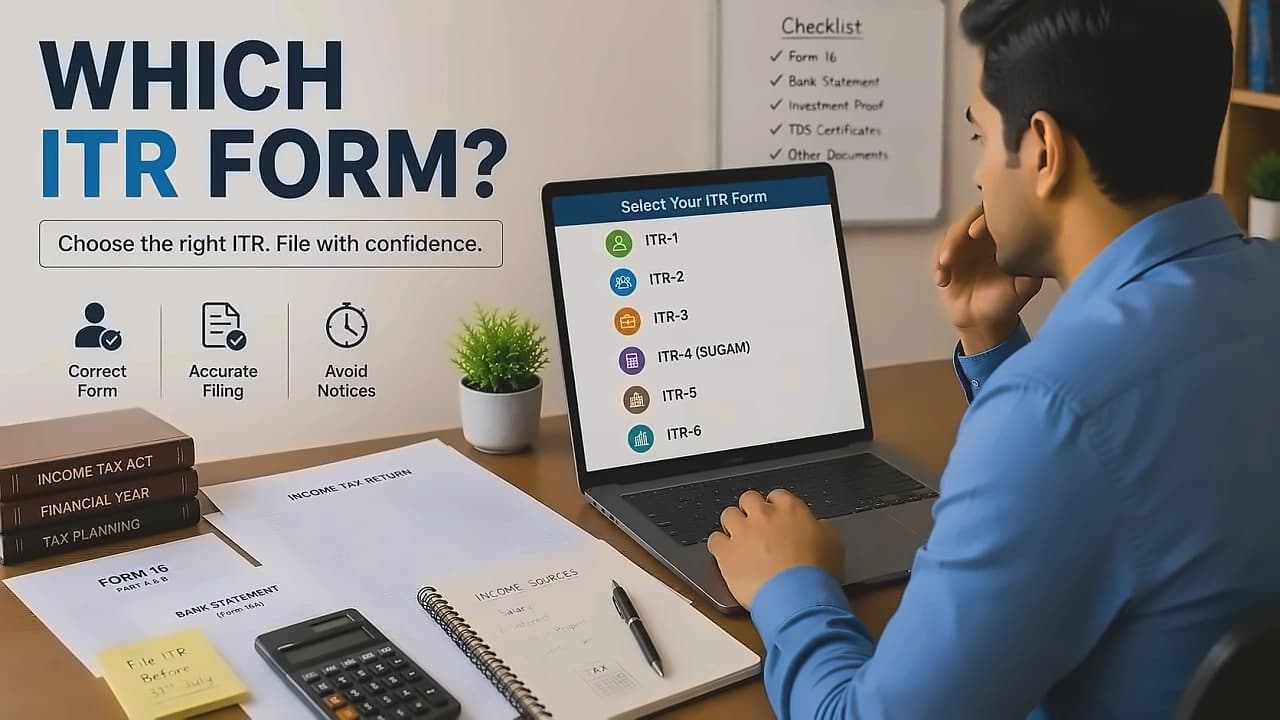
Selecting the correct income tax return form is crucial as it depends on factors including income sources, total income and financial circumstances. ITR-1 (Sahaj) suits most salaried individuals, while ITR-2 is for capital gains or more than one house property. ITR-3 is relevant for individuals and HUFs with income from business or profession, including F&O trading, and ITR-4 (Sugam) is available to eligible taxpayers reporting income on a presumptive basis. The portal now helps identify the correct form automatically based on your profile and previous filings, making the selection process more streamlined for most taxpayers. For complex cases involving multiple income sources, the "Assisted by a CA" option handles computation for you starting at ₹881. Submitting an income tax return is only part of the process, as taxpayers must complete e-verification within 30 days of filing according to the Income Tax Department's filing framework. The return can be e-verified through available methods on the tax portal, including Aadhaar OTP and other electronic verification routes.
The Income Tax Department introduced ITR-U (Updated ITR) in 2026 as a simplified correction mechanism for taxpayers who filed original returns but discovered mistakes later. Unlike the old revised return process, ITR-U requires only limited corrections and doesn't need to be filed as a complete return. Taxpayers can file ITR-U before receiving a tax notice under Section 143(2) or Section 142(1), showing good faith and avoiding stricter penalties. The system automatically recalculates tax liability based on corrections made, with no penalties for voluntary corrections but additional tax due if income was underreported. For example, if a taxpayer originally reported ₹10 lakh income and paid ₹1.5 lakh tax, but missed ₹2 lakh interest income, filing ITR-U would increase taxable income to ₹12 lakh with potentially higher tax liability.
While filing independently may be manageable for salaried taxpayers with straightforward income, the situation becomes considerably more complicated where taxpayers have complex capital gains, business or professional income, foreign assets or foreign income, or other transactions involving detailed tax reporting. According to The Economic Times, in such cases, professional advice may help reduce the risk of incorrect reporting. The process is less about rushing through the portal and more about three basic checks: choosing the correct ITR form, matching tax information with personal records, and declaring all applicable income, with accuracy matters more than speed in the filing process. As per the latest guidance, taxpayers should avoid hiding income — discrepancies can lead to notices from the Income Tax Department later.