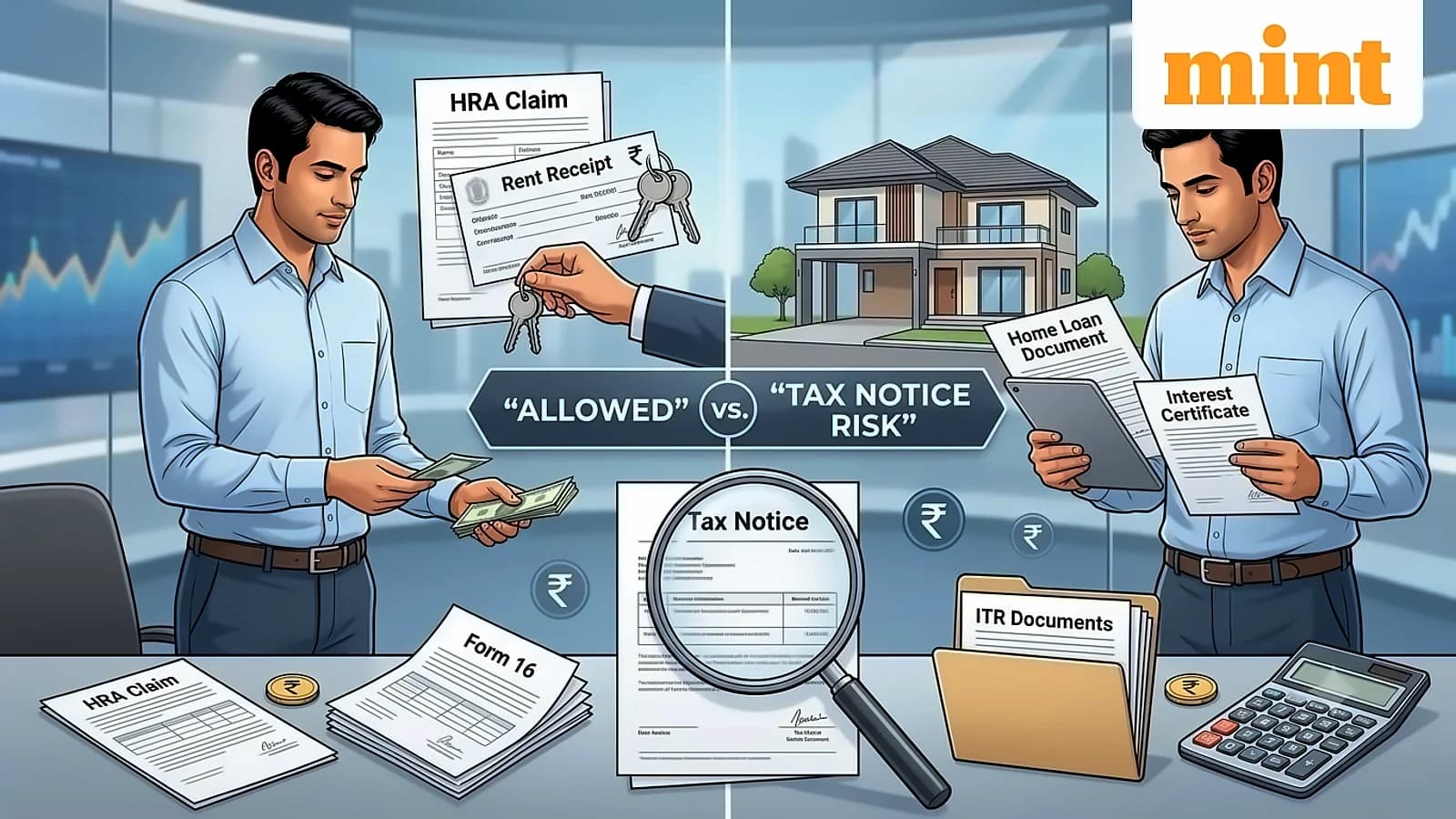
Income tax exemptions provide tax relief on specific sources of income as defined in the Income Tax Act. According to reports from Mint, agricultural income is exempted from tax, while gains from property sales reinvested into real estate are also exempted. Section 10 covers exemptions for agriculture income, education and hostel allowance for children, gratuity under voluntary retirement, HRA, leave travel allowance, life insurance premium, pension, provident fund, and more. Section 10(13A) allows HRA exemptions for those living in rented accommodation, with the exempt amount being the least of 50% of basic salary (for metro cities) or 40% (for non-metros), rent paid minus 10% of basic salary.
Income tax deductions are investments and expenditures that reduce a taxpayer's total taxable income and thus reduce tax payable. As reported by Mint, standard deduction allows salaried individuals to claim up to ₹50,000 from gross income, while Section 80C permits deductions of up to ₹1.5 lakh for investments in equity-linked saving scheme (ELSS), five-year fixed deposits, home loan principal repayment, LIC premium, National Savings Certificate (NSC), PPF, Senior Citizens Saving Scheme (SCSS), and Sukanya Samriddhi Yojana. Section 80D allows deductions of up to ₹25,000 for medical insurance premium for self, spouse, and dependent children, with additional deductions of ₹25,000 for parents aged within 60 years and ₹50,000 for parents over 60 years. Section 80CCD offers additional NPS benefits with Section 80CCD(1) allowing contributions within the overall ₹1.5 lakh limit, Section 80CCD(1B) providing an additional ₹50,000 deduction exclusively for NPS, and Section 80CCD(2) covering employer contributions with no monetary limit.

Unlike exemptions and deductions, income tax rebates are claimed from the total tax payable under Section 87A for income within the 10% tax slab. According to Mint, under the new tax regime, a rebate of ₹60,000 is allowed for income up to ₹12 lakhs. Under the old regime, a rebate of ₹12,500 is allowed for income up to ₹5 lakhs. Rebates cannot be claimed against LTCG and STCG under Section 112A and Section 111A of the Income Tax Act, and for income taxed at special rates such as lottery winnings. Rebates are only allowed for individuals, with companies and Hindu Undivided Families (HUFs) unable to claim this benefit.
Section 54 of the Income Tax Act provides exemption from long-term capital gains on sale of residential house property when gains are reinvested in another residential property. Individuals and HUFs can claim exemption on long-term capital gains from selling a residential house if they reinvest in another residential property. The exemption is available under both old and new tax regimes, with the maximum exemption capped at ₹10 crore. The asset sold must be a long-term capital asset (held for more than 24 months) and should be a residential house property. The new residential property must be located in India and the seller must purchase another residential house within 1 year before or 2 years after the sale, or construct a new house within 3 years from the date of sale. If the new house is sold within 3 years, the exemption claimed earlier under Section 54 shall be taxable in the year of sale of the new house property.
While super senior citizens above 75 years are exempt from mandatory e-filing under Section 194P, they must still file returns if certain conditions are met. According to Moneycontrol, super senior citizens are only exempt from e-filing, not necessarily from filing ITR altogether. They are the only category of individual taxpayers permitted to file their returns in physical/paper format using forms ITR-1 or ITR-4. For AY 2026-27, the basic exemption limit is ₹5,00,000 under the Old Regime and ₹4,00,000 under the New Regime. ITR filing remains mandatory if income exceeds these limits, or if they own foreign assets, have deposits above ₹1 crore in current accounts, spend over ₹2 lakh on foreign travel, or spend more than ₹1 lakh on electricity in the previous year. Even with the '80+' status and e-filing relaxations, they must file if they claim refunds for tax deducted at source.