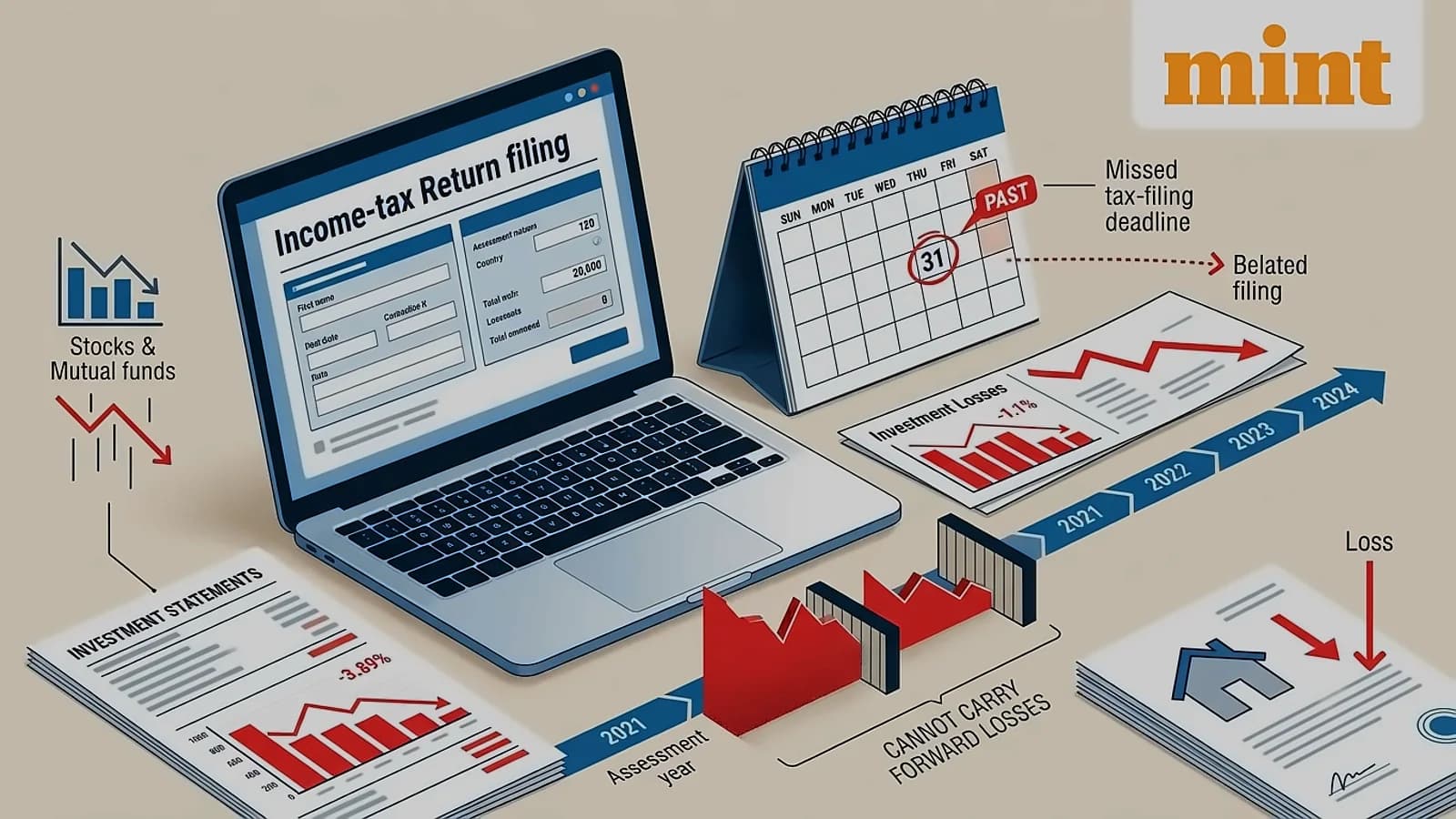
Investors who incurred losses from shares, mutual funds, or other capital assets during the year may still need to file an income tax return (ITR) to preserve important tax benefits. According to tax expert Balwant Jain, filing an ITR is particularly important when investors have incurred capital losses and want to carry them forward for adjustment against future gains. An individual whose income is below the basic exemption limit may not be mandatorily required to file an ITR, but if losses from capital assets are unadjusted and the taxpayer wishes to carry them forward, filing the return becomes essential.
Missing the prescribed ITR filing deadline can result in significant tax consequences for investors with unadjusted losses. As explained by Jain, if an investor fails to file the return within the due date, the right to carry forward those losses is lost, and future gains cannot be reduced by those past losses. For example, if an investor incurs a ₹2 lakh capital loss in FY26 but misses the ITR deadline, and subsequently earns a ₹5 lakh capital gain in the following year, tax would be payable on the entire ₹5 lakh gain. Had the investor filed the return within the deadline, the ₹2 lakh loss could have been carried forward and adjusted against the future gain, reducing the taxable gain to ₹3 lakh.
The applicable ITR form depends on the nature of income reported. For investors reporting capital gains or capital losses from shares and mutual funds, ITR-2 is generally the appropriate form. However, if the taxpayer also has business income, such as from intraday trading activities treated as business income, ITR-3 may be required. According to Jain, the requirement to file the return for carrying forward losses applies irrespective of the nature of the investment, whether equity shares, equity mutual funds, debt mutual funds, gold ETFs, or other capital assets.

Most capital losses can generally be carried forward for up to eight assessment years, subject to conditions prescribed under the Income-tax Act. However, speculative losses are treated differently and can typically be carried forward for only four years. As noted by Jain, speculative losses can be adjusted only against speculative profits and cannot be set off against other categories of income or gains. Transactions where positions are squared off without actual delivery of shares are generally treated as speculative transactions under tax rules.