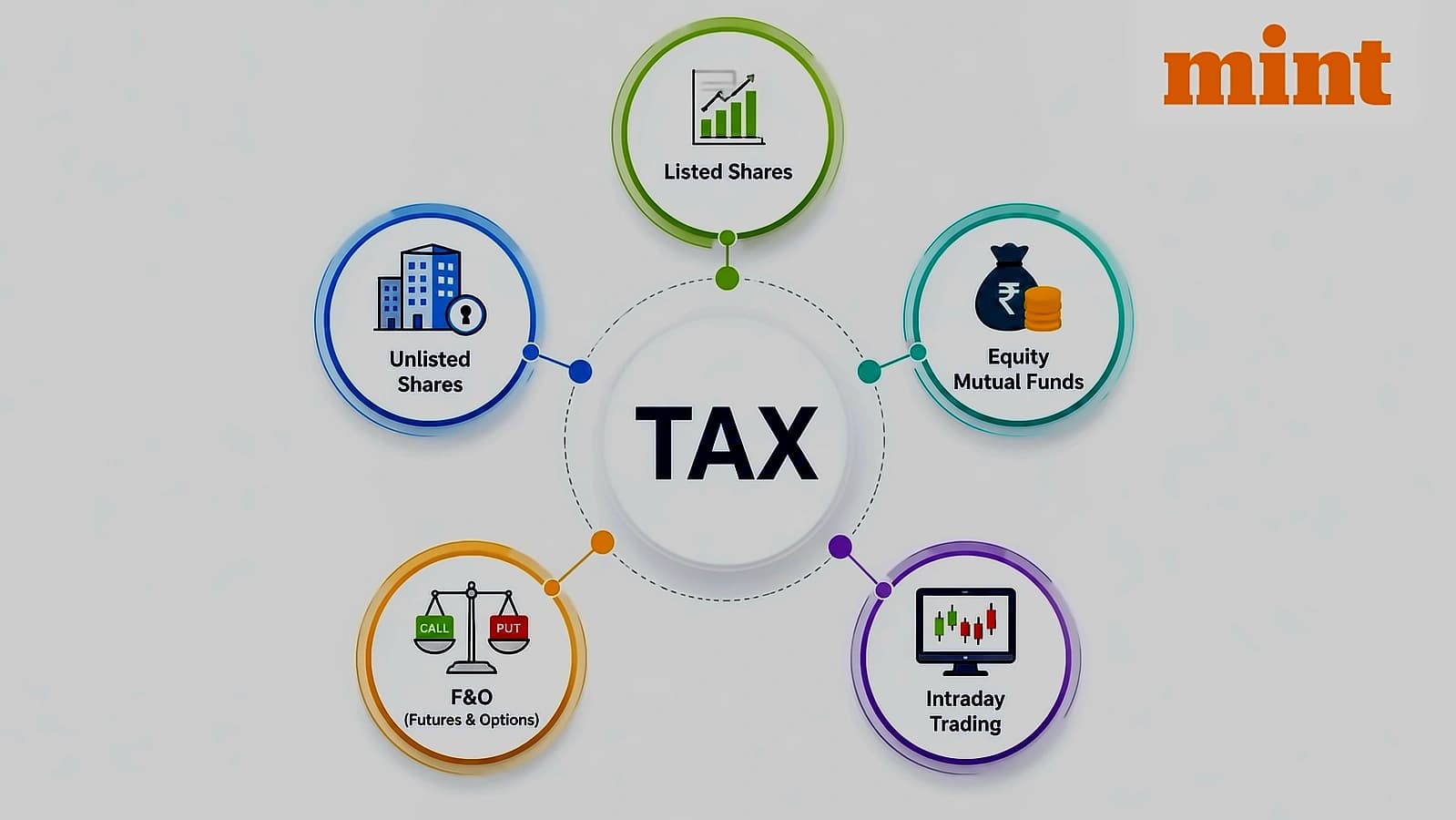
Taxpayers with capital gains must file ITR-2 for AY 2026-27, according to Siddharth Maurya, Managing Director of Vibhavangal Anukulkara Pvt Ltd. However, if taxpayers report capital gains alongside income from business or profession, they must file ITR-3. The July 31, 2026 deadline approaches with significant consequences for late filers. As reported by The Economic Times, failing to file by the deadline results in interest charges and late filing fees for delayed submissions. Not filing an ITR prevents claiming refunds and carrying forward losses, while the tax department may issue notices for non-compliance and missed filings.
According to Nishant Shanker, Tax & Investments Expert at Navraj Global Advisors, capital gains must be reported under the 'Capital Gains' schedule of the ITR. For listed equity shares, equity mutual funds, and equity ETFs, held for 12 months or less qualify as Short-Term Capital Gain (STCG), while held for more than 12 months constitutes Long-Term Capital Gain (LTCG). The Union Budget 2024 increased the STCG tax rate from 15% to 20% for transactions from July 23, 2024, which remains applicable for FY 2025-26. Taxpayers should report each transaction with sale proceeds, cost of acquisition, and resulting capital gain or loss, along with eligible brought-forward capital losses to offset current-year gains. As reported by Mint, taxpayers can also report eligible brought-forward capital losses to set them off against current-year capital gains.
Section 111A provides a concessional flat tax rate of 20% for short-term capital gains from listed equity shares and equity-oriented mutual funds, replacing slab-rate taxation. The section applies to equity shares of companies listed on recognised stock exchanges and units of equity-oriented mutual funds, with a mandatory Securities Transaction Tax (STT) requirement of around 0.1% on delivery-based equity trades. Resident individuals and HUFs can use their unused basic exemption limit (₹2.5 lakh under old regime, ₹3-4 lakh under new regime) to offset STCG before applying the 20% rate. However, non-resident individuals (NRIs) cannot claim this basic exemption adjustment and are typically subject to TDS on STCG regardless of their overall income level.
Long-term capital gains (LTCG) on most assets, excluding certain Debt Funds, are now taxed at 12.5% under the simplified framework introduced by Budget 2024. For equity mutual funds, exchange-traded funds (ETFs) and listed stocks, the long-term holding period is more than 12 months, while short-term gains are taxed at 20%. Gold ETFs also qualify for long-term capital gains if held for more than 12 months and attract a 12.5% LTCG tax. However, short-term gains from gold ETFs are taxed as per the investor's slab rate. Real estate investment trusts (REITs) and infrastructure investment trusts (InvITs) follow equity-like taxation with holding period of more than 12 months for LTCG, taxed at 12.5% while short-term gains attract 20% tax. Listed bonds held for more than 12 months are considered long-term investments and are taxed at 12.5%.
Debt mutual funds have experienced significant changes after April 1, 2023. Debt funds purchased after this date no longer receive indexation benefits, and all gains are taxed according to the investor's slab rate, regardless of the holding period. Debt funds bought before April 1, 2023 continue to follow earlier rules, with long-term gains after 24 months taxed at 12.5%. Real estate taxation has special transition rules - properties purchased before July 23, 2024 offer investors a choice between 12.5% tax without indexation or 20% tax with indexation, whichever results in lower tax liability. However, properties purchased after July 23, 2024 are taxed at a flat 12.5% LTCG rate without indexation benefits. For example, a ₹5 lakh gain from Large-Cap equity mutual fund after holding for 14 months would result in tax liability of around ₹46,875 before cess, while a similar gain from physical gold sold within 20 months would be treated as short-term gain and added to taxable income.