The tax treatment of equity investments in India depends on the type of investment, the holding period, and whether the income is classified as capital gains or business income. According to reports from Mint, gains from delivery-based equity shares and equity mutual funds are classified as either short-term capital gains (STCG) or long-term capital gains (LTCG) based on the holding period. For listed equity shares, if an investor sells shares within 12 months of purchase, the profits are treated as STCG and taxed at 20%. If the shares are held for more than 12 months, the gains qualify as LTCG and are taxed at 12.5%, but only on the amount exceeding ₹1.25 lakh in a financial year. FY 2025-26 marks the first full assessment year under the new 20% short-term and 12.5% long-term rates on listed equity, following the mid-FY 2024-25 capital gains tax structure changes. For unlisted shares, the taxation framework differs significantly, with STCG taxed according to applicable income tax slab rates and LTCG at 12.5% after a 24-month holding period. The notable change this year is that ITR-1 and ITR-4 can now accommodate small long-term equity gains up to ₹1.25 lakh, provided there are no brought forward capital losses.
ITR filing 2026 for Assessment Year 2026-27 covers income earned between 1 April 2025 and 31 March 2026, with different deadlines based on taxpayer categories. Salaried individuals and non-audit taxpayers using ITR-1 or ITR-2 have a due date of 31 July 2026, while non-audit business and professional filers using ITR-3 or ITR-4 get an extended deadline of 31 August 2026 under Finance Act 2026 amendment. Taxpayers requiring tax audit have a due date of 31 October 2026 with audit report submission by 30 September 2026. The new tax regime under Section 115BAC remains the default, with the basic exemption rising from ₹3 lakh to ₹4 lakh and a fresh 25% band inserted between ₹20 lakh and ₹24 lakh. For listed equity shares and equity-oriented mutual funds, the holding period dividing line is 12 months, with short-term capital gains under Section 111A taxed at a flat 20% and long-term gains under Section 112A taxed at 12.5% on amounts above the ₹1.25 lakh annual exemption.
Intraday trading, where shares are bought and sold on the same day without taking delivery, is treated differently from regular investing. As reported by Mint, under Section 43(5) of the Income Tax Act, intraday trading is considered speculative business income. Therefore, the income is taxed under the head "Profits and Gains of Business or Profession" rather than capital gains. The profits are added to the taxpayer's total income and taxed according to the applicable income tax slab rate, which can range from 5% to 30%. For ITR filing 2026, intraday equity trading is reported in ITR-3 form, with turnover computed using the absolute profit method summing absolute values of profit and loss on each squared off contract. Tax audit under Section 44AB becomes mandatory once turnover crosses ₹1 crore with more than 5% cash transactions, or ₹10 crore regardless of cash usage. According to Taxmann Research, in speculative transactions, the aggregate of both positive and negative differences is considered as turnover. For example, if Mr. X does intra-day trading of shares during the year, his turnover computation would include both gains and losses from all transactions, with losses from speculative transactions not allowed to be set off against other income. Loss-making F&O traders should generally file ITR-3 with proper books rather than opting into presumptive taxation.
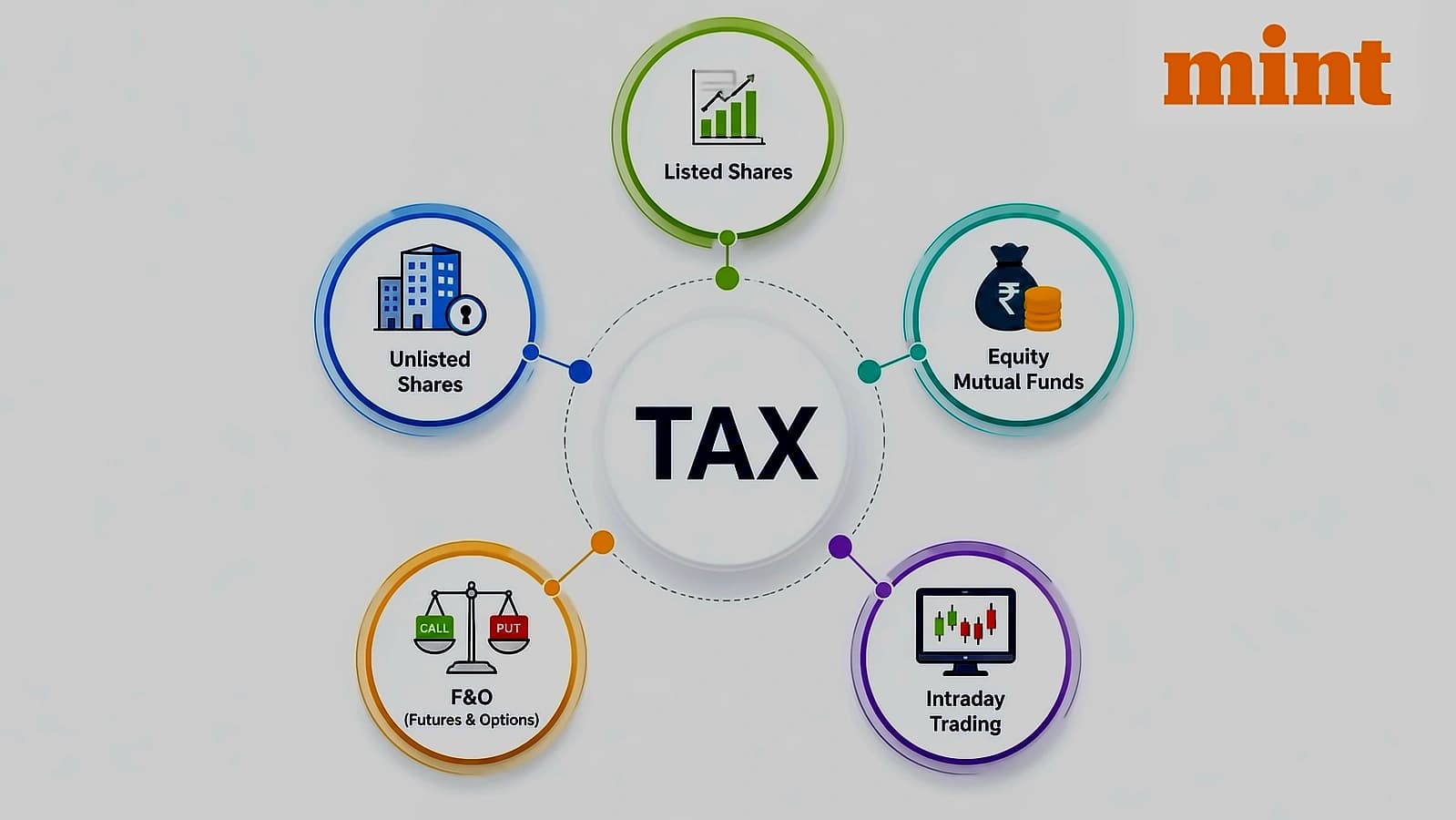
The taxation of unlisted shares depends on how long the shares are held before being sold. According to Mint, if unlisted shares are sold within 24 months, the gains are treated as short-term capital gains and taxed according to the investor's applicable income tax slab. If the shares are held for more than 24 months, the gains qualify as long-term capital gains and are taxed at 12.5% with no indexation benefits available. Equity-oriented mutual funds follow the same tax framework as listed equity shares, with gains classified as STCG at 20% for units held within 12 months and LTCG at 12.5% for units held longer than 12 months. For ITR filing 2026, debt mutual funds (post 1 April 2023) are taxed at slab rates, while unlisted shares long-term gains under Section 112 are taxed at 12.5%. For shares acquired before 1 February 2018, the cost of acquisition under Section 112A is grandfathered at the higher of actual cost or the lower of the 31 January 2018 fair market value and the sale price. When unlisted shares get listed, they become listed equity with different tax implications - STCG is taxed at 20% if sold within 12 months of listing, while LTCG is taxed at 12.5% if sold after 12 months, with listed shares eligible for the ₹1.25 lakh annual LTCG exemption.
F&O trading income is classified as non-speculative business income under the Income Tax Act. As reported by Mint, the resulting profits are added to the taxpayer's total income and taxed according to the applicable income tax slab rate, which can range from 5% to 30%. This classification differs from intraday trading, which is treated as speculative business income. For ITR filing 2026, F&O trading in equity, index, commodity and currency derivatives is reported in ITR-3 form, with turnover computed using the absolute profit method. Tax audit under Section 44AB becomes mandatory once turnover crosses ₹1 crore with more than 5% cash transactions, or ₹10 crore regardless of cash usage. According to Taxmann Research, income from speculative business is computed in the same way as normal business and taxed at rates applicable to the individual taxpayer. However, any loss arising from speculative business is not allowed to be set off from any other income including income from non-speculative business. A frequently missed trap under Section 44AD(4) is that traders who opted for presumptive taxation and later declare profit below the presumptive rate can trigger mandatory audit under Section 44AB(e) irrespective of turnover. Loss-making F&O traders should generally file ITR-3 with proper books rather than opting into presumptive taxation, since 44AD deems a profit and bars loss carry forward.