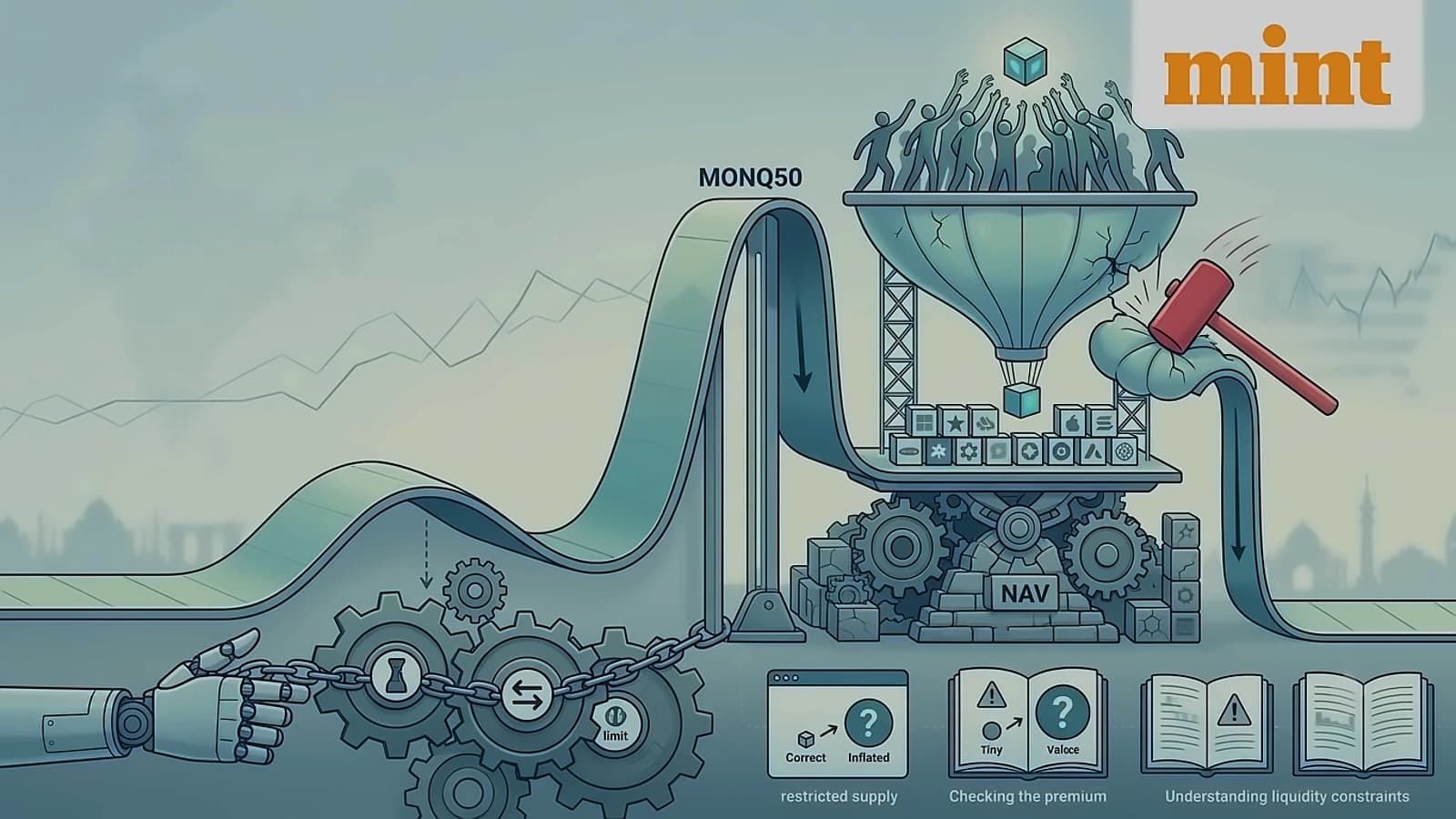
The BSE has officially cautioned investors and market participants about certain Exchange Traded Funds (ETFs), particularly those investing in overseas securities, trading at a substantial premium to their Net Asset Value (NAV). According to the latest BSE advisory, the NAVs of the underlying schemes of these ETFs have remained broadly stable, while new units cannot be created by mutual funds as the overseas investment limits available to mutual funds are fully utilised. The exchange has advised investors to exercise extreme caution and conduct due diligence before placing orders in such ETFs, including verifying the NAVs provided on the stock exchange, AMFI website or trading application/terminal. As per The Financial Express, this warning comes as Indians are paying a much higher price than the actual value when buying global ETFs through stock exchanges.
India-listed international ETFs have recently highlighted a critical issue for investors: the price paid on stock exchanges may not match the value of underlying assets. According to reports from CNBC TV18, this became evident in September when some international ETFs, including the Motilal Oswal Nasdaq Q50 ETF, traded at substantial premiums to their indicative net asset value (iNAV). Several other India-listed international ETFs have also traded above their underlying value, though the size of premiums has varied significantly across different funds. As explained by The Financial Express, if the NAV of a fund is ₹100, the market price of the ETF could be ₹130, on any given day, translating into a premium of 30%. This premium could rise even further, creating significant cost implications for investors.
The primary reason for Indian global ETFs trading at a premium to NAV is primarily regulatory, as reported by The Financial Express. Two SEBI rules have impacted their pricing structure, creating artificial demand-supply imbalances. The exchange has specifically warned investors about risks associated with purchasing units at steep premiums, as reported by NDTV Profit. The exchange cautioned that investors purchasing such units at steep premiums are exposed to the risk of an abrupt fall in prices unrelated to movements in the underlying securities. Such a fall could occur upon enhancement of overseas investment limits or migration of the base price for ETF price bands to the T-1 day NAV from April 1, 2027, as per the SEBI circular dated June 15, 2026. The provisions came into effect from September 7, 2026.
The most damaging aspect of premium trading is the potential for overnight crashes that could wipe out investor returns. According to The Financial Express, what if the premium disappears? It may crash overnight, with the ETF hitting the lower circuit for 2 to 3 days in a row. That means the market price may fall 20% a day, pulling the price down to nearly half in just three days of trading. Additionally, investors are not only paying premiums but also holding a price that has drifted away from the performance of the underlying benchmark that the ETF tracks. As reported by Vested, US-listed ETFs bought through the LRS route trade at or very close to their NAV, so the premium itself can become the biggest cost. The premium itself can overwhelm relatively small differences in brokerage or expense ratios.
Direct investment in overseas-listed ETFs through the Liberalised Remittance Scheme (LRS) offers an alternative route for Indian investors. As reported by CNBC TV18, this provides access to overseas-listed ETFs directly rather than India-listed ETFs influenced by local demand and supply. According to Vested, US-listed ETFs can be bought directly through the LRS route, and they trade at or very close to their NAV because units can be created and redeemed freely. International brokerage platforms also offer access to global ETFs, with brokerage on US stocks and ETFs at 0.25% of trade value on Basic plan and 0.15% on Premium, capped at $35 per trade. However, investors must consider forex conversion, remittance charges, brokerage, taxation and currency movements. UCITS ETFs remain another option, though investors need to evaluate domicile, dividend treatment, taxation, and currency exposure factors.