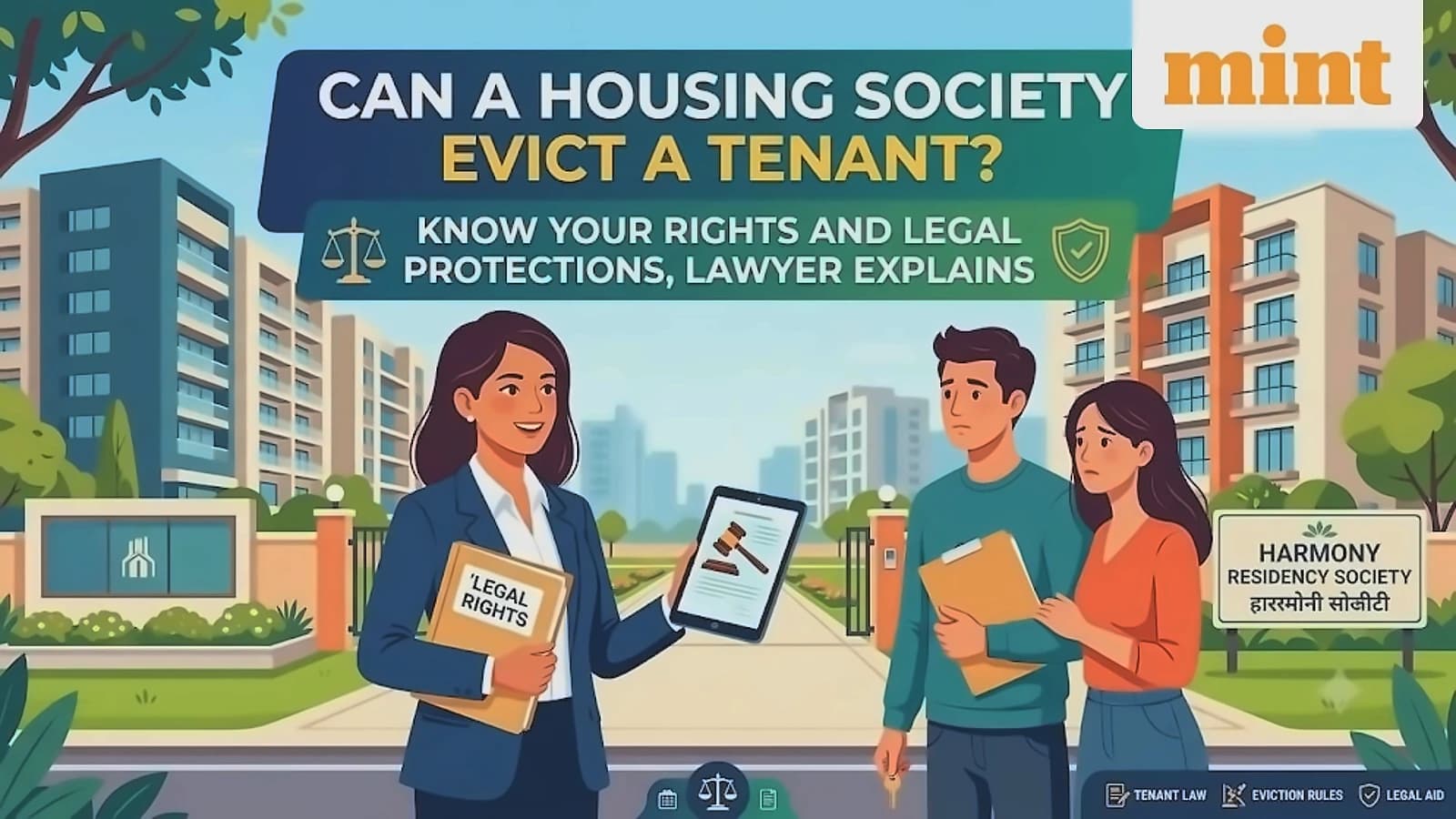
A housing society cannot force a flat owner to vacate or sell the property merely because its general body passed a majority resolution. According to reports from Business Standard, even in Maharashtra where the law allows a cooperative society to expel a member in specified circumstances, expulsion from membership and eviction from the flat are legally separate matters. The issue gained prominence after a recent Maharashtra Co-operative Appellate Court ruling, where a housing society's attempt to evict a resident over alleged nuisance and disturbance was rejected, with the court underlining that a society cannot treat its internal resolution as an eviction order.
Under Section 35 of the Maharashtra Co-operative Societies Act, 1960, a society can initiate expulsion proceedings against a member in specified circumstances. As reported by Business Standard, the provision requires a resolution passed by at least three-fourths of members entitled to vote and present at the relevant general meeting. The member must also be given an opportunity to put forward their case, and the expulsion requires the Registrar's approval. Sneha Agicha, advocate at D. M. Harish & Co., emphasized that 'the expression 'three-fourths majority' should not be understood as giving the society an unrestricted power to remove a person from his property.'
The central point for flat owners is that membership of a cooperative housing society is a statutory relationship, while ownership of a flat is a property right. According to Business Standard reports, Grahita Agarwal, senior associate at B Shanker Advocates LLP, stated that 'expulsion from membership does not, per se, terminate the member's title or confer upon the society a right to dispossess the owner.' Vipul Jai, partner at PSL Advocates & Solicitors, noted that Article 300A of the Constitution protects the right to property and provides that no person can be deprived of property except by authority of law. This means a society cannot simply tell an owner that they must sell their flat because three-fourths of residents have voted against them.
When a resident repeatedly violates bye-laws, causes nuisance, carries out unauthorized commercial activity or defaults on legitimate dues, a society can enforce applicable bye-laws and initiate proceedings through the mechanisms provided under relevant co-operative law. As reported by Business Standard, Tvisha Desai, principal associate at The Fort Circle, explained that expulsion proceedings under Maharashtra law require a minimum one-month notice, an opportunity for the member to be heard, and the prescribed three-fourths majority. The resolution must then be sent to the Registrar, with consequences depending on how the flat is held and applicable state law and bye-laws.

If a society threatens to remove an owner, force a sale or disconnect essential services, experts recommend that owners should avoid confrontation and document all notices, resolutions and communications. According to Business Standard, available remedies include challenging unlawful society resolutions before the appropriate statutory forum, seeking an injunction against forcible dispossession, approaching competent co-operative or civil forums depending on the dispute nature, and seeking restoration of essential services if water or electricity is disconnected. Tushar Kumar, advocate at Supreme Court of India, emphasized that a society must operate within the powers given to it by law and establish its entitlement before the competent forum.