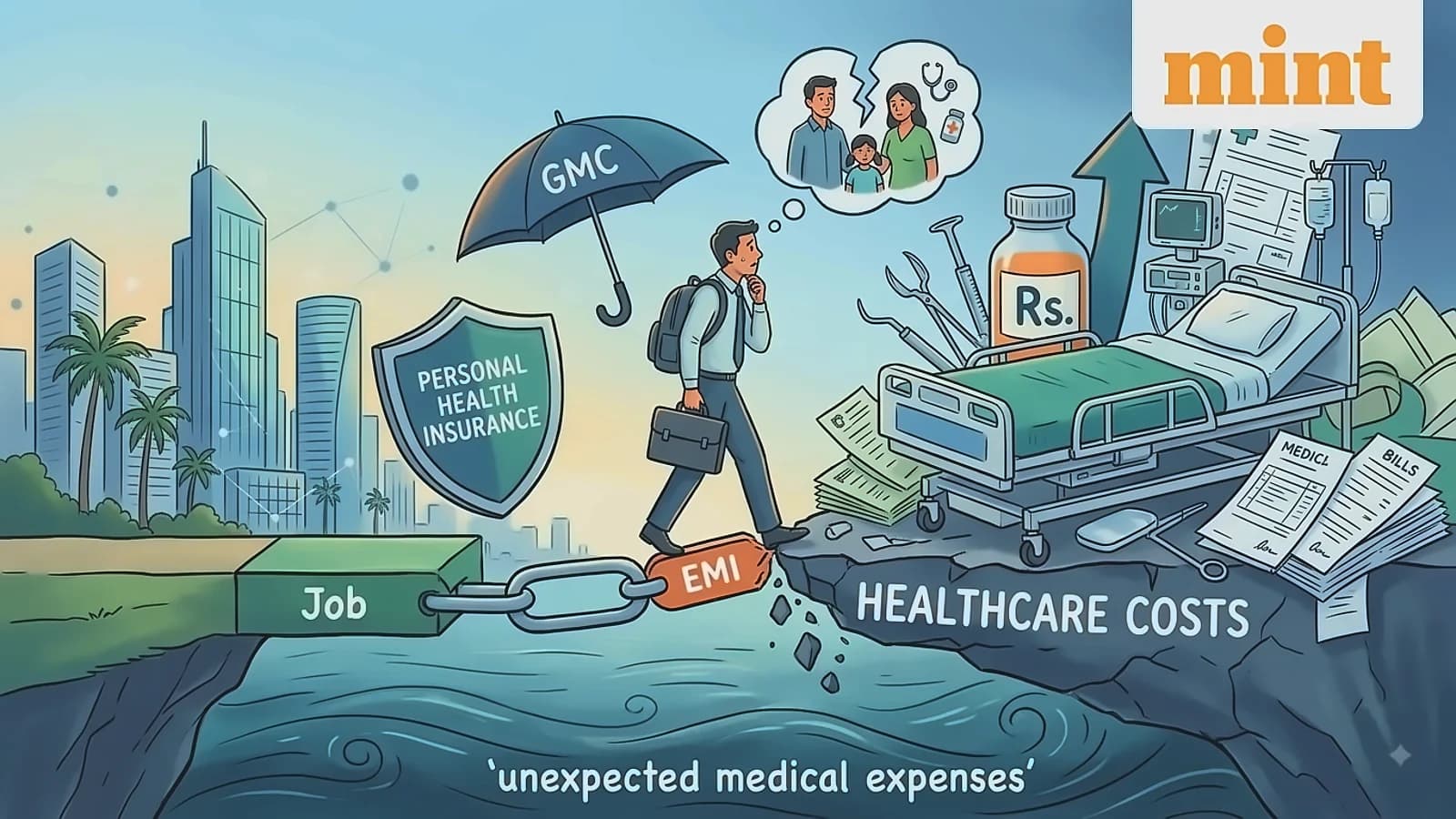
Employers are facing unprecedented healthcare cost pressures, with employer healthcare spending expected to rise 76% from 2018 through 2027, roughly twice as fast as overall inflation. According to the Business Group on Health, this marks the third consecutive year employers have spent more on healthcare than they forecast. The crisis has drawn increased attention from chief financial officers and other senior executives, with Jim Winkler, the group's chief strategy officer, comparing it to repeatedly missing sales forecasts. Nearly all employers surveyed sought new bids for at least one healthcare vendor, and more than half plan to eliminate vendors that aren't performing well. Workers are bearing the brunt of these increases, with Oregon workers paying nearly $9,400 annually for family coverage in 2025, up from $3,900 in 2010, while single coverage costs rose from $850 to $1,500 over the same period.
Health insurance policies contain three primary cost-sharing mechanisms that can significantly impact out-of-pocket expenses during medical treatment. According to Mint, deductibles are fixed amounts that policyholders must pay upfront, with the exact amount clearly specified in policy documents. Co-pays are percentage-based charges that increase proportionally with claim size, as explained by Shashi Kant Dahuja, executive director and chief underwriting officer at Shriram General Insurance. However, coinsurance represents a percentage of the allowed amount that changes based on what the service costs, with the difference becoming apparent when comparing a ₹2 lakh claim with a ₹5 lakh claim under a 10% co-pay structure - the out-of-pocket expense increases from ₹20,000 to ₹50,000 respectively. As reported by educational resources, copays are fixed dollar amounts that usually stay the same for the same covered service, while coinsurance applies as a percentage of the allowed amount and may be calculated on the negotiated rate rather than the provider's original billed charge.
Marketplace health insurance offers four metal categories - bronze, silver, gold, and platinum - each indicating how policyholders and insurers share costs for covered services. As reported by Mint, bronze plans tend to have the lowest premiums but generally require higher deductibles, copays, and coinsurance when receiving care. The premium structure varies significantly by age, with 2026 benchmark premiums ranging from $481.70 for 21-year-olds to $1,308.63 for 60-year-olds before tax credits. Silver plans may qualify for cost-sharing reductions that lower deductibles, copays, coinsurance, and out-of-pocket maximums for eligible enrollees. Catastrophic plans are available to eligible consumers but generally have lower premiums and very high deductibles, making them suitable only for those who expect minimal medical expenses. Recent data shows that in 2026, Vermont, Wyoming, and West Virginia have the highest average Marketplace benchmark premiums among the states, while New Hampshire, Maryland, and Minnesota have the lowest. For individual coverage, the average 2026 Marketplace deductible stands at $3,786, up from $2,759 the previous year, with standard silver plans averaging $5,304.

The choice between deductibles, co-pays, and coinsurance depends significantly on claim size and individual financial capacity. According to Bikash Choudhary, CEO of FatakSecure, a ₹50,000 deductible versus a 5% co-pay would result in identical ₹50,000 contributions on a ₹10 lakh claim. However, on smaller claims, the co-pay structure proves more cost-effective - a ₹1.5 lakh claim would require only ₹7,500 under a 5% co-pay versus the full ₹50,000 deductible amount. On larger claims like ₹30 lakh, the co-pay structure becomes substantially more expensive, requiring ₹1.5 lakh versus the fixed ₹50,000 deductible amount. Coinsurance typically applies after meeting the deductible, with the percentage changing based on the allowed amount for different services - for example, a specialist visit with a ₹40 copay versus 20% coinsurance on a ₹500 allowed amount would result in ₹100 total responsibility. In 2024, more than half of workers with employer coverage were enrolled in high-deductible health plans, according to federal data analysis, highlighting the growing shift toward cost-sharing structures.
Employers are implementing various strategies to manage escalating healthcare costs while minimizing worker burden. According to industry analysis, employers expect to keep picking up about 80% of the healthcare bill, but workers still face increased financial pressure as their 20% contribution represents a larger absolute amount. Some employers are tying employee contributions to salaries so lower-paid workers pay less, while others are exploring alternative plan structures. Johnson of Precision NW Electric moved his company to a level-funded plan, which places more financial risk on the business for employees' medical bills in exchange for potential cost savings. He estimates comparable medical coverage costs about 11% less than the company's previous health plan, using savings to expand benefits including family coverage and dental/vision insurance. The impact on workers is substantial - one-third of U.S. adults said they had cut other spending to cover healthcare or medicine, with nearly 30% of insured adults reporting healthcare costs forced financial trade-offs. Healthcare costs are affecting major life decisions, with 18% of adults delaying job changes, 14% postponing home purchases, and nearly one in 10 postponing retirement due to healthcare expenses.