Indian household asset allocation has undergone a significant transformation over the past three years, with gold emerging as the standout performer. According to the latest Kotak Mutual Fund 'D-Kode' report for September 2026, gold's share in household assets jumped from 15.4% in March 2023 to 24.2% in March 2026, representing one of the most notable shifts in where Indian households are storing their wealth. This dramatic increase occurred despite total household assets rising from $11.3 trillion in March 2023 to $16 trillion in March 2026, making the change even more significant in absolute terms. The data suggests that while India's rising mutual fund SIP and equity fund inflows may indicate households moving toward equities, the broader asset allocation trends tell a different story.
The scale of the shift in gold holdings is particularly striking when examined in dollar terms. As reported by Mint, gold accounted for about $1.74 trillion of Indian household assets in March 2023, rising to roughly $3.87 trillion by March 2026. This represents a substantial increase of approximately $2.1 trillion in three years, with household wealth held in gold more than doubling during this period. By comparison, equities barely moved from 5.6% to 5.7% of total household assets over the same three-year period, despite rapid growth in SIP investments and mutual fund participation. The data indicates that while new money may be flowing into market-linked products, it has not yet fundamentally altered the overall composition of Indian household wealth.
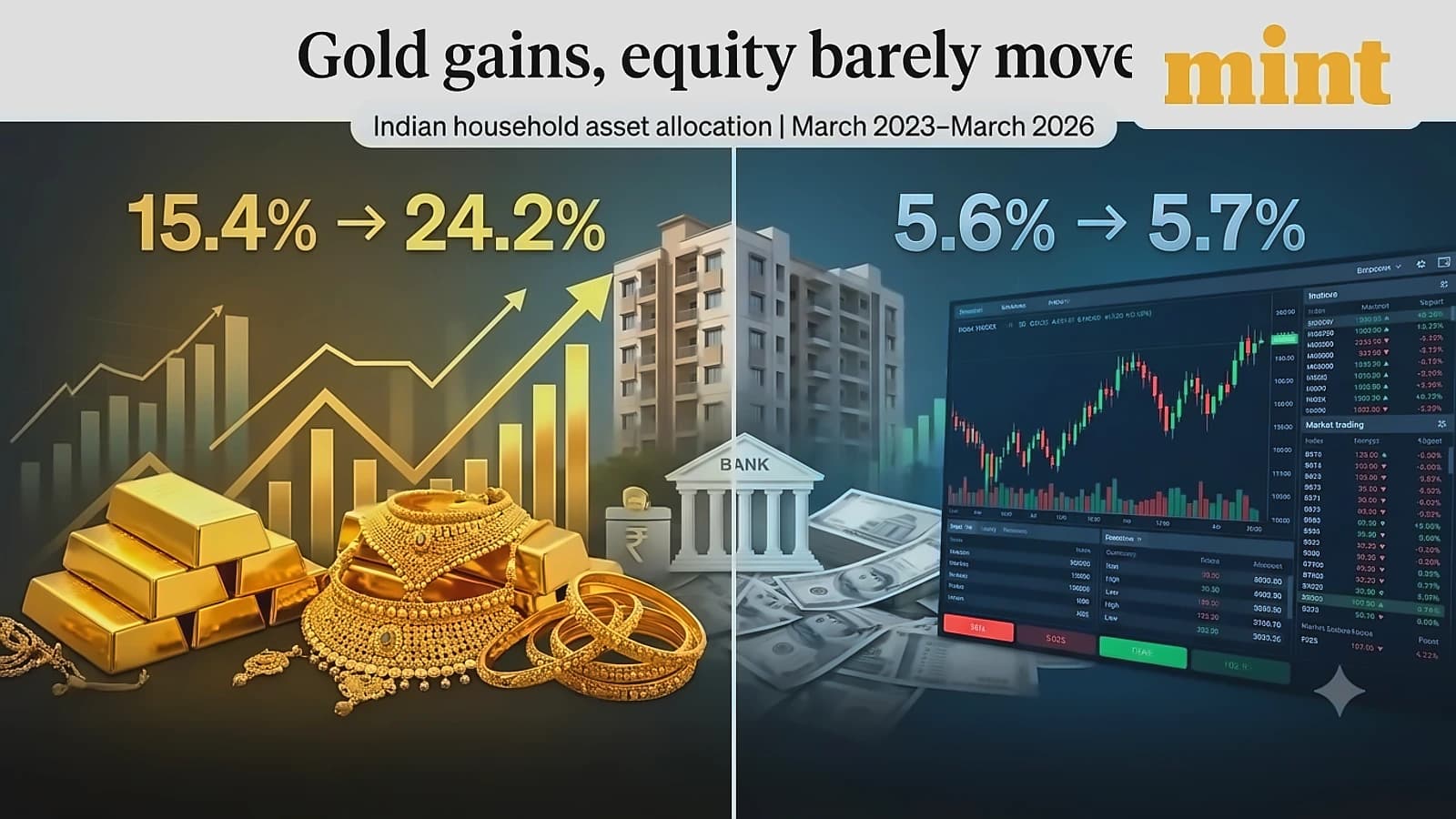
Despite India's rising mutual fund SIP and equity fund inflows, equities barely moved from 5.6% to 5.7% of total household assets over the three-year period. According to the Kotak Mutual Fund 'D-Kode' report, this modest increase occurred despite the rapid growth in SIP investments and mutual fund participation. The data suggests that while new money may be flowing into market-linked products, it has not yet fundamentally altered the overall composition of Indian household wealth, indicating that households are not necessarily moving away from traditional asset classes toward equities. This trend continues to be a key observation in the latest asset allocation data.
Property remains the biggest component of Indian household assets, though its share has declined meaningfully from 51.3% in March 2023 to 47.6% in March 2026. As reported by Mint, this decline in property's dominance still leaves nearly half of the household asset pool tied up in real estate, underlining how important real estate continues to be in Indian wealth creation and preservation. Bank deposits have also lost ground, with their share declining from 14.1% in March 2023 to 11.2% in March 2026, suggesting that while bank deposits continue to form an important part of household savings, they have lost some ground within the overall asset mix. Bank deposits remain the third-largest component of household wealth despite this decline.
Several other asset classes have experienced declining shares in household wealth over the three-year period. According to the Kotak Mutual Fund 'D-Kode' report, insurance funds saw their share decline from 6.3% to 5.1%, while provident and pension funds edged down from 3.9% to 3.7%. Cash holdings fell more sharply, from 3.4% to 2.5% during the same period. These declines suggest that Indian households are gradually changing the composition of their wealth, but the shift is not simply from traditional assets to equities, with gold emerging as the primary beneficiary of this reallocation. The numbers show that Indian households are gradually changing the composition of their wealth, with property still dominating household balance sheets while gold has gained considerable ground.