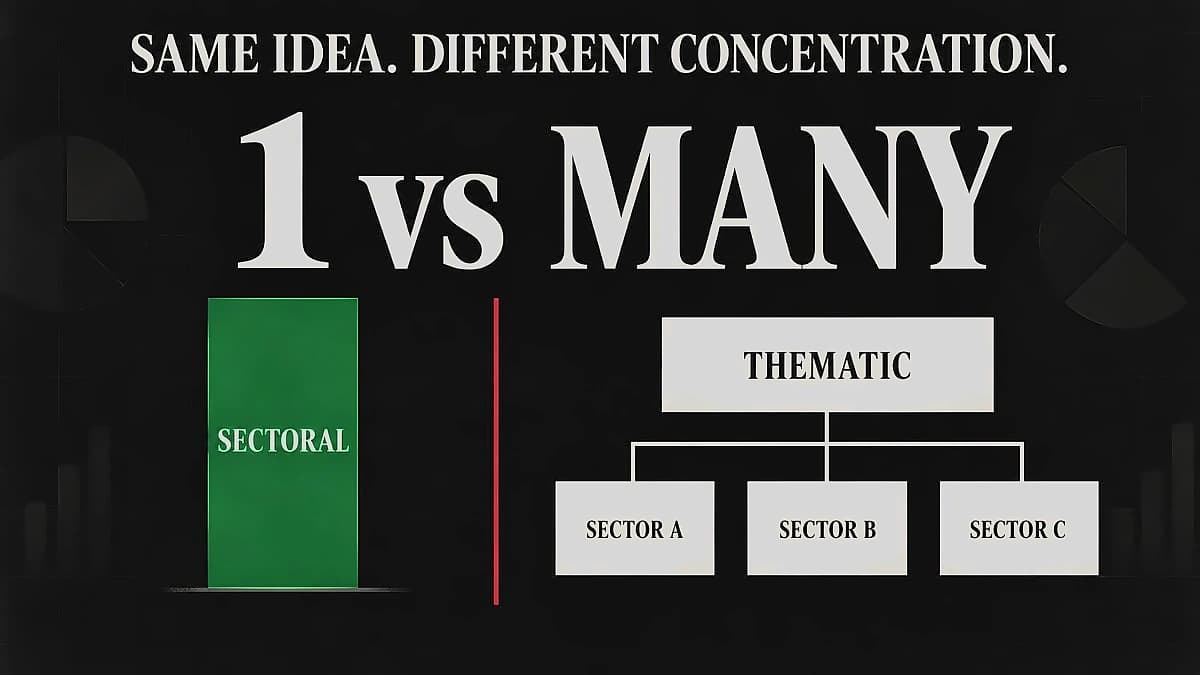
According to reports from Mint, focused funds are equity mutual fund schemes that invest in a limited number of stocks, allowing fund managers to take concentrated bets. Under SEBI regulations, focused funds can invest in up to 30 stocks with a mandatory allocation of at least 80% of their total assets to equity and equity-related instruments. The revised framework, effective 1 April 2026, requires schemes to clearly specify their investment focus, such as large-cap, mid-cap, small-cap, or multi-cap. This updated definition aims to provide greater clarity on the investment universe while ensuring a higher allocation to equities.

As reported by Mint, focused funds follow a concentrated portfolio strategy where fund managers screen a broad universe of stocks based on factors such as business quality, earnings growth, management strength, valuation, and future prospects. Since the portfolio is restricted to 30 stocks or fewer, each holding typically carries a larger weight than in diversified equity funds. The funds have flexibility to allocate capital across sectors and market capitalisations, allowing managers to capitalise on opportunities wherever they see the greatest potential. This concentrated approach enables managers to allocate more capital to quality ideas, potentially enhancing returns if their investment thesis plays out as expected.
According to Mint, focused funds are best suited for investors with a long-term horizon of 5-7 years or more due to the portfolio's limited stock exposure. Investors should consider the fund's risk appetite as these schemes tend to be more volatile than diversified equity funds, with sharper ups and downs. Performance review over 3-year, 5-year, and 10-year periods can provide insights into how the fund navigates different market environments. Key metrics to evaluate include alpha (measuring fund manager's ability to generate returns above the benchmark), beta (indicating fund sensitivity to market movements), portfolio turnover ratio, and fund manager track record.
As reported by Mint, focused funds offer several advantages including a higher conviction portfolio that allows fund managers to allocate more capital to quality ideas, potentially enhancing returns. These funds can outperform during certain market cycles when select groups of stocks drive performance, as successful stock picks have larger portfolio impact. Focused funds provide greater flexibility across market segments as they're not restricted by market capitalisation, enabling investment across large-, mid-, and small-cap stocks. The easier portfolio monitoring with fewer holdings allows investors to better understand fund composition and strategy alignment.
According to Mint, focused funds face significant risks including concentration risk where poor performance in even a few holdings can significantly impact overall returns due to the lower margin for error. The funds tend to experience higher volatility with sharper ups and downs than diversified equity funds. Success depends heavily on fund manager's stock-picking ability and investment process, with a few incorrect decisions directly affecting returns over time. Sector and theme concentration can create vulnerability if specific industries fall out of favour, potentially causing prolonged portfolio pressure.