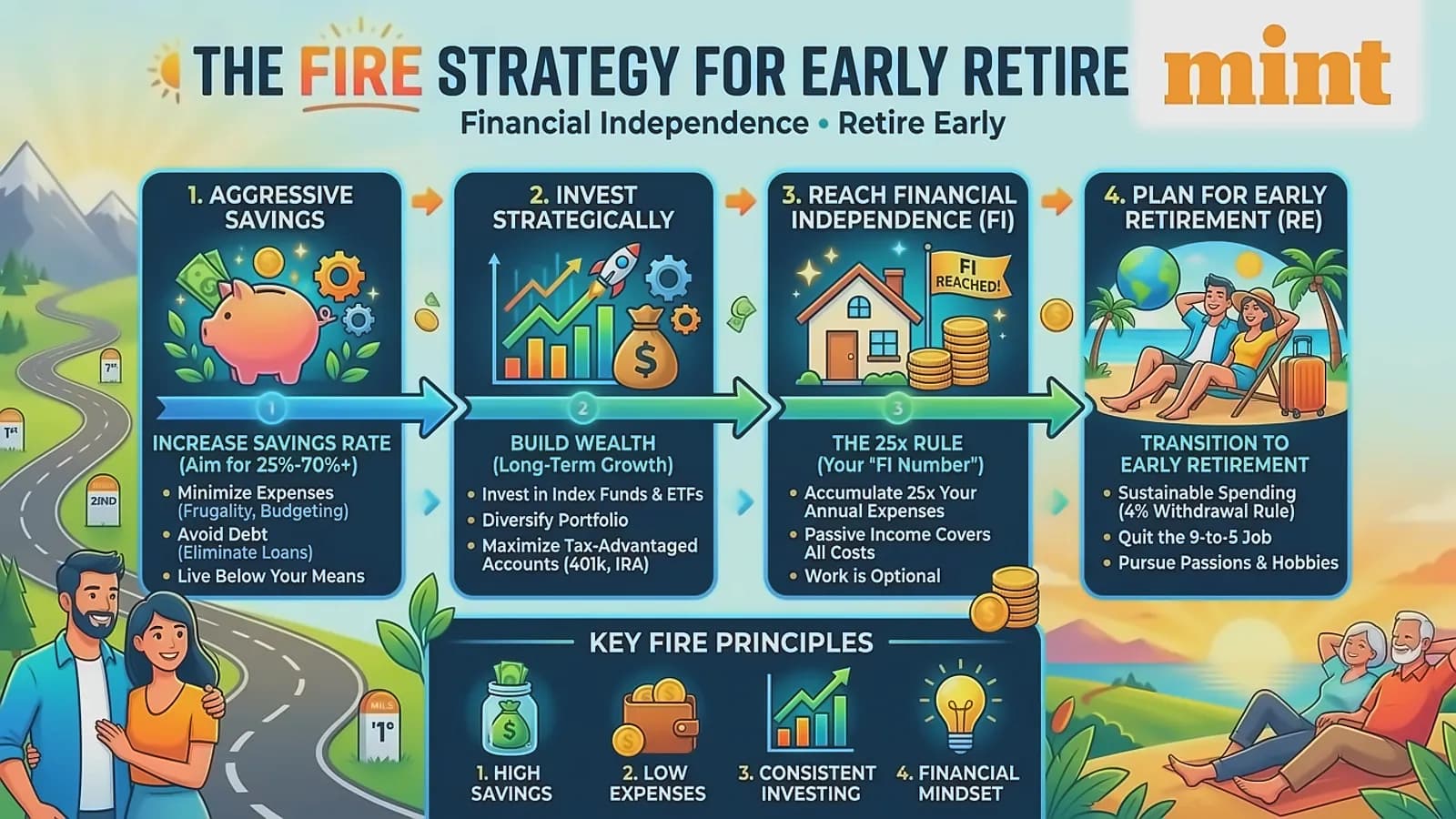
Financial Independence, Retire Early (FIRE) represents a growing trend among Indian professionals seeking to retire by age 45. According to reports from The Economic Times, the strategy involves saving a large portion of income, investing in assets that grow over time, and building a corpus large enough to live off returns without needing a salary. The common rule suggests requiring approximately 25 times annual expenses for retirement, meaning someone spending ₹6 lakh annually would need about ₹1.5 crore invested. However, due to higher Indian inflation, many experts recommend a safer withdrawal rate of 3-3.5%, which requires an even larger corpus.

As reported by The Economic Times, FIRE offers diverse paths based on lifestyle preferences. Lean FIRE is suitable for those comfortable with simple living and low expenses, allowing early retirement with smaller investment corpuses. Fat FIRE targets people who want financial freedom without compromising lifestyle, requiring much larger corpuses for continued comfortable spending. Barista FIRE represents a middle path where individuals do part-time work or freelancing to cover expenses while investments remain untouched. Coast FIRE focuses on heavy investing at young ages, then stopping fresh investments to allow compounding until normal retirement age.
According to The Economic Times, most FIRE followers invest heavily in equity mutual funds through SIPs due to equities' potential for higher long-term returns. During wealth-building years, investors typically allocate 70-80% of funds to equities to maximize growth. As retirement approaches, they gradually shift more money into safer investments like debt funds or fixed-income products to reduce risk. The approach emphasizes that saving discipline is more crucial than returns, with consistent 40-50% savings potentially enabling much faster wealth building and earlier retirement than traditional 10% saving rates. Recent guidance from financial experts also emphasizes the importance of emergency savings as a buffer against dipping into long-term investments during unexpected financial challenges.
Recent personal accounts highlight the practical difficulties of implementing FIRE strategies. As reported by The iPaper, one individual who started a pension at age 31 initially begrudged the small contributions while struggling with debt from student loans and overdrafts. When she left her job five years later, she forgot about the pension and focused on basic bill payments as a freelance journalist. The experience underscores how mortgage responsibilities can feel more pressing than retirement planning, and how individuals often prioritize immediate financial needs over long-term wealth building. These stories demonstrate that emotional barriers around money and immediate financial pressures can derail even well-intentioned FIRE plans.
According to The Economic Times, FIRE offers valuable benefits beyond early retirement, including disciplined saving habits, regular investing practices, and understanding of financial needs. Many Indian FIRE planners maintain separate healthcare funds specifically for medical emergencies to prevent healthcare costs from affecting the main retirement corpus. The strategy encourages financial freedom and flexibility, allowing individuals to make career choices based on interest rather than necessity. While FIRE is easiest for those with high incomes or very low expenses, the core principles remain valuable for improving financial security regardless of retirement timeline. Real-life experiences show that even when FIRE plans face setbacks, the underlying principles of consistent saving and long-term wealth building can provide a foundation for financial stability.