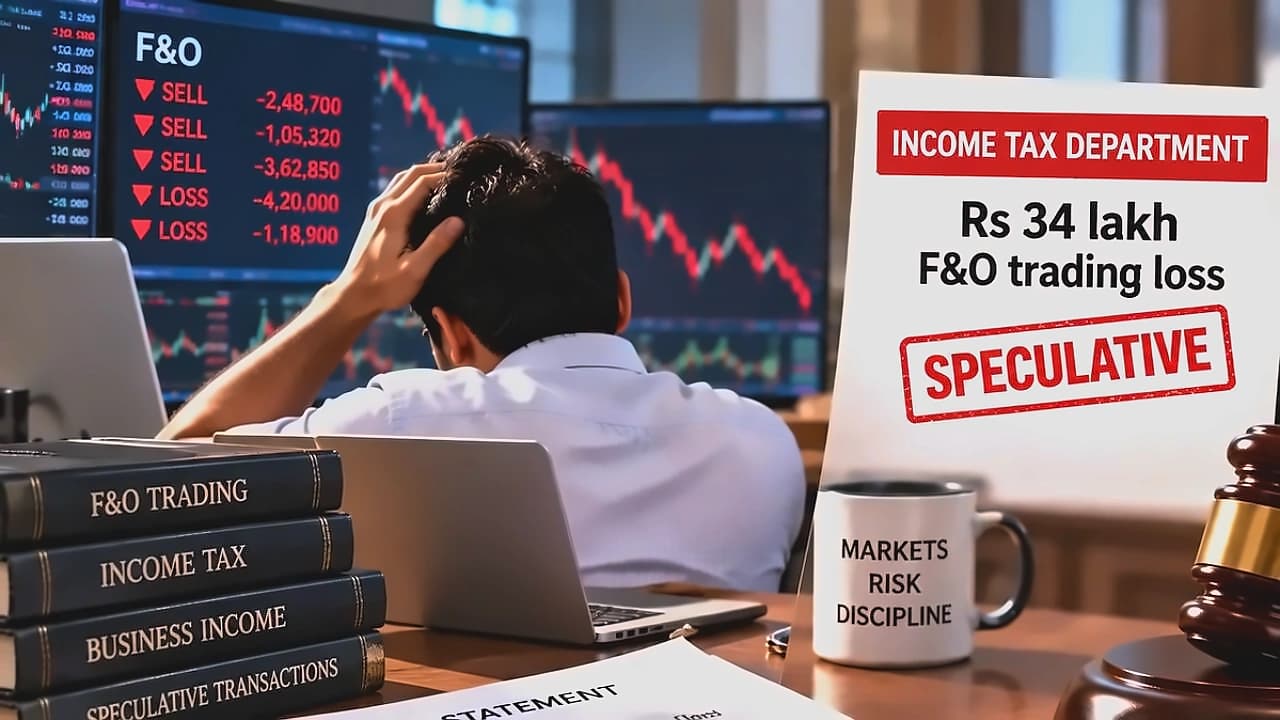
The Income-tax Act 2025, effective since April 1, 2026, maintains the same tax treatment for futures and options trading as the previous Act. According to CA Dr Suresh Surana, profits from exchange-traded F&O are generally taxable under the head 'Profits and Gains of Business or Profession' as non-speculative business income. The treatment was previously contained in section 43(5)(d) of the Income-tax Act, 1961, and now finds place in sections 66(31) and 66(33) of the Income-tax Act, 2025. The taxable amount is the net F&O profit after deducting eligible business expenses such as brokerage, exchange charges, internet expenses, professional fees and other expenditure incurred wholly and exclusively for the trading activity. As per Nishant Shanker from Navraj Global Advisors, F&O transactions are not treated as speculative transactions and are generally taxable at applicable business rates, with specified derivative transactions excluded from speculation-loss restrictions.
F&O losses from eligible transactions on a recognised stock exchange are treated as non-speculative business losses, not speculative or capital losses. According to Dr Surana, the loss may be adjusted against income under any other head, including capital gains, house property income or income from other sources. However, it cannot be set off against salary income, and specific restrictions may apply to certain specially taxed incomes. Any balance left after the current-year set-off may be carried forward for eight tax years under Income-tax Act, 2025. In subsequent years, it can be adjusted only against profits from a business or profession, which need not necessarily be the same F&O activity. For traders, the timing of return filing is crucial, as a belated return ordinarily does not preserve the right to carry forward the business loss. As per Section 112 of the Income Tax Act, 2025, non-speculative business losses can be carried forward for up to eight years and subsequently adjusted against business or professional income, while speculation-driven losses under Section 113 have a 4-year carry-forward period and can only be set off against speculation profits.
For tax audit and compliance purposes, turnover calculation is guided by the ICAI Guidance Note on Tax Audit. According to Dr Surana, the absolute value of all profits and losses arising from squared-off derivative transactions should be aggregated while determining turnover. Premium received on the sale of options should be included in turnover, but if such premium has already been considered while computing profit or loss, it should not be included again to avoid double counting. Any gains or losses arising from reverse or offsetting trades should also be considered while calculating turnover. In cases where derivative positions remain open at year-end, the turnover attributable to such contracts is generally recognised in the year when the positions are ultimately squared off or settled. As per Nishant Shanker, F&O turnover is determined using the prescribed methodology, principally considering the aggregate of favourable and unfavourable differences, with relevant treatment of option premiums. When derivatives result in delivery, applicable differences between trade and settlement prices along with relevant sale value of stock-in-trade need due consideration.
For F&O traders, the practical checklist from the new Act remains unchanged. According to Dr Surana, one should calculate turnover as per the ICAI guidance, net off eligible expenses, report the result as non-speculative business income in ITR-3, and never miss the due date if the year ends in a loss. Individuals and HUFs generally disclose such income in ITR-3. For instance, if the gross F&O profit is ₹5 lakh and eligible trading expenses are ₹75,000, the net business income taxable would ordinarily be ₹4.25 lakh. An individual with an F&O loss of ₹3 lakh, interest income of ₹1 lakh and salary income of ₹10 lakh can set off the loss against interest income but not against salary, with the remaining ₹2 lakh eligible for carry-forward for up to eight years. As per Section 121 of the new Act, traders are mandated to file loss returns within prescribed due dates to preserve carry-forward benefits. The key requirement is correctly determining whether the transaction qualifies as a specified derivative, calculating turnover under prescribed methodology, posting eligible expenses, and reporting losses within prescribed deadlines for meaningful tax compliance.