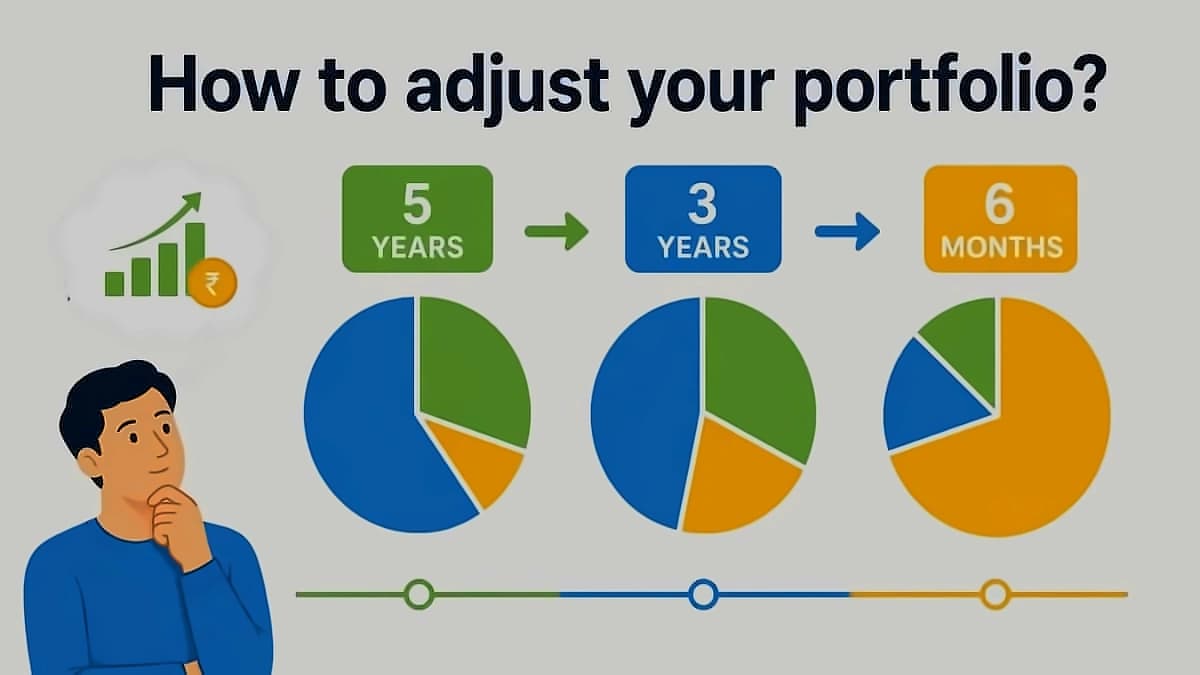
When investors feel uncomfortable with their equity allocation, the focus should shift from current market conditions to long-term financial objectives. According to financial planning expert Rajendra Saxena, the way investors began their journey can significantly influence their current portfolio perspective. The key lies in understanding why investments were made in the first place, considering available time horizons, and determining when actual financial needs will arise. As noted by Duncan Financial Group, younger investors face the risk of concentrating too much capital in a single company, sector, investment style, or asset class, which can leave a portfolio poorly aligned with long-term financial objectives. Portfolio rebalancing strategy emerges as a disciplined approach that systematically restores target asset allocation through structured buying and selling processes, ensuring portfolios don't become unintentionally overexposed to certain investments due to market performance.
For investors with retirement goals still 20 years away, maintaining a relatively high equity allocation may be justified. As reported by Mint, depending on financial position, expected returns, and risk tolerance, an allocation of 60-80% to equity with the balance in debt could be appropriate. Equities historically provide stronger wealth creation potential over extended periods, while combining equity with debt helps create a more balanced portfolio with reduced volatility. According to Duncan Financial Group, although younger investors often maintain higher allocations to equities, no single allocation is appropriate for every investor, and portfolio construction should reflect both financial capacity and the ability to remain disciplined during periods of market volatility. Portfolio drift can significantly alter the risk profile over time, with a portfolio that began at 60% equity potentially running at 75% after strong market performance, carrying risk levels never intended.

Recent market developments have significantly influenced how investors view their equity exposure, particularly for those who began investing after 2020. As noted by Mint, investors who started after 2020 have witnessed substantial market movements, including strong recoveries after the pandemic and continued equity outperformance through much of 2024. According to Feroze Azeez, joint chief executive at Anand Rathi Wealth, this period of market strength may have created a sense of comfort with higher equity allocations, but subsequent volatility since September 2024 has made some investors question their risk tolerance. Conversely, investors who began before 2020 may have already experienced more market cycles and seen how equity can reward long-term investors who stay invested through various market phases.
When equity investments are meant for approaching short-term goals, the strategy should shift toward greater stability. According to the report, reducing equity exposure and increasing debt or stable investments may be prudent. For investors in higher tax brackets, arbitrage funds could serve as viable options depending on individual circumstances and the specific timing of financial requirements. As noted by Duncan Financial Group, funds needed within a relatively short period generally require greater attention to capital preservation, while retirement assets intended for decades of growth may be better positioned to withstand short-term market volatility. Tax-efficient rebalancing becomes particularly important in taxable accounts, where selling appreciated assets to restore balance may trigger capital gains taxes, reducing net returns and creating friction in the rebalancing process.
For medium-term goals such as purchasing a house seven years from now, a balanced equity allocation of 50-70% may be appropriate. As reported by Mint, equity can continue providing growth potential while debt investments add stability as the goal approaches. The specific allocation will depend on available time and ability to tolerate market fluctuations. According to Duncan Financial Group, every investment plan should begin with clearly defined financial goals, with common objectives for professionals in their late 20s through early 40s including saving for a home purchase within five to 10 years, funding a future business venture, building retirement assets, and balancing student loan obligations while investing for long-term growth.
A frequently overlooked component of investment strategy is establishing adequate financial buffers beyond portfolio allocation. According to Feroze Azeez, maintaining an adequate emergency fund, alongside proper health and term insurance, prevents investors from having to liquidate equity investments during unexpected emergencies. This safety net approach ensures that portfolio adjustments are made strategically rather than due to financial necessity. As emphasized by Duncan Financial Group, a disciplined investment process emphasizes long-term planning rather than reacting to short-term market headlines, with many investors reviewing their portfolios at least annually, although individual circumstances may justify more frequent evaluations. Portfolio rebalancing connects directly to this broader planning philosophy, maintaining the structure first, acting with discipline through volatility, and letting compounding do its work over time.