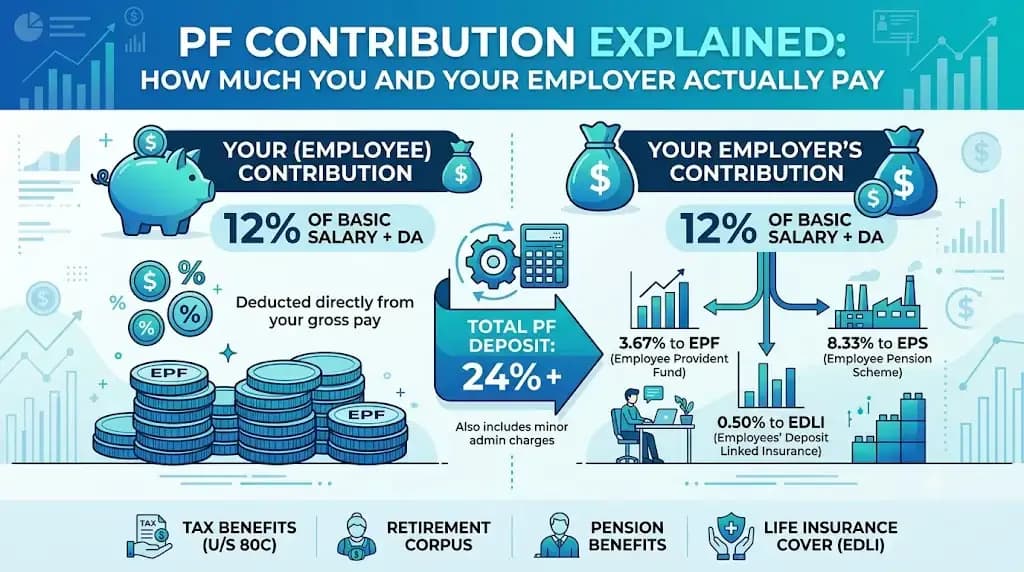
The Employees' Pension Scheme (EPS) operates as the pension arm of the Employees' Provident Fund Organisation (EPFO), with contributions structured differently from EPF. According to reports from Mint, employees contribute 12% of their basic salary and dearness allowance entirely to EPF, while 8.33% of the employer's matching 12% contribution is diverted to EPS, subject to the statutory wage ceiling of ₹15,000 per month. This means the maximum EPS contribution is ₹1,250 per month, with the balance flowing to the EPF account. Unlike EPF, EPS contributions are pooled into a common pension fund and do not earn annual interest or maintain individual account balances. As per recent reports, EPS contributions are automatically deducted from employee salaries without separate contribution requirements, making it the least understood part of the provident fund system despite significant contributions being made.
EPS allows lump-sum withdrawal only if an employee leaves before completing 10 years of eligible service, which is 113 months or 9.4 years. As reported by Mint, EPFO rounds this up to 10 years for claims above 113 months. Once the 10-year threshold is crossed, employees become eligible for monthly pension generally from age 58. For employees leaving after 10 years but not joining another organization, a scheme certificate from the last employer preserves pensionable service history and can be used to claim pension at retirement or when transferred to another EPF-covered establishment. However, recent claim rejections due to incorrect EPS contributions have brought the spotlight back on the pension scheme, highlighting the need for better understanding of these complex rules.
EPS eligibility is determined by the September 1, 2014 cutoff date. According to Mint reports, employees joining workforce after this date with basic salary exceeding ₹15,000 per month are not eligible for EPS membership, with employer contributions credited entirely to EPF. However, those with basic salary of ₹15,000 or less become EPS members. Existing EPS members who joined before September 2014 and later earned above ₹15,000 continue contributing under prevailing rules. This eligibility rule has become a major source of disputes, with many pension claims being rejected due to incorrect EPS contributions or classification issues. As explained by Kunal Kabra, co-founder of fintech startup Kustodian.Life, "If EPS has been deducted for a member who was never eligible for the pension scheme, the contribution has to be transferred from EPS to EPF. Since EPF earns interest while EPS does not, the interest also has to be recalculated."

The EPFO calculates monthly pension using the formula pensionable salary × pensionable service ÷ 70. As reported by Mint, assuming 35 years of pensionable service, the maximum pension works out to ₹15,000 × 35 ÷ 70 = ₹7,500. However, this figure is not a statutory cap - members with more than 35 years of service can receive higher pensions, while those opting for higher pension schemes may receive substantially larger amounts calculated on actual eligible salary rather than the ₹15,000 wage ceiling. The minimum pension under EPS remains ₹1,000 per month. Unlike EPF, where transfers consolidate balances, EPS transfers only carry forward pensionable service history, meaning EPS contributions continue to appear separately against each employer in member passbooks.
Rectification of erroneous EPS contributions can take months depending on the financial year involved. According to Mint reports, if the error relates to FY26, corrections can be initiated from July, but mistakes during the current financial year require waiting until the financial year ends and several additional months for processing. Kunal Kabra explained that "If the erroneous contribution relates to FY26, the correction can be initiated from July. But if the mistake occurred during the current financial year, say, between April and June, the member will have to wait until the financial year ends and then wait several more months for the correction to be processed." The rectification process involves transferring funds between accounts and recalculating interest components, making it crucial for members to understand their eligibility and contribution status.