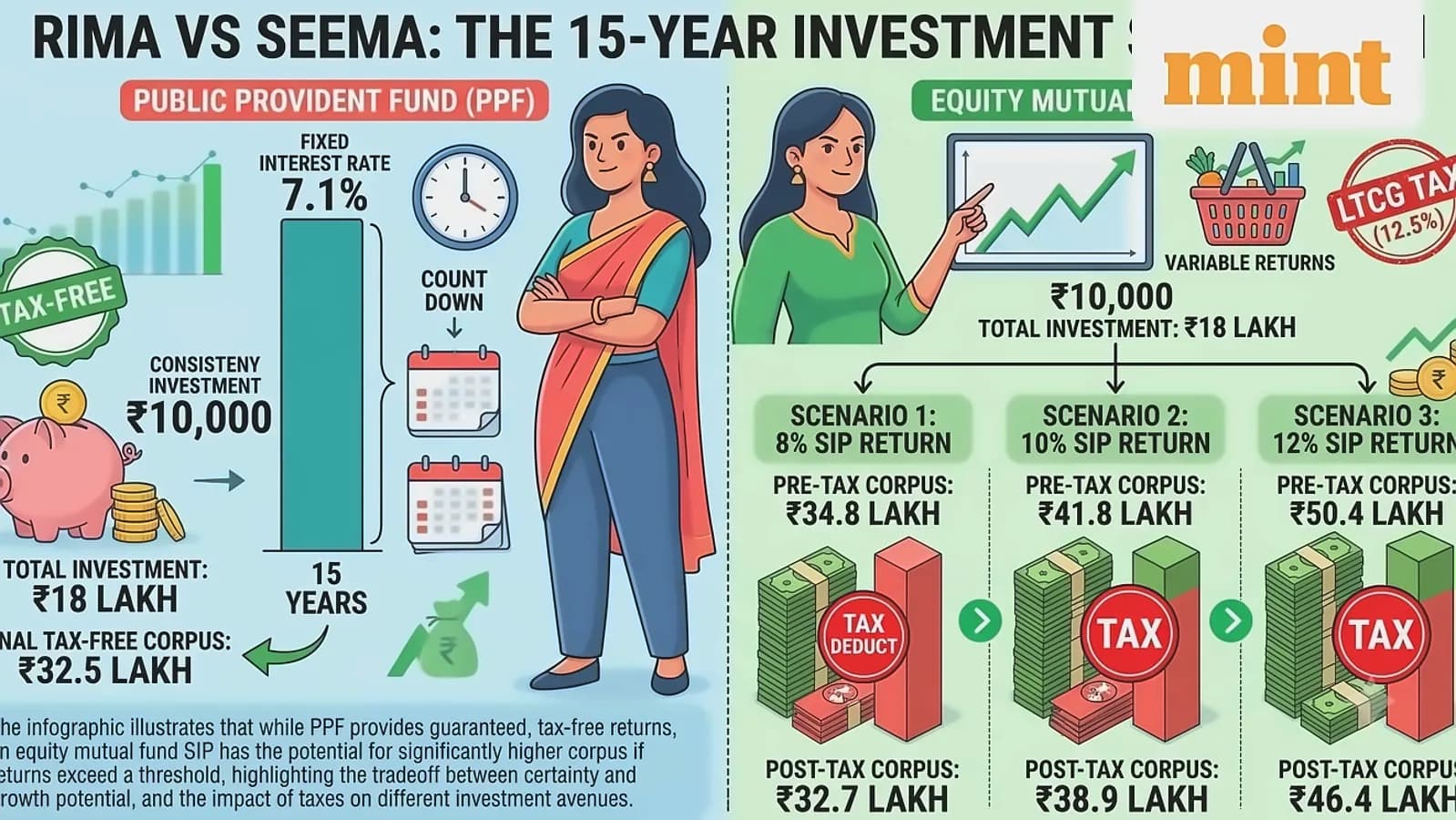
For investors focused solely on building a ₹1 crore corpus in the shortest possible time, Systematic Investment Plans (SIPs) in diversified equity mutual funds generally hold the advantage, driven by the long-term return potential of the stock market. According to reports from NDTV Profit, both Employees' Provident Fund (EPF) and SIPs continue to be among the most widely used wealth-building tools for salaried employees across India, with EPF valued for its security and fixed returns while SIPs appeal to those seeking potentially higher gains through stock market exposure.
The Employees' Provident Fund is a retirement savings scheme available to salaried employees in the organised sector, where both the employee and employer contribute a portion of the employee's basic salary and dearness allowance every month. As reported by NDTV Profit, the EPF interest rate is declared annually by the Employees' Provident Fund Organisation (EPFO) and has typically hovered around 8% to 8.5% in recent years, with the current interest rate for FY 2025-26 set at 8.25%.
A Systematic Investment Plan allows investors to invest a fixed amount regularly in mutual funds, with SIPs commonly used to invest in equity mutual funds that have historically delivered higher long-term returns than traditional fixed-income products. According to the analysis, diversified equity mutual funds have generated annualised returns of around 10% to 15% over long periods, though returns are not guaranteed. For an investment of ₹11,000 per month over 20 years with an expected 12% return rate, the estimated corpus would reach ₹1.01 crore.
The comparison reveals that SIPs can help investors potentially accumulate larger corpuses over time, but they come with market risk. As reported by NDTV Profit, SIPs can help investors hit ₹1 crore sooner: often 5-8 years earlier than EPF alone for similar contribution levels. For an EPF investment of ₹11,000 per month over 25 years with the 8.25% return rate, the estimated corpus would reach ₹1.08 crore, demonstrating the compounding advantage of higher expected returns from equity growth.
Financial planners often argue that the most effective strategy is not choosing between EPF and SIPs, but combining the strengths of both approaches. According to the analysis, this strategy involves using EPF for stability and SIPs to drive portfolio growth, allowing investors to benefit from the security of fixed returns while potentially achieving higher long-term wealth accumulation through diversified equity exposure. The approach emphasizes building a strong foundation through health insurance, term insurance, and emergency funds before aggressive investment strategies.