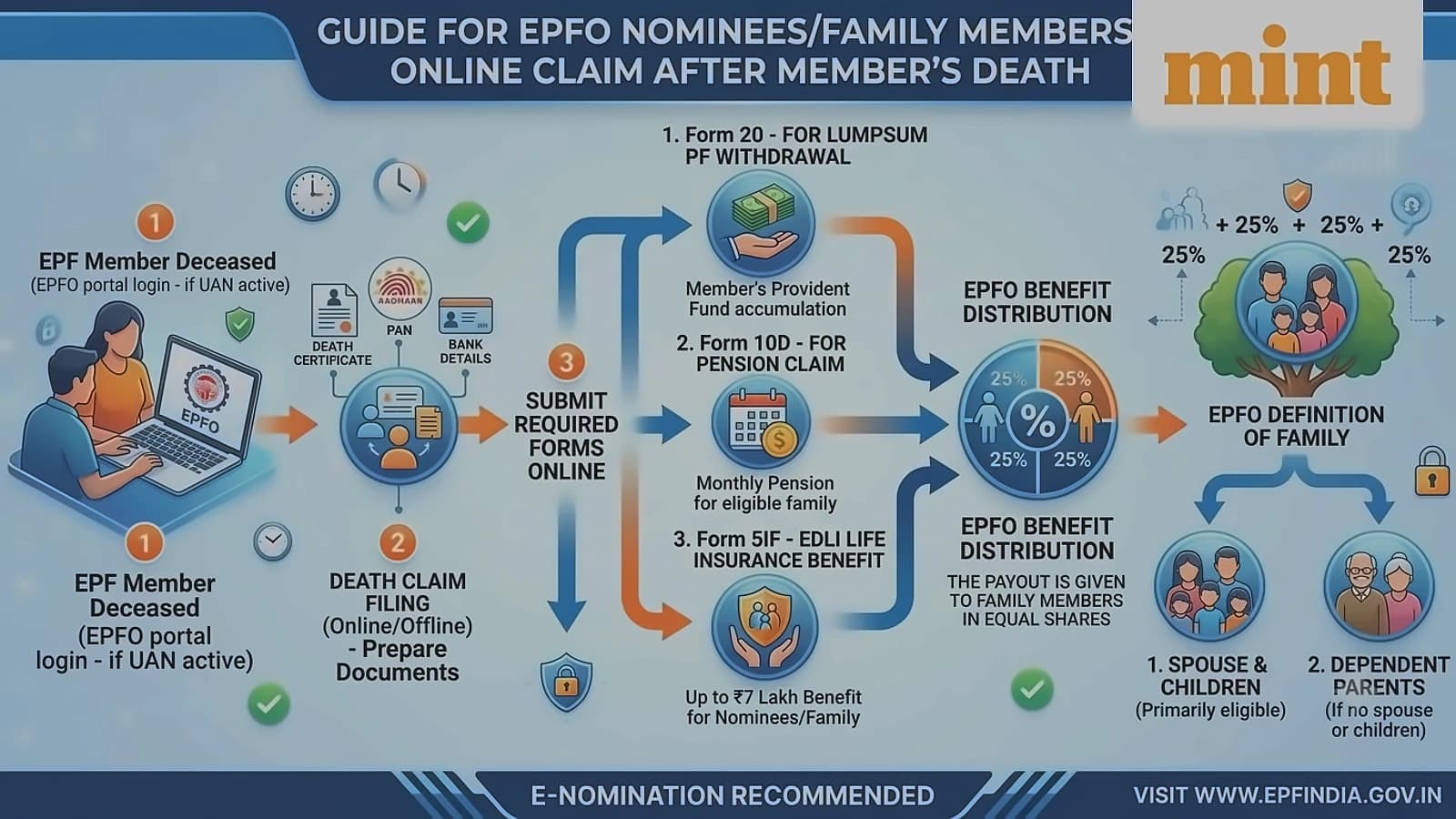
In case of death of EPF members, the provident fund is usually paid to the nominee registered by the member. According to reports from Zee News, if no nomination has been registered, the amount is given to eligible family members such as a spouse or children. The framework extends further to cover specific scenarios where members had no family but had nominated someone to receive pension benefits, allowing that person to claim the pension. Similarly, if the member had no family and had not nominated anyone for a pension, dependent parents can claim the benefit. Under EPF rules, spouse and children are considered family members for payment purposes, with the spouse and children receiving equal distribution if no nomination exists. If a member had no family while filing the nomination, they could nominate any person of their choice, but if the member later got married or acquired a family, a fresh nomination in favour of family members becomes necessary. As reported by Dylan Chong & Co, for Muslim members, the nominee receives the funds in the capacity of a wasi (administrator) rather than as the final beneficial owner, with the funds distributed to entitled heirs according to faraid rules after estate obligations are addressed.
Families of EPF members can claim the dead member's provident fund, pension and insurance benefits online through the EPFO portal. As reported by Zee News, members can submit Form No-2 online through the employer to expedite the process. The application can be submitted through the EPFO member portal, with beneficiaries required to enter the deceased member's UAN along with the beneficiary's Aadhaar details and date of birth. An OTP is sent to the registered mobile number for verification, after which the death claim option can be selected with the date of death and death certificate uploaded. Applicants can choose Form 20 for lump-sum provident fund withdrawal and Form 5IF for EDLI insurance benefits, depending on eligibility. Some applicants may receive messages stating service details are required against all service records, indicating incomplete employment history. In such cases, beneficiaries should check the Service History section and ask previous employers to update records using a Digital Signature Certificate (DSC), or submit a Joint Declaration to the EPFO office. According to Dylan Chong & Co, EPF may have procedures that allow certain immediate payments to eligible dependents in limited circumstances, though families should not assume this replaces the need for proper estate authority.
The death claim requires specific documentation including the death certificate of the member and the deceased member's 12-digit Universal Account Number (UAN). According to Zee News, beneficiaries must provide their Aadhaar, name and date of birth, along with a copy of blank/cancelled cheque. For pension-related claims, Form 10D is required for claiming pension benefits when the claimant is a family member or nominee for pension or dependent parents. Form 10C is necessary for withdrawal benefit cases where the member died after 58 years of age and had not completed 10 years of service as on date of crossing 58 years age. Additionally, beneficiaries must provide death certificate (PDF, up to 2 MB) and cancelled cheque or bank passbook of the beneficiary (PDF, up to 2 MB). If there is neither a valid nominee nor an eligible family member, the money is paid to the person legally entitled to receive it. As reported by Dylan Chong & Co, EPF commonly requires proof of death, proof of identity, and documents proving the claimant's authority. A nominee will generally need their identification documents and the deceased member's death certificate, while an executor or administrator will need the relevant court grant, as well as the documents required by EPF for the withdrawal application.
The claim amount is paid directly into the bank account provided by the claimant, with the claimant required to attach a copy of blank/cancelled cheque with the IFS code and bank account number clearly visible. As reported by Zee News, TDS will be applicable in death cases as in the case of a live member. The process enables families to get the benefit of PF or pension or insurance without any delay by submitting Form No-2, ensuring smooth transfer of funds to eligible beneficiaries. For FY2025-26, EPF and Voluntary Provident Fund (VPF) deposits continue to earn 8.25% annual interest, marking the third consecutive year that subscribers have received the same rate. Employee contributions up to ₹1.5 lakh qualify for deduction under Section 80C under the old tax regime, while employer contributions of up to 12% remain tax-free under both old and new tax regimes. Interest earned on eligible EPF contributions also remains tax-exempt within prescribed limits.