Financial experts are recommending a three-bucket emergency fund strategy that moves beyond traditional savings accounts to maximize returns while maintaining quick liquidity access. According to recent financial guidance, this approach involves diversifying across savings, liquid funds, and fixed deposits to create a comprehensive emergency fund structure. As reported by financial advisors, the strategy allows investors to optimize returns while maintaining access to emergency cash when needed, with the approach ensuring that funds are strategically allocated across different investment vehicles to balance liquidity requirements with growth potential. Pankaj Mathpal, MD of Optima Money, emphasizes that emergency funds should be the foundation of financial planning because unexpected situations can arise even when earning income.
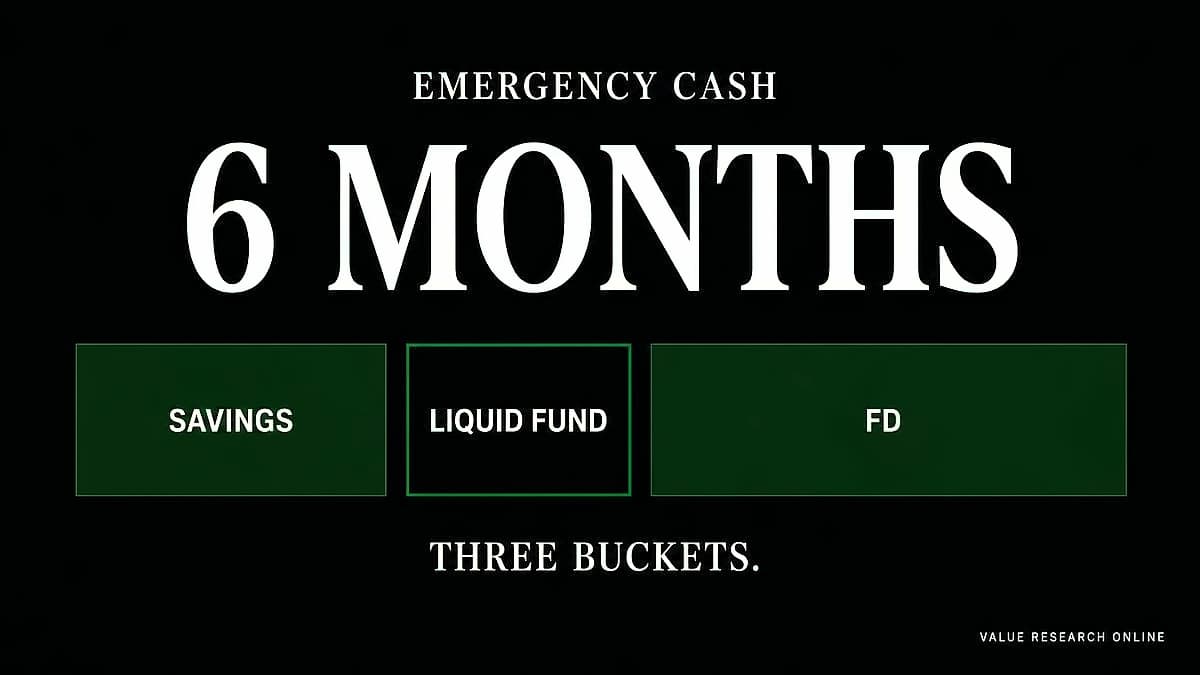
The three-bucket system is designed to provide different levels of liquidity and returns based on specific needs and time horizons. According to financial advisors, the strategy allows investors to optimize returns while maintaining access to emergency cash when needed. The approach ensures that funds are strategically allocated across different investment vehicles to balance liquidity requirements with growth potential. Recent guidance suggests that inflation protection should not come from taking excessive risk inside the emergency fund, with the focus on maintaining safety and liquidity first. Harshvardhan Roongta, CFP from Roongta Securities, highlights that people often fail to prepare for when regular income may stop, making emergency funds crucial for financial freedom.
Experts recommend different emergency fund sizes based on individual circumstances and financial responsibilities. For most individuals, 3-6 months of essential expenses serves as the basic emergency cushion, with Mathpal suggesting that people should have enough money to cover essential monthly expenses for at least three to six months. However, freelancers with uneven income or those with greater family responsibilities may need up to 12 months of expenses set aside. The calculation should be based on essential monthly expenses rather than salary, as illustrated in the table below: | Emergency Fund Period | Calculation | Required Fund | 3 months | ₹50,000 × 3 | ₹1.5 lakh | 6 months | ₹50,000 × 6 | ₹3 lakh | 12 months | ₹50,000 × 12 | ₹6 lakh |
The strategy specifically recommends savings accounts, liquid funds, and fixed deposits as the primary investment vehicles for the three buckets. According to financial guidance, these different investment types offer varying liquidity profiles and returns that can be optimized based on individual circumstances. Recent expert advice emphasizes that a liquid mutual fund is not the same as a bank deposit, with NAV fluctuations and redemption processes that may not provide instant access. The approach ensures that emergency funds are not sitting idle in low-yielding accounts while maintaining quick access when needed. Mathpal stresses that emergency funds should be liquid and easily accessible, so that money is readily available even if needed at 2 AM without having to ask others for help.
Financial experts emphasize that this three-bucket approach should be customized based on individual financial goals and risk tolerance. As reported by financial advisors, the strategy allows investors to balance immediate liquidity needs with long-term financial goals while maintaining the flexibility to access emergency funds when required. Recent guidance suggests a practical allocation of 15% to 20% in savings bank account, 30% to 40% in suitable bank deposits with easy premature withdrawal, and 40% to 50% in carefully selected liquid mutual funds. For most salaried families, around 6 months of essential household expenses can serve as a reasonable starting point, with higher amounts recommended for self-employed individuals or those with large financial commitments. The experts note that financial freedom is not just about investing aggressively or building a retirement corpus - investors first need to create a financial safety net before focusing on other long-term goals.