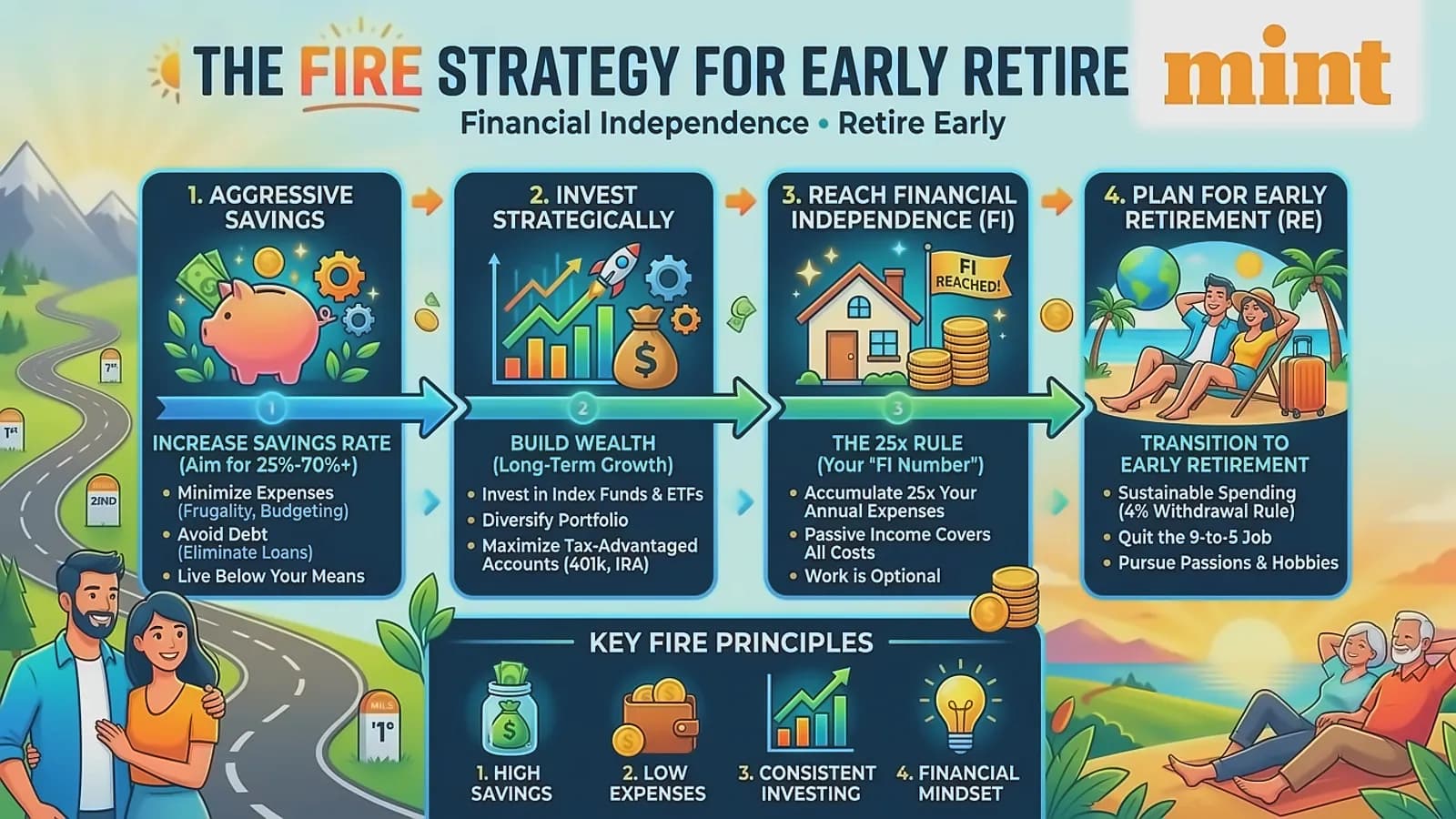
Early retirement in India requires more than just high income, according to financial experts. As reported by Mint, Sandeep Jethwani, co-founder of Dezerv, emphasized that age is not the right unit for retirement planning. "Financially, early retirement is the point at which your portfolio can fund your expenses for the rest of your life without you adding to it," he stated. The size of the required corpus depends significantly on savings rates, with someone earning ₹2 lakh monthly and saving half consistently for 22-25 years potentially reaching a workable number, while someone earning ₹5 lakh but saving only 15% may struggle despite higher income. Finoda's comprehensive guide confirms that starting early makes a significant difference - investing ₹5,000 monthly at 12% returns from age 25 will result in ₹1.76 crore by age 55, compared to only ₹56 lakh if started at 35. The 100 minus age rule provides a starting point for equity allocation, with a 25-year-old comfortable at 70-80% equity allocation, while a 50-year-old should be closer to 40-50%.

For investors with 15-20 years before retirement, experts broadly favor high equity allocation due to the longer investment horizon. According to Mint reports, Rahul Jain, president and head of Nuvama Wealth, suggested around 70-80% equity allocation, while Sanjiv Bajaj, joint chairman of BajajCapital Ltd, recommended 75-80% equity with the balance in short-duration debt and liquid buffer. Finoda's comprehensive guide reinforces this approach, noting that asset allocation across equity, debt, and gold in proportions matching risk tolerance and time horizon is crucial. The appropriate allocation depends on existing corpus, dependents, and ability to withstand a 30% market decline without selling. Debt remains important for stability and helping investors remain invested during market downturns.
For those targeting a ₹1 crore retirement corpus by age 50, step-up SIP strategies offer a more manageable entry point while achieving the same long-term goal. As per Groww SIP calculator analysis, a ₹7,850 monthly step-up SIP with 5% annual increases can help reach ₹1 crore in 20 years starting at age 30, while a ₹16,160 monthly step-up SIP is required for those beginning at age 35. Most significantly, a ₹37,130 initial step-up SIP with 5% annual increases can achieve the same ₹1 crore target in just 10 years. Historical data from Value Research shows that large-cap mutual funds have delivered 11.76% annualised returns over 10 years, while mid-cap and small-cap categories have provided 15.50% and 16.76% returns respectively, supporting the assumption of 12% annualised returns for long-term equity investments.
Experts caution against overloading portfolios with too many funds while emphasizing diversification across different equity segments. As reported by Mint, Jain suggested combining large-cap, mid-cap, and small-cap funds, with large-cap providing stability and mid/small-cap adding long-term return potential. Bajaj warned against holding eight to ten funds without significant overlap, recommending investors focus on underlying holdings rather than just counting schemes. The equity portion should evolve as retirement approaches, with gradual increase in debt allocation within 5-7 years of retirement to reduce market volatility impact. Finoda's guide emphasizes that the most important principle is asset allocation, spreading money across equity, debt, and gold in proportions that match risk tolerance and time horizon.
Effective early retirement planning requires calculating future expenses based on lifestyle expectations rather than generic retirement formulas. According to Mint reports, Bajaj emphasized that using today's expenses without accounting for inflation can lead to inadequate retirement targets, particularly for portfolios lasting 30-40 years. Healthcare costs deserve particular attention, as major medical events can create significant unexpected expenses and force investors to liquidate long-term investments at unfavorable times. Finoda's comprehensive guide confirms that India in 2026 presents unique challenges with inflation eating into savings, healthcare costs rising at 12-14% annually, and children's education abroad now routinely costing ₹50 lakh to ₹1 crore. Jethwani also cautioned that affluent households may experience spending inflation different from headline consumer inflation due to rising lifestyle expenses.
Building an early retirement portfolio requires continuous review and adjustment as income, expenses, and risk tolerance change. As reported by Mint, Jethwani warned against setting up SIPs and treating the portfolio as finished, noting that allocation drift can occur when equity performance leads to overly concentrated positions. He recommended portfolio review twice yearly for most investors, distinguishing between reviewing and churning to avoid unnecessary tax implications. Finoda's guide reinforces this approach, emphasizing that a financial plan is a written roadmap of income, expenses, savings, and investments aligned to specific life goals. SIP amounts should increase with income growth, as doubling salary while maintaining unchanged SIPs can significantly reduce the proportion of income being invested. The key is to save first and spend from what's left, not the other way around.