In 2024, a cook employed at a 5-star hotel in Delhi received an income tax notice demanding nearly ₹4 crore in tax, along with a penalty for under-reporting income. According to reports from The Times of India, the notice alleged that the man had made cash sales worth ₹24.62 crore through a company dealing in packing materials. The document showed an entry against his Permanent Account Number (PAN) for cash sales of ₹24.62 crore with tax deducted at source at 1% on the reported amount.
The man immediately suspected that his PAN details had been misused and approached the Greater Kailash Police Station in New Delhi and the Delhi Police Cyber Cell in Saket to lodge formal complaints. As reported by The Times of India, his advocate argued that the man was a victim of identity theft and that an unidentified person had misused his PAN credentials. The advocate pointed out that the man had no connection with the packing materials company mentioned in the notice, as his occupation was that of a cook and he was working as a contractual employee who provided copies of his PAN card to various contractors. According to The Times of India, the man's advocate A.K. Babbar highlighted that the cook was a contractual employee in the Ashoka Hotel and the Vigyan Bhawan and had worked with many contractors to whom he had given copies of his PAN card for verification purposes.
Challenging the demand was difficult as the man would have had to deposit around ₹78 lakh in advance for the tax liability of nearly ₹4 crore. According to The Times of India, the man approached the Delhi High Court on October 6, 2026, arguing that he had no taxable income and had never carried out the transaction referred to in the tax notice. The court questioned the Income Tax Department about evidence beyond the man's Form 26AS and sought to know whether the department had conducted an independent investigation. The Income Tax Department Assessing Officer (AO) initially ignored the cook's efforts to explain the situation, telling him that under tax law, he must pay the tax or challenge the order in front of a competent authority.
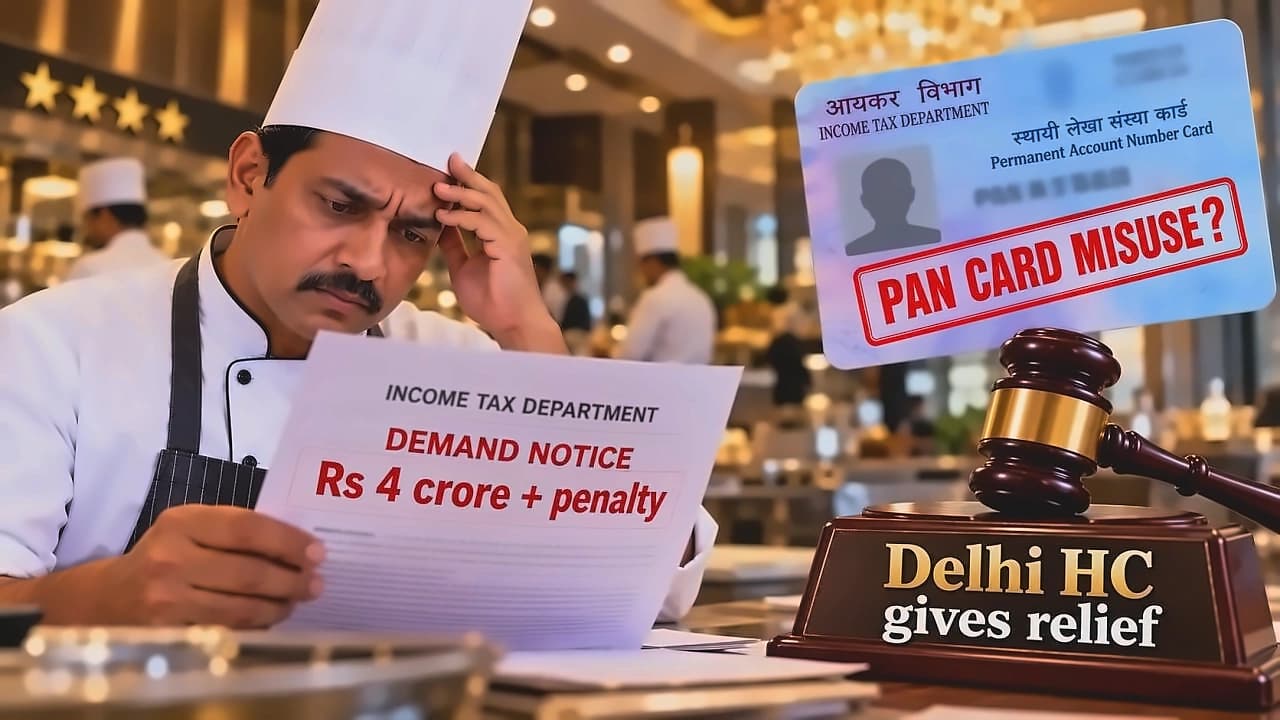
The Delhi High Court ruled in the man's favour by cancelling the entire tax demand notice on October 6, 2026. As reported by The Times of India, the court found that the assessment relied entirely on Form 26AS and information available on the tax portal without independent evidence. The court pointed out that the AO could have issued a notice under Section 133(6) of the Income-tax Act to the packaging company for further information. Another error identified was the double counting of gross and net amounts relating to the same transaction by the tax officer. The court emphasized that tax enforcement officers should balance enforcement with realistic assessment of facts, stating that their eyes should be sharp to pierce through fraud but should not slip away from the facts.
Pranshu G, Partner at Ashok Pranshu & Co, told ET that these lapses amounted to a violation of principles of natural justice and constitutional safeguards against arbitrary action. According to The Times of India, the court clarified that the Income Tax Department could reopen the case in the future if it discovered incriminating evidence linking the man to the alleged transactions. The court emphasized that tax enforcement officers should balance enforcement with realistic assessment of facts, stating that their eyes should be sharp to pierce through fraud but should not slip away from the facts.