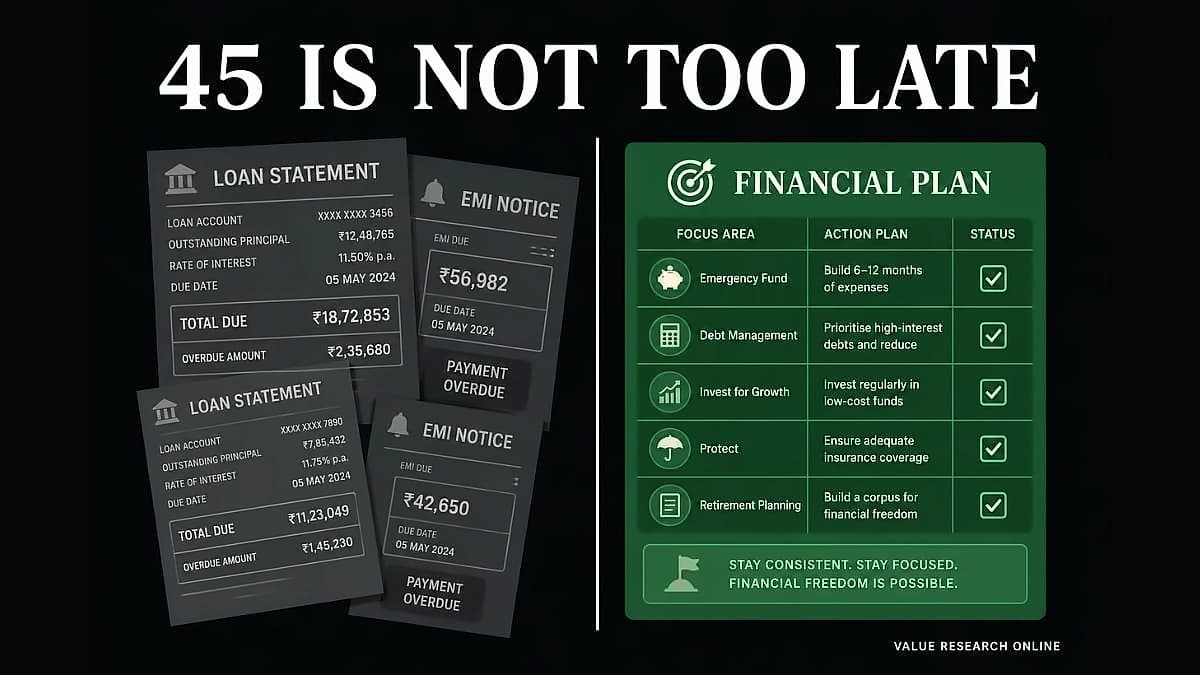
The dream of early retirement faces stark mathematical reality in India, with financial planners estimating that barely 5 to 10% of Indians are anywhere close to having the money required to retire early and still live the life they actually want. According to latest reports, retiring 15 years early doesn't just mean 15 fewer years of income - it means 15 more years of expenses, layered on top of an already longer lifespan. A person retiring at 60 today could easily live another 20 years, but the traditional formula of saving whatever's left at the end of the month no longer applies to early retirement planning. As per inXits advisors, retirement planning should begin with retirement income needs rather than tax-saving opportunities, with healthcare expenses often increasing during retirement requiring careful planning for future medical costs alongside everyday living expenses.
Conventional wisdom suggests child-free couples require smaller retirement savings due to lower child-related expenses. However, according to financial planning expert Priya Sunder from PeakAlpha Investments, this assumption often proves incorrect. Child-free couples face unique challenges including longer retirement periods and absence of family safety nets that can make financial planning more complex than traditional retirement planning. The key risk is underestimating the cost and complexity of aging, as child-free couples must explicitly plan for care, support, and decision-making in later life without assuming family assistance. As reported by inXits, retirement planning after 50 requires careful decision-making with every financial decision carrying greater importance because there is less time to recover from poor choices or unexpected market conditions.
The financial implications of early retirement can significantly impact retirement planning for child-free couples. As reported by Mint, couples like Anita and Sanjay in their forties who hoped to retire within a few years must plan for nearly 50 years after retirement instead of the typical 30-year period. This extended time horizon requires larger retirement corpus to account for care costs, flexibility, and uncertainty of decades-long retirement. The planning framework should divide retirement assets into three buckets: essential expenses, desired lifestyle funding, and contingency reserves to maintain financial security while enjoying current wealth. According to inXits advisors, retirement planning after 50 focuses less on maximising growth and more on building dependable retirement income, with investors generally needing disciplined contributions, realistic return expectations, and careful asset allocation rather than aggressive investing.
A quieter but significant problem affecting Indian retirement planning is the fading joint family system in urban India. Children move cities and countries, households have shrunk to nuclear units sometimes to just two people, sometimes to one. The old assumption -- "my children will take care of me" -- no longer holds up financially, as parents today can't build their retirement plan around their kids' future income. Many older Indians are actively choosing different kinds of independence - not isolation, but community-based living. This shift is part of why senior living and retirement communities are seeing rising interest, with developers like DLF entering the senior living segment with upcoming projects. As reported by inXits, many investors experience competing financial priorities during this stage of life, with children's higher education, marriage expenses, home loan repayments, and caring for ageing parents all happening simultaneously, often reducing attention to retirement savings.
For child-free couples, retirement planning extends beyond traditional wealth accumulation to ensuring resources, support, and autonomy for aging with dignity. According to the financial guidance, a sound retirement plan must model different spending scenarios and indicate when expenses can be adjusted. The framework emphasizes that while child-free couples may have fewer liabilities and lower day-to-day expenses, their retirement corpus may still require larger amounts than expected due to care costs, flexibility needs, and the uncertainty of potentially decades-long retirement periods. Today's retirees approach this stage differently, wanting to remain socially connected, mentally active and emotionally fulfilled, with independence increasingly viewed as preserving dignity and maintaining strong family relationships. As per inXits advisors, retirement planning should answer questions such as how much monthly income will retirement require, how long should retirement savings last, which investments will provide liquidity, and how will inflation affect purchasing power over the next two decades. The approach should combine NPS with diversified investments, emergency savings, insurance, and appropriate asset allocation to create greater financial flexibility.