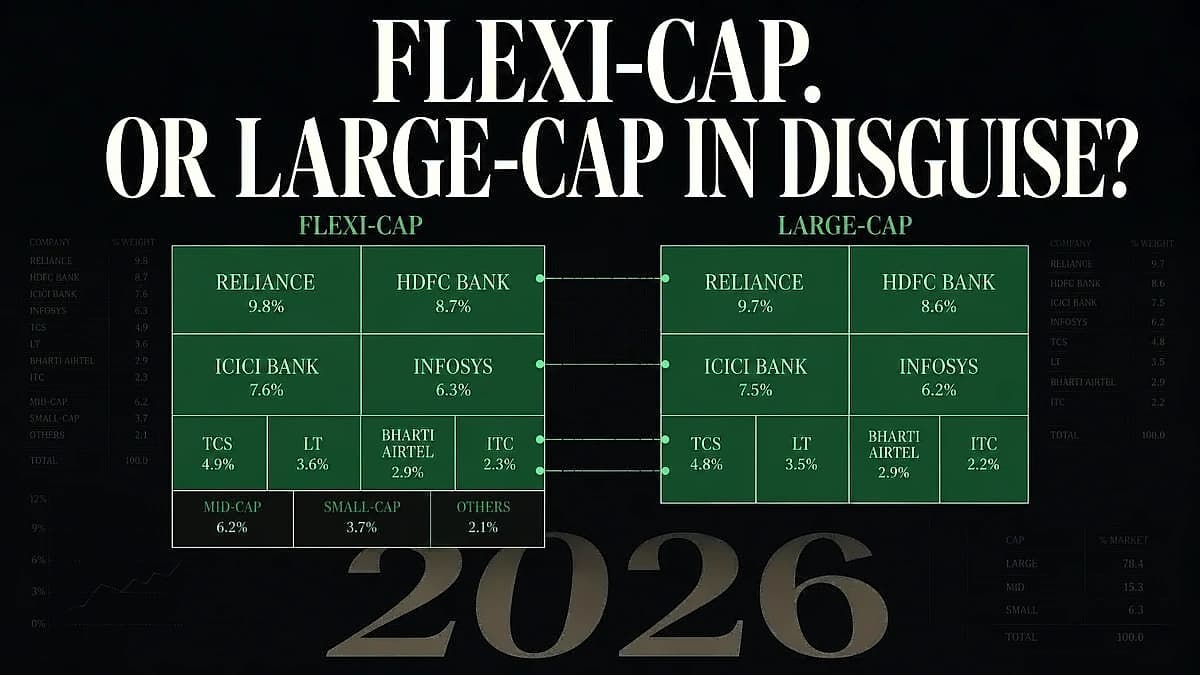
A comprehensive study by DSP Mutual Fund has revealed a critical issue in active large-cap fund management - 90% of sectoral allocation closely mirrors the Nifty 50 index, indicating limited deviation from benchmark at the sector level. The analysis shows that 58% of large-cap fund portfolios comprise stocks that are also part of the Nifty 50, while the remaining 42% represent active bets outside the benchmark. According to the study, this means that most large-cap funds offer limited sectoral differentiation for investors who also hold a Nifty 50 index fund. The overlap becomes even more pronounced among the industry's largest schemes, with the top 10 large-cap funds by AUM having an average portfolio overlap of 64% with the Nifty 50, leaving only 36% of the portfolio in active positions outside the index. Recent analysis from Mint confirms this trend, showing that large-cap funds have seen their alpha generation decline over the years compared with the Nifty 50 TRI, with the advantage narrowing significantly after 2020.
According to reports from Value Research, the active large-cap fund category has consistently underperformed its benchmark over multiple time periods. Over a 10-year period, the active large-cap category generated 11.58% annualised returns compared to the BSE 100 TRI's 12.68%. Similarly, over a 5-year period, the category earned 10.24% versus the benchmark's 10.82%. The analysis reveals that 50% of 28 actively managed large-cap funds outperformed their benchmark over 5-year rolling periods, while only 43% of 23 funds managed to beat the index over 10-year periods. Recent data shows that 55% of 22 funds outperformed the BSE 100 TRI over a 15-year period, demonstrating slight improvement but with nearly half still lagging behind. However, Mint reports show a more concerning trend - large-cap funds lagged the index after 2020, with negative alpha generation of 0.6% over 3-year rolling returns and 1.3% over 5-year rolling returns.
New research from Chicago Booth reveals significant regulatory constraints affecting large-cap fund management. The study analyzed 2019-24 data for nearly 5,000 US equity funds, focusing on compliance with the 50/5/10 regulation that limits single stock positions to 5% of portfolio assets. At the study's peak in third quarter 2024, 171 funds managing nearly $1.4 trillion were in the regulatory danger zone, representing about 8% of total fund assets. Among large-cap growth funds specifically, roughly one in three portfolios was constrained, with these funds accounting for about half the category's total assets. The largest companies now represent nearly half the market value of large-cap growth stocks, pushing funds closer to diversification limits. According to Mint, SEBI mandates that large-cap funds invest at least 80% of their portfolio in the top 100 companies by market capitalisation, significantly limiting the investable universe and reducing fund managers' flexibility to take meaningful active bets.
Subhendu Harichandan, Executive Director at Anand Rathi Wealth Limited, attributes the decline in alpha generation to narrower investment universe constraints. As per Mint, he explains that the average active weight of large-cap funds compared with the Nifty 50 is only around 30% to 40%, meaning a significant portion of these portfolios remains similar to the benchmark. Only a handful of funds, such as Quant Large Cap Fund, maintain active weights of 60% to 70%, making fund selection an important factor within the category. Harichandan recommends that investors should not assume that large-cap exposure can only be achieved through large-cap funds, suggesting that diversified categories such as flexi-cap and focused funds often maintain 60% to 70% allocation to large-cap stocks while retaining flexibility to invest across market capitalisations. He advocates for a balanced market-cap mix of around 50% to 55% in large caps, 20% to 25% in mid caps, and the remaining allocation in small caps to provide adequate large-cap exposure while improving potential for better risk-adjusted returns.