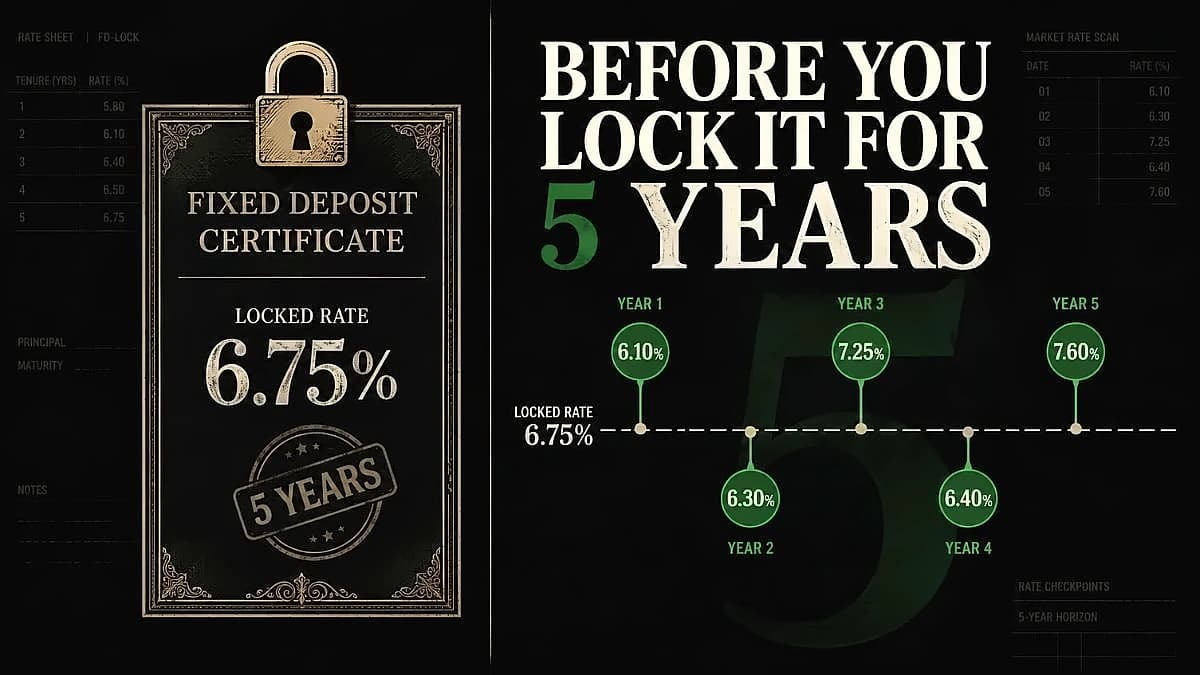
Senior citizen investors can benefit from additional FD interest rates of up to 0.50% above standard rates, creating meaningful value over longer investment periods. According to financial guidance, this incremental return can generate thousands of rupees in additional earnings over a five-year investment horizon, particularly when combined with compounding effects. While 0.25% to 0.50% per annum may seem modest initially, the impact becomes more significant for larger deposits and longer investment periods, making it a valuable advantage for retirees managing household expenses and healthcare costs.
Investors should avoid selecting 5-year fixed deposits based solely on the highest interest rate offered by banks. According to recent financial guidance, there are several critical factors that must be evaluated before making a commitment to a 5-year FD. These additional considerations can significantly impact the overall investment experience and returns, with the premature withdrawal rules varying across banks and resulting in substantial penalties that make it crucial for investors to understand these restrictions before committing to a 5-year FD.
Liquidity emerges as a primary concern for investors considering 5-year FDs. As reported by financial experts, the 5-year lock-in period creates a significant barrier to accessing funds during emergencies or unexpected financial needs. The premature withdrawal rules vary across banks and can result in substantial penalties, making it crucial for investors to understand these restrictions before committing to a 5-year FD. Senior citizens particularly value flexible payout options that allow them to choose between cumulative deposits that maximize corpus growth and non-cumulative deposits that provide regular monthly, quarterly, half-yearly, or annual income, depending on their financial priorities.
Tax-saving lock-ins represent another important consideration for 5-year FD investors. According to financial guidance, these lock-in periods can create additional restrictions on fund access, potentially limiting the flexibility of the investment. The tax implications of 5-year FDs also require careful evaluation, as they can impact the overall return on investment and should be factored into the decision-making process. For senior citizens, understanding how additional FD interest rates translate into actual earnings can help make more informed decisions about their retirement planning strategies.
Beyond interest rates, senior citizen investors should evaluate credit ratings of financial institutions, minimum investment requirements, premature withdrawal conditions, nomination and auto-renewal facilities, and ease of online investment and account management. As reported by financial experts, a combination of competitive returns and strong financial stability often provides greater peace of mind during retirement. An FD calculator simplifies investment planning by estimating maturity amounts and comparing different scenarios, helping investors understand how even a 0.50% increase affects long-term returns and choose investment tenures that align with retirement objectives.